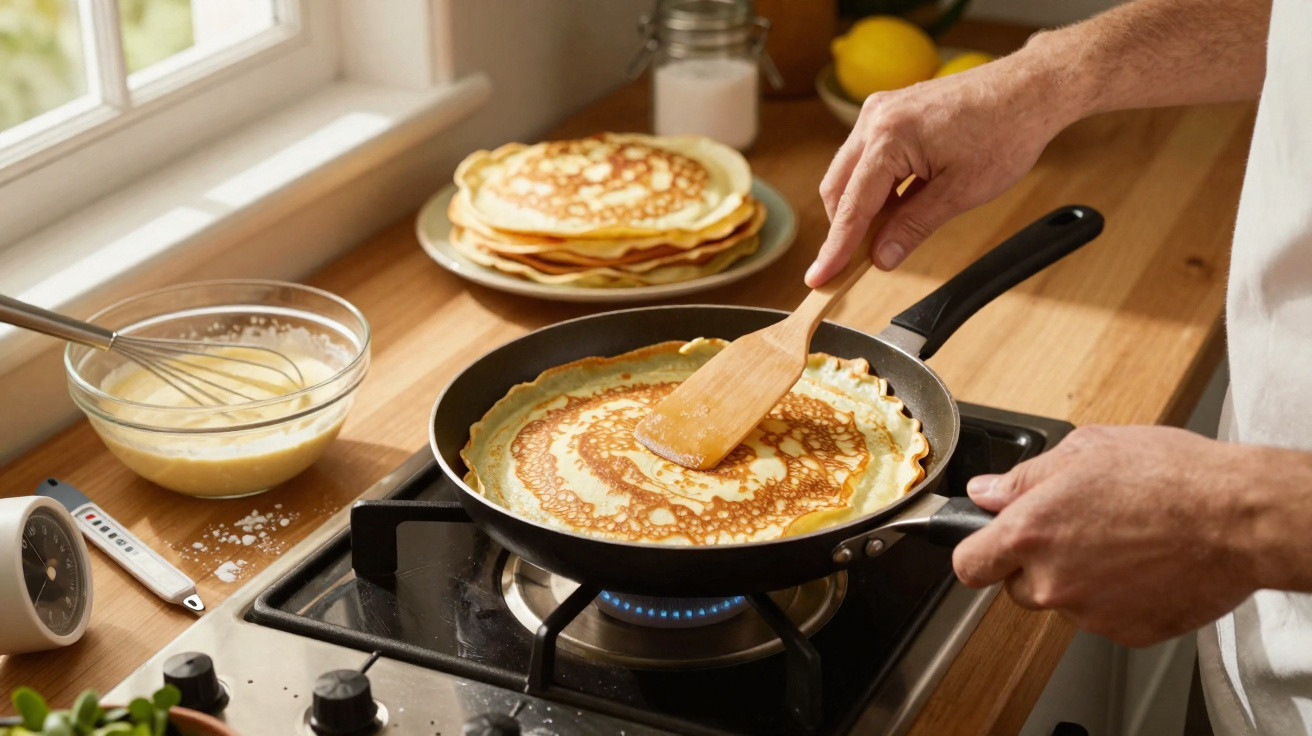
Chilly weekend, warm pan, hungry faces waiting.
A single pour, a quick flip… then that infamous “failed” first crepe looks back at you.
The idea is so ingrained that many of us practically expect to throw away the first crepe, as though it were an unavoidable culinary tax. Experienced crepe makers, however, say this offering is unnecessary: getting the first one right is a matter of technique, not luck.
Why we keep blaming the first crepe
In France, crepes are more than a Candlemas custom. Surveys indicate that most homes eat them several times a year, with many doing so at least once a month. Sweet crepes remain the favourite, usually served with simple sugar, chocolate spread or jam rather than elaborate fillings.
If crepes are made so regularly, why is the first one still considered unreliable? Much of the answer lies in habit. Parents casually tell children “the first one is always ruined”, as if it were a rule of nature. That saying then becomes an excuse for using a pan that has not heated properly or batter that has not had time to rest.
The first crepe fails not because of a curse, but because the pan and batter aren’t ready at the same time.
Professional crepe makers and confident home cooks see things differently. To them, the first crepe is not a trial attempt. It should be every bit as round, thin and golden as those that follow, particularly when guests or customers are waiting.
The real culprit: temperature, not talent
The usual reason for a torn or uneven first crepe is straightforward: the pan is not hot enough. Crepe batter requires a sharp burst of heat at the beginning so that it sets fast and evenly. Without it, the mixture sits in the pan, sticks and develops holes.
How hot is “hot enough”?
Crepe specialists aim for a pan-surface temperature of around 200°C (about 390°F). Few people cook with a surface thermometer, though, so a practical test is more useful than chasing an exact reading.
- Warm the pan over a medium-high heat for several minutes, without adding any fat.
- Sprinkle in a few drops of water.
- If the drops remain still and gradually steam away, the pan is not hot enough.
- If they immediately “dance” and slide around before vanishing, the pan has reached the right range.
Those dancing droplets are your green light: batter can go in, and the first crepe has a real chance.
After the pan is hot, turn the heat down slightly to hold that temperature rather than allowing it to burn. You are looking for a consistent, assured sizzle, not oil smoking fiercely.
The other half of the equation: batter that’s ready
Correct heat alone will not rescue batter that has been rushed. Flour needs time to hydrate properly. If you mix the batter and cook it immediately, it is often thicker, lumpier and less flexible.
Why resting the batter changes everything
Leaving the batter in the fridge for at least an hour gives the starches time to take in liquid and expand. The result is a smoother, runnier batter that is easier to swirl into a fine layer.
A standard sweet crepe batter generally contains:
- Flour
- Eggs
- Milk, sometimes with some of it replaced by water or beer
- A small amount of fat, such as melted butter or neutral oil
- A pinch of salt and, if desired, a little sugar or vanilla
Whisk only until the lumps have disappeared, then leave it alone. Excessive mixing can make crepes slightly tough. When stubborn lumps remain, strain the batter through a sieve instead of whisking endlessly.
The exact sequence for a perfect first crepe
When the batter has rested and the pan passes the water-drop test, you are almost ready. What separates a good first crepe from a poor one is the timing and the movement that follow.
| Step | What to do |
|---|---|
| 1. Preheat | Heat the pan over a medium-high setting until water droplets dance. |
| 2. Grease lightly | Use kitchen roll dipped in oil or butter to wipe the surface, leaving only a fine coating. |
| 3. Pour | Lift the pan slightly away from the heat and pour a ladleful of batter into one area. |
| 4. Swirl fast | At once, tilt and rotate the pan to spread the batter into a thin, circular layer. |
| 5. Cook | Put the pan back on the heat and cook until the edges are dry and lift easily, while the underside turns brown. |
| 6. Flip | Turn it with a spatula or a practised flick of the wrist, then cook the second side briefly. |
If your pan is hot, lightly greased and your swirl is quick, the first crepe should already look camera-ready.
The pan itself: does it really matter?
Crepes can be made in nearly any shallow pan, although some styles are more forgiving than others. A heavy-based pan retains heat more effectively, meaning its temperature falls less when the batter is added. This helps keep both the first and final crepe consistent.
Non-stick, steel or cast iron?
Every type has its own characteristics:
- Non-stick pans are the most straightforward choice for beginners because batter seldom sticks when the pan is properly heated and lightly greased.
- Cast iron or carbon steel pans produce excellent colour and flavour once seasoned, but they require more careful temperature control.
- Electric crepe makers common in Brittany keep a stable temperature across a broad cooking plate, making them well suited to bigger batches.
Whichever pan you choose, do not make abrupt changes to the heat. Repeatedly turning the control up and down causes uneven colouring and thin patches.
Why experts rarely “waste” a crepe
In Brittany, where crepe culture runs deep, skilled cooks regard the first crepe as a promise rather than a rehearsal. Repeating the same actions over years creates a form of muscle memory: they assess batter thickness by sight, heat by sound, and the right flipping point by smell and colour.
For regular crepe makers, the first attempt is already part of the meal, not a sacrificial offering to the pan.
For anyone who only uses a crepe pan once or twice annually, that instinct can disappear. Fortunately, experience can be recreated with a simple routine: use the same batter recipe, resting period, hob setting and pan every time. Before long, your hands will recognise the sequence.
Common mistakes that secretly ruin the first crepe
Aside from pan temperature and resting time, several small issues can send that first crepe towards failure:
- Too much fat in the pan: pools of oil fry the edges and leave uneven holes.
- Batter straight from the fridge and very thick: it spreads sluggishly and forms clumps.
- Hesitation while swirling: tilting too late creates a thick middle with thin, delicate edges.
- Flipping too early: before turning it, the upper surface should appear dry rather than shiny.
Addressing even one of these issues can noticeably improve the first batch. Resolve all of them and the old “first crepe” myth will usually disappear altogether.
From myth to method: what actually changes for you
Changing the way you think about the first crepe does more than save a little batter. It also shifts your wider approach to cooking. Rather than blaming superstition, you begin to spot the details within your control: heat, resting time, pan choice and batter consistency.
The same approach applies to other everyday dishes. Pancakes, omelettes and even stir-fries follow a similar principle: when ingredients hit a surface at the appropriate temperature, they cook more effectively and are less likely to stick.
A quick scenario to test at home
The next time you make crepes for friends, run a simple comparison. Make your usual batter, then split it between two bowls. Cook one portion immediately in a pan that is only moderately hot. Chill the second portion for an hour, then wait until water droplets dance in the pan before cooking it.
Serve both “first” crepes side by side and ask which one looks like it came from a professional kitchen.
The rested batter and properly heated pan will probably win without difficulty. That straightforward test often persuades even highly superstitious cooks that the supposedly cursed first crepe is simply a technical problem that can be corrected.
When you give the first crepe the same conditions and attention as every other one, it ceases to be a running joke and becomes a modest source of pride. One pan, one ladle, one neat golden circle from the very beginning - with no more automatic journeys from pan to bin.

















Comments
No comments yet. Be the first to comment!
Leave a Comment