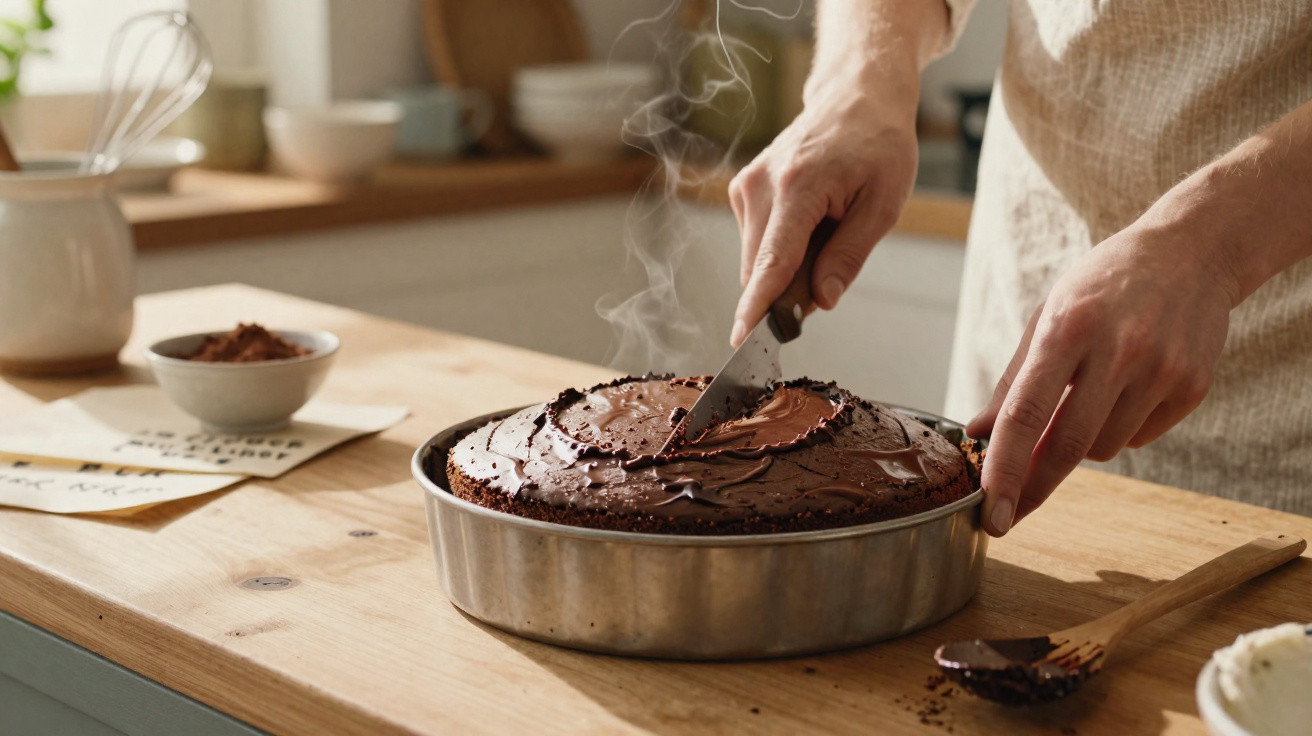
The first time I made this cake, my kitchen looked like a lazy baker’s ideal setup: one bowl, a whisk and a saucepan still warm from melting the chocolate. There was no mixer roaring away on the worktop and no flour drifting into my face. The method was so calm and ridiculously straightforward that it barely seemed like baking at all.
Forty minutes later, I sliced into a dense, glossy, warm centre that slowly stuck to the knife. Its edges were firm, its top had the delicate papery crust usually associated with brownies, and the entire kitchen smelled like a chocolate shop just before closing time.
I thought, “Alright, what’s the catch?”
There isn’t one.
The no-mixer chocolate cake that still looks impressive
There is a particular satisfaction in putting a rich chocolate cake worthy of a bakery on the table, knowing you have not even switched on an appliance. No mixer, no specialist equipment - only a spatula and hardly any washing-up once it is over. This is that cake.
The batter comes together in a few minutes, but the baked result has the fudgy centre people tend to credit to secret methods or inherited family recipes. It all comes down to the proportions: plenty of chocolate, a restrained amount of flour, and enough sugar and fat to make it soft and indulgent.
It is the sort of pudding you can make on a Wednesday evening, then let everyone assume took far more effort.
Imagine it is 8.30 p.m., you have had a long day, the kitchen is already partly tidied, and somebody says, “I wish we had something sweet.” Usually, that would sound like a direct challenge to your remaining energy. This cake changes the situation.
Melt the chocolate and butter over a low heat, mix in the sugar, whisk in the eggs individually, then fold through the flour and cocoa. That is it. It takes ten quiet minutes at most: no leaving butter out for an hour, no whipping egg whites, and no theatrical crater in the middle because the oven door was opened too early.
Half an hour later, everyone will be gathered around the oven as though it were a campfire.
The reason it produces a fudgy result every time is less complicated than it sounds. A batter high in fat and chocolate acts more like brownie batter than a traditional sponge mixture. It does not depend on lots of beaten-in air, so a mixer cannot achieve anything a whisk will not.
With less flour comes less gluten development, leaving the crumb tender rather than bread-like. The sugar and eggs work together to retain moisture in the centre, making it almost creamy even once the outside edge has set. The goal is not an immaculate rise or a feather-light texture.
You are after a soft, satisfyingly dense slice that nearly bends before it gives way.
The precise steps for a fudgy centre
Use proper chocolate rather than relying on cocoa powder alone. Coarsely chop 200 g dark chocolate, with around 60–70% cocoa solids, then gently melt it with 150 g butter in a saucepan. Keep the heat low and stir regularly; there is no need for anything more dramatic. Once smooth and glossy, remove it from the heat and leave it for a couple of minutes, preventing the eggs from scrambling.
Whisk 200 g sugar straight into the warm chocolate and butter mixture. Add three large eggs, one at a time, whisking only until each one is incorporated. Add 70 g flour, 20 g cocoa powder and a pinch of salt, then fold with a spatula until there are no remaining streaks.
The finished batter should be thick, shiny and slightly elastic. That is the sign that everything is going to plan.
Nearly every mishap with this sort of cake comes down to one of four very common errors: stirring too forcefully, overbaking, choosing an oversized tin, or slicing it while it is still fiercely hot. Fortunately, each problem has a simple adjustment.
Rather than attacking the mixture as you stir it, stop once it is evenly combined. Excess mixing adds too much air and can make the cake tougher. Choose a smaller 20–22 cm tin, keeping the middle deep enough to settle into that desirable fudgy texture. Bake at roughly 170–175°C for 22–28 minutes, according to your oven.
Then comes the most difficult part: leave it to rest for at least 15–20 minutes before slicing. Yes, the smell will test your self-control.
There’s a quiet kind of confidence that comes from sliding a perfect cake out of the oven, knowing you didn’t rush, fuss, or fake anything.
Line and butter the tin
Put baking paper on the base and lightly butter the sides, so the cake releases neatly despite its sticky centre.Use room-temperature eggs
Cold eggs may seize a little when added to warm chocolate, resulting in a grainy mixture instead of a silky batter.Test for doneness with the wobble test
Give the tin a gentle tap: the edges should appear set while the middle retains a soft wobble, like set custard rather than liquid.Cool it on a wire rack
After 10–15 minutes, remove the cake from the hot tin so residual heat does not continue baking it and rob it of its fudgy middle.Keep the serving simple
Try a spoonful of crème fraîche, a scoop of vanilla ice cream or merely a dusting of cocoa. No one is expecting an elaborate seven-layer frosting arrangement.
The chocolate cake that becomes your signature pudding
This recipe has a habit of quietly becoming part of people’s routines. At first, it is a late-night trial. Next, it appears at an informal dinner, cut into generous slices with the middle still warm. Within a month, it becomes the “Can you bring that chocolate cake?” request for birthdays, workplace bring-and-shares and friends having a difficult week.
In truth, nobody makes it every single day. Still, having one dependable no-mixer cake in your repertoire changes the way you approach pudding. Baking stops feeling like a planned occasion and becomes something that can happen alongside ordinary life.
Others remember how the knife slips into the soft centre, followed by the quiet that settles over the table after everyone has their first mouthful. You remember just how little effort it took.
| Key point | Detail | Value for the reader |
|---|---|---|
| High chocolate-to-flour ratio | Made with real chocolate, cocoa and a limited quantity of flour | Creates a naturally fudgy texture with a lower chance of dryness |
| No mixer needed | Every stage is completed using one saucepan, one bowl and a whisk | Reduces time and washing-up, while keeping the recipe manageable on busy days |
| Gentle baking and resting | Bake at a moderate temperature, remove while the centre still wobbles, then rest before slicing | Produces reliable results that look and taste like a bakery cake |

















Comments
No comments yet. Be the first to comment!
Leave a Comment