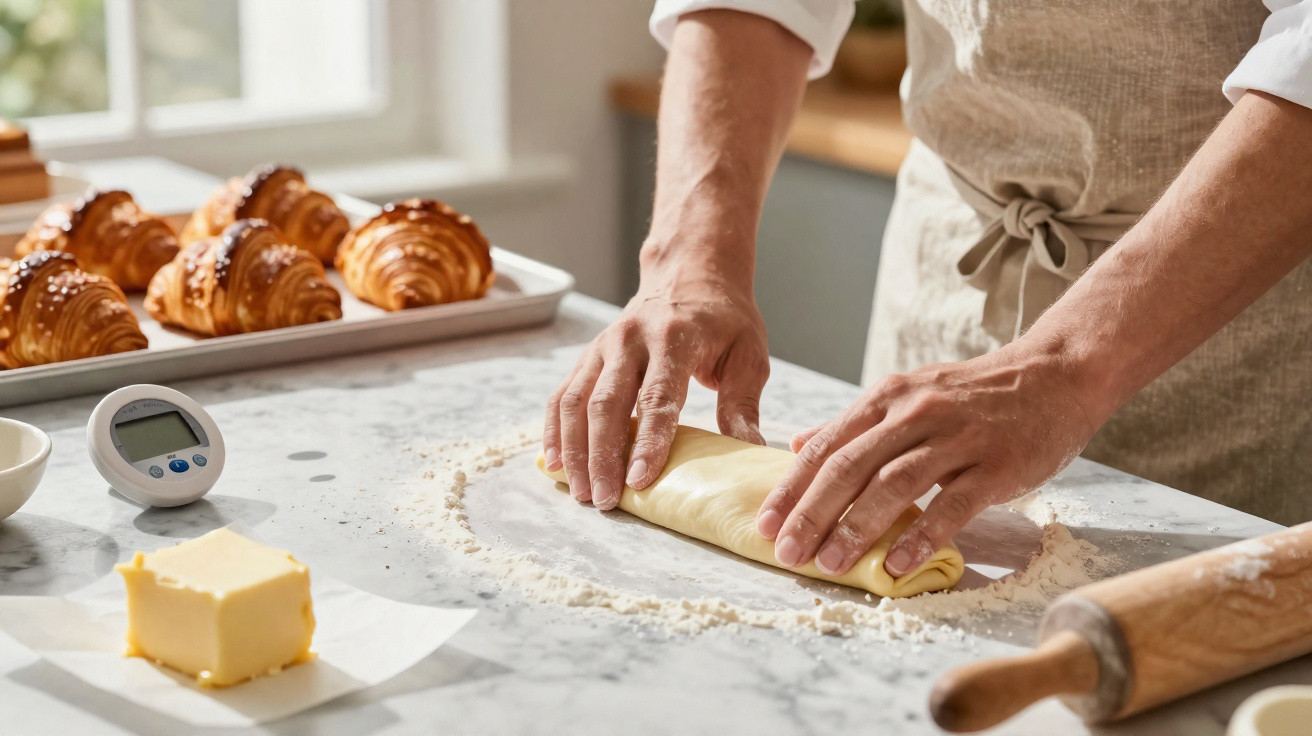
At daybreak in Paris, with the shutters still drawn, chef Camille Laurent works a slab of butter as delicately as a cellist finding the first note. His hands meet palm to palm to demonstrate how dough and butter must come together as partners. Most recipes insist on “cold butter, cold hands”, yet that often leaves layers breaking into erratic fragments or melting into an oily mass. Camille gives a small smile, gestures towards an almost inconspicuous thermometer, and offers a different answer. Use room-temperature butter: neither melted nor rigid, but flexible. He pushes his thumb into the butter and leaves a deep, slow-forming impression. When the dough encloses it, it seems to relax.
So why avoid cold butter?
What a French chef means by “room temperature”
Camille does not mean butter softened by a hot summer kitchen until it sags from the plate. For him, it is butter that flexes with the dough: roughly 18–20°C, pliable rather than hard or greasy. He describes this as alignment: butter and dough need equal resistance, so that neither overwhelms the other.
He discovered the value of this during a week when the kitchen radiator stopped working. Butter that was too cold splintered through the dough like glass, and the resulting croissants had irregular cavities. For the following batch, he gently warmed the butter block, flattening it between sheets of baking parchment until it handled like clay. The crumb then formed a clear honeycomb. Many domestic kitchens sit between 19–23°C, and that can work in your favour when you move efficiently and allow the dough to rest at the right intervals.
The understated science is this: at 18–20°C, butter reaches an ideal state of fat crystals (beta-prime). It is elastic enough to extend, while remaining stable enough to keep distinct sheets. When it is too cold, it cracks and creates gaps through which steam escapes unpredictably. When it is too warm, it blends into the dough and destroys the layers you have created. At that point, butter stops being merely an ingredient and becomes structure.
How to laminate with room-temperature butter
Choose European-style butter with at least 82% fat, and leave it on the worktop until gentle thumb pressure leaves a mark. Roll it between baking parchment into an even rectangle around 1 cm thick; if the outside looks glossy, refrigerate it for 5–10 minutes. Wrap it in dough with the same pliable texture, roll the package to 6–7 mm, and complete one single or letter fold. Chill for 20–30 minutes between folds, then carry out two further folds.
The small details count. Flour the work surface sparingly, brushing away surplus flour before each fold so the seams join instead of slipping. Should butter break through, cover it with a small piece of dough rather than rolling frantically. Everyone knows the moment when the dough begins to feel slippery and the room suddenly feels mentally overwhelming. Honestly, no one manages that flawlessly every day.
Look for signals rather than treating the process as a fixed set of rules. Pressed dough should slowly spring back; the butter should stretch without leaving streaks; and, when you trim a corner, the layers should resemble the page edges of a book.
“Room temperature isn’t a number on the wall,” Camille says. “It’s the temperature of the conversation between butter and dough.”
- Target butter: 18–20°C, pliable, not shiny.
- Rolling thickness: 6–7 mm before folds, 3–4 mm final.
- Rest windows: 20–30 minutes cold between folds, 1–2 hours before shaping.
- Proof: 24–27°C with modest humidity, no visible melting.
The practical logic behind better layers
Consider the changes inside the oven. Every sheet of butter melts, rapidly produces steam, and raises the dough above and below it like a series of miniature air mattresses. Butter that shattered while cold allows steam to escape through tiny cracks, causing uneven expansion. Butter that was smeared while too warm leaves no proper sheets capable of lifting the dough at all.
Camille sets out two trays to illustrate the point. The batch laminated with butter straight from the fridge emerges patchy and compact; the tempered batch separates into long, orderly leaves that can be pulled apart with your fingertips. The distinction is not magic; it is plasticity. When I ask him for the secret, he laughs, taps his wristwatch and names timing, temperature and touch. That is all, he says, before returning to feed the mixer.
The dough itself introduces another consideration. Strong, thoroughly developed dough can support softer butter without difficulty because its gluten network will not split beneath the rolling pin. A weaker dough requires firmer butter or it will be overwhelmed. Bringing these two elements into balance is the subtle skill that recipes often overlook. Properly tempered butter simply gives you a wider, more forgiving opportunity to achieve it.
What to do when your kitchen fights back
On a warm day, cool the work surface instead. Put a baking tray in the freezer while weighing the ingredients, then use it as your rolling surface. Work in brief stages: roll for 2–3 minutes, chill quickly, and resume. Stop when the butter turns shiny. If the dough snaps back firmly, let it rest for another five minutes. Approach it as a series of sprints rather than a marathon.
When the day is cool, soften the butter block by tapping it between baking parchment instead of simply waiting. Butter straight from the fridge can crack inside the dough even when its outer surface appears manageable. If your kitchen temperature changes sharply, laminate at a more stable time, such as early morning or evening. Use a proving box, or an oven with its light switched on, to provide a consistent proving environment. Perfection is not the aim; you only need conditions good enough for the physics to do its work.
Camille is generous about errors. In his view, most problems result from persistence rather than a lack of ability.
“If the dough or the butter tells you to stop, you stop,” he says. “There’s no prize for pushing through a bad minute.”
- If the butter smears: chill 10 minutes, flour lightly, and roll across the length once, not back-and-forth.
- If the butter shatters: warm the slab by tapping, then relaminate one gentle pass to re-knit layers.
- If layers vanish: cut losses, turn the dough into pain au chocolat or kouign-amann.
- If proofing feels risky: lower the temp, extend the time, watch the jiggle, not the clock.
The small change that transforms breakfast
There is also a human appeal to this approach. Room-temperature butter offers more control and less anxiety, making home baking feel like a craft rather than a fight. It encourages you to work through touch: the softness beneath a thumb, the way a corner turns over, the sound made by the rolling pin, while still achieving bakery-level rise. I watched a family pull apart a tray Camille had just baked. They were silent at first, then began loudly debating who would get the crispest ends. The layers did not break apart; they seemed to breathe. At 8 a.m., that is all most people could want.
I still think about that thumbprint: unassuming, quiet and strangely bold. You can pursue precise figures yet fail to notice the instant when butter becomes willing to cooperate. Or you can watch, feel and listen until the dough agrees. It is a minor adjustment in habit and a different form of attention. Bake one batch this way, and you may begin to see both your kitchen and yourself a little differently.
| Key point | Detail | Benefit for the reader |
|---|---|---|
| Match butter to dough | Target 18–20°C butter, dough equally pliable | Predictable lamination, clean layers |
| Work in short sprints | Roll 2–3 minutes, chill 10–20 minutes, repeat | Less smearing, calmer workflow |
| Use higher-fat butter | European-style 82%+ fat, beta-prime crystal friendly | Better lift, richer flavour, fewer leaks |

















Comments
No comments yet. Be the first to comment!
Leave a Comment