You lift the lid of the biscuit jar with a small sense of occasion, already imagining that first mouthful. Then comes the sound: the miserable clatter of biscuits knocking together like little stones. You take a bite and, rather than a soft, delicate crumble, your teeth hit a crunchy barrier of disappointment.
At some point between yesterday and today, your perfect batch became dusty coasters.
A few days later, you call on a friend. She opens her biscuit jar and the biscuits are still soft, almost as fresh as those from a bakery. Tucked beside them, like a secret housemate, is one lonely slice of plain white bread.
She gives a shrug and says, “Oh, that? It keeps them soft.”
You laugh, yet you lean closer too. After all, a slice of bread apparently working magic inside a jar is exactly the sort of kitchen witchcraft that stays with you.
Why a slice of bread keeps cookies from going sadly crunchy
The strange thing about cookies is that they do not really “go bad” first. They become hard. They lose that soft give in the middle, the chewy edge and the tender crumble that makes you close your eyes for half a second.
They may look unchanged as they sit innocently on the worktop, but 48 hours later they taste as though they have crossed a desert. Your lovely chocolate chip cookies, flawless sugar cookies and gingerbread all become edible fossils.
Then you discover the bread trick, which seems almost too inexpensive to be true. Drop one ordinary slice of bread into the jar and, somehow, the cookies remain soft for days. It has the feel of something your grandmother knew but never thought to write down.
Imagine this. You bake on a Sunday afternoon, with the kitchen scented with butter and vanilla while the tray cools on the worktop. You put the cookies into a jar, tell yourself they will last all week, and by Wednesday they have already lost their best days.
A reader from Ohio told me that she once threw away half of every batch. Her children disliked “stale” cookies, her partner quietly stopped taking them to work, and she began making smaller and smaller batches.
One day, her neighbour, an older woman in an immaculate apron, saw her put six cookies straight into the bin. The neighbour came over, took a bag of sliced sandwich bread from her own worktop and placed one slice on top of the cookies in the jar. “Tomorrow,” she said, “these will be soft again.”
And they were. They were not only soft the following day, but for several days afterwards too.
The “magic” is not magic at all; it is moisture gradually shifting around a sealed space. Cookies begin with a certain level of moisture from butter, eggs and sugar. When left exposed to the air, that moisture escapes into the room, leaving them dry and firm.
Bread, by contrast, acts like a sponge. It retains water in its structure and releases it readily. When you add a slice of bread to a sealed jar containing cookies, the bread starts drying out first, giving off moisture into the air inside the container.
The drier cookies take in some of that moisture again, particularly at the surface and just beneath the crust. This is why the cookies remain soft, or can even soften again, while the bread shrivels as if it has aged ten years overnight. You are essentially sacrificing the bread to save the batch.
How to use the bread trick without spoiling your cookies
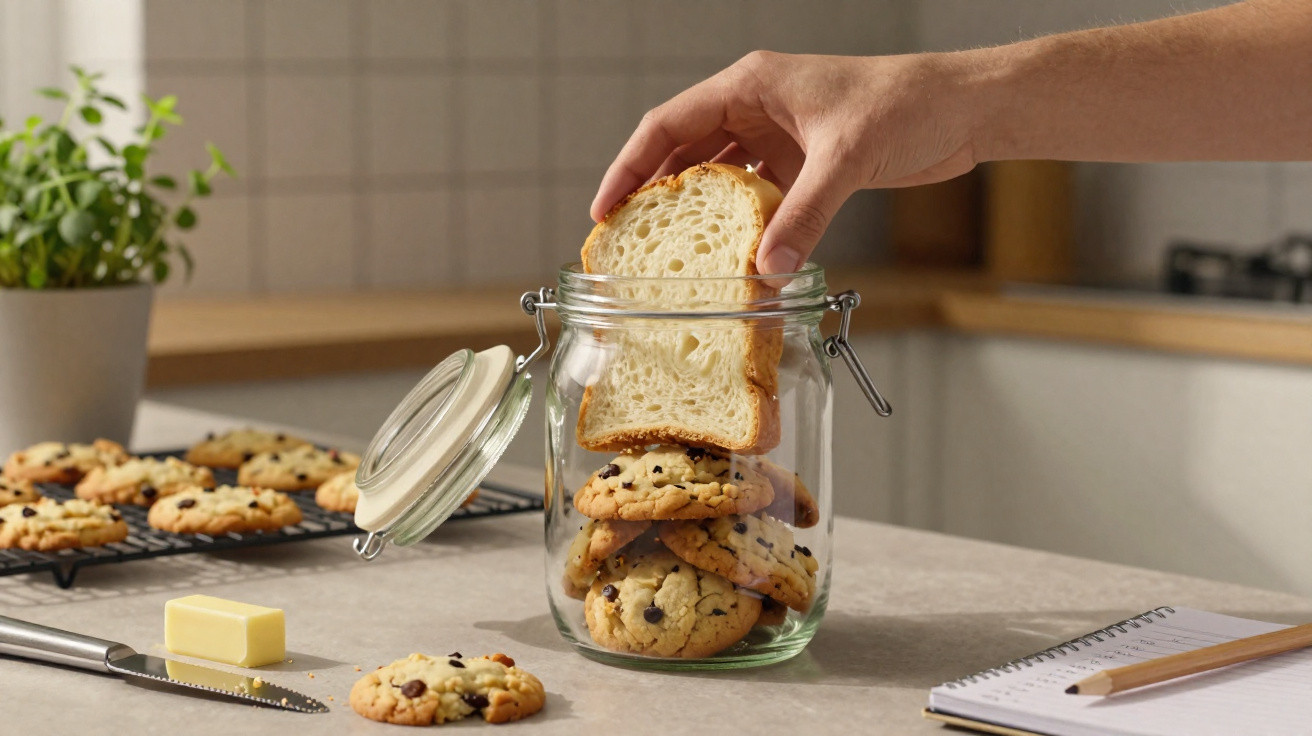
The method itself could not be simpler: after your cookies have cooled completely, put them into an airtight container or biscuit jar. Add one slice of fresh bread - plain sandwich bread is ideal - then close the lid tightly.
For an ordinary jar or medium-sized container, one slice will generally be sufficient for several days. If you have a large tin or several layers of cookies, place half a slice between the layers, using baking parchment so that crumbs and smells do not transfer too much.
Leave the bread inside and inspect it after a day or two. You will see the bread becoming dry, firm and a little forlorn, while the cookies remain remarkably soft. That weary-looking slice has done you a major favour.
This is the point where plenty of people go wrong: they use flavoured bread or add far too much of it. Garlic bread, vanilla-heavy brioche or strongly flavoured wholemeal slices will pass on both moisture and aroma to your cookies. All of a sudden, your chocolate chip batch has a faint taste of last night’s dinner.
Choose neutral bread, preferably white or a very mild sandwich bread, and use it sparingly. If you squeeze four slices into a small container, the cookie surfaces may become almost soggy, especially if the kitchen is warm.
We have all experienced that moment of trying a “hack” with great enthusiasm, only to wonder why everything became strange. Have faith in the method, but be restrained: one slice, a sealed jar and a little patience. Honestly, nobody weighs a slice of bread or measures its moisture; we simply learn by feeling how the cookies are beneath our fingertips.
There is another understated point that people overlook: timing. Putting in the bread while the cookies are still warm can hold in too much steam, making the whole jar into a humid cave. Allow them to cool fully before adding the bread as your secret softening agent.
“Once I started adding bread to my cookie tins, my grandchildren thought I’d changed the recipe,” laughs Anne, 72, who has been baking for five decades. “I didn’t. I just stopped letting them dry out on the counter and started treating them like they were worth protecting.”
- Use plain, fresh bread: White or neutral sandwich bread is best and will not give your cookies unusual flavours.
- Seal the container well: This trick relies on holding in moisture, so a loose lid or open jar stops it working.
- Watch the bread, not the cookies: Once the bread is fully hard and dry, replace it if you want the batch to stay soft for longer.
- Keep cookies fully cooled:
- Avoid strong-smelling breads: Keep onion rolls, garlic loaves and herb-studded slices away from your treasured chocolate chips.
What this small kitchen trick quietly changes
There is something especially comforting about a solution that costs virtually nothing and relies on something already in your kitchen. One slice of bread and a jar can make cookies last long enough to be enjoyed slowly, rather than eaten in a rush before they “go stale.”
It can alter the way you bake. You can double a recipe without worrying about waste. You can send a tin of cookies to a friend across town knowing they will still feel soft when they lift the lid. You can bake on Sunday for a Thursday visit and still feel pleased to hand them over.
More deeply, small ideas like this can shift how we treat food at home. You stop binning half-dry cookies, make your effort go further and create less waste. The kitchen begins to feel like somewhere that preserves and passes on clever little habits.
The next time you take a tray of cookies from the oven, you may find yourself reaching for a slice of ordinary bread. Not as an afterthought, but almost as part of the recipe: the quiet final step that keeps the softness, and a little joy, for a few more days.
| Key point | Detail | Value for the reader |
|---|---|---|
| A slice of bread keeps cookies soft | Bread gives off moisture in a closed jar, which the cookies absorb | A longer-lasting, bakery-style texture without special equipment |
| Use plain bread in an airtight container | White or neutral bread in a sealed jar prevents drying and flavour transfer | A simple, low-cost approach that works with any homemade cookies |
| Replace dry bread, not the cookies | Once the bread is hard, replace it with a fresh slice to prolong softness | Cuts food waste and saves time by preserving every batch |
FAQ:
- Question 1 Can I use any type of bread to keep cookies soft?
- Question 2 How long will cookies stay soft with a bread slice in the jar?
- Question 3 Will the cookies taste like bread after a few days?
- Question 4 Is this method safe for cookies with icing or chocolate drizzle?
- Question 5 Can the bread trick rescue cookies that are already hard?

















Comments
No comments yet. Be the first to comment!
Leave a Comment