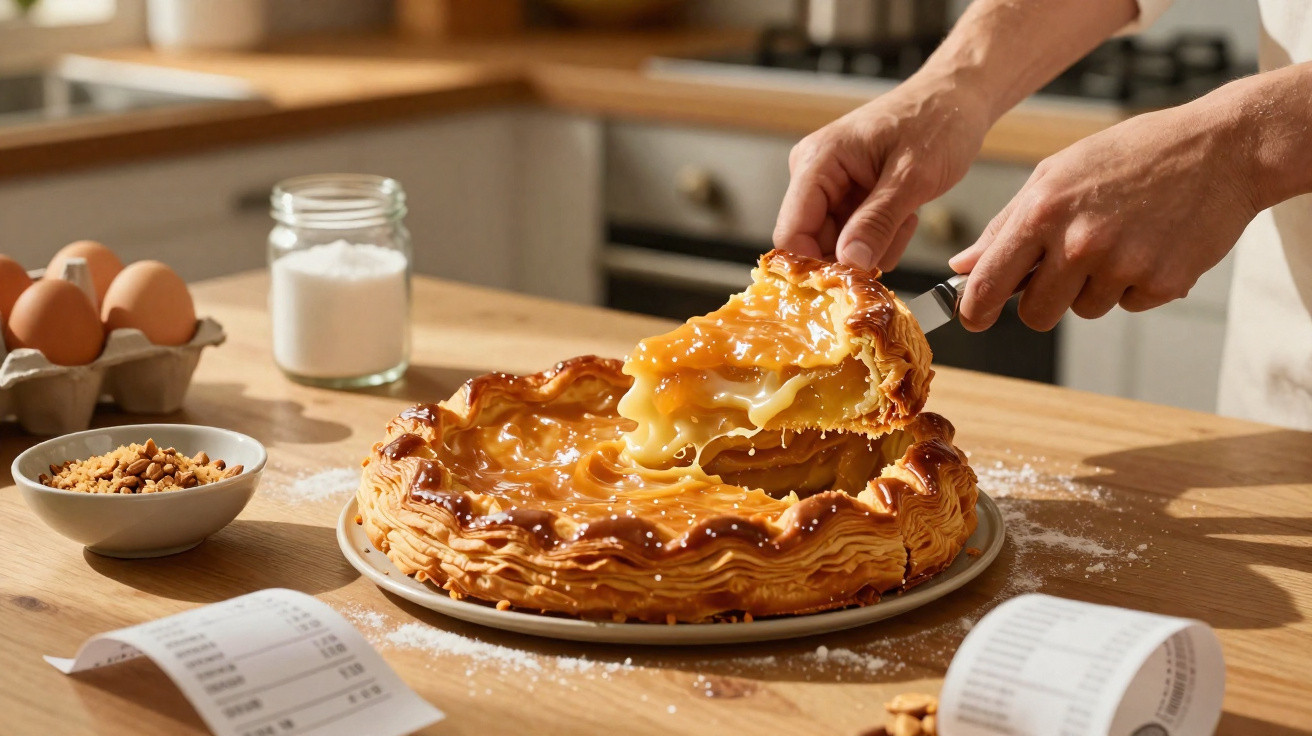
Crisp pastry, a deep almond aroma, a surprise hidden within… and a cost that discreetly falls rather than spiralling.
With food bills continuing to rise, even the comforting January tradition of making a galette des rois can seem costly. However, one straightforward adjustment to the filling can make this traditional almond tart much more affordable, while your guests notice nothing beyond its delicious flavour.
Why homemade galette des rois now seems so costly
For many households in France, January is synonymous with galette des rois, often eaten repeatedly until the month ends. The custom has travelled far beyond France too, as home bakers elsewhere have adopted its flaky pastry, almond centre and little token concealed inside.
Baking one at home is generally assumed to be cheaper than buying from a baker. Yet anyone who has made several this year is likely to have noticed the expense. Ground almonds, good butter and ready-rolled puff pastry have all become comparatively costly ingredients.
Almonds are usually the single most expensive ingredient in a galette des rois, quietly doubling the cost of the filling.
A great many home recipes described as “frangipane” are really almond cream: a mixture of ground almonds, butter, sugar and eggs. It is delicious, but contains plenty of nuts, which also makes it expensive.
The trick: use proper frangipane
The unexpected part is that this cheaper approach is not a lesser alternative. In fact, it more closely follows the traditional method used by professional pastry chefs.
Proper frangipane is more than almond cream alone. It combines almond cream with pastry cream (crème pâtissière). Raising the proportion of pastry cream means using considerably fewer almonds, while maintaining - or even enhancing - the final texture.
By letting pastry cream take the lead and cutting almond content to around 25%, the filling can cost up to half as much.
Pastry cream is mainly made from milk, eggs, sugar and a little starch. It costs far less than almonds, yet provides a silky texture and satisfying body. A few drops of bitter almond flavouring can then intensify the nutty taste without increasing the cost.
How the saving works in practice
Consider two galettes serving 6–8 people, each made using good puff pastry and butter:
| Type of filling | Almonds used | Estimated filling cost* |
|---|---|---|
| Classic almond cream only | Roughly 120–150 g | 100% |
| Mixed frangipane (25% almond cream) | About 60 g | ≈ 50–60% |
Indicative proportions based on usual supermarket pricing; your precise saving will depend on local prices.
As nuts are among the most expensive products in the baking aisle, even a relatively small reduction has an impact. For families making several galettes during January, those savings can soon add up.
The affordable frangipane recipe
To make one galette for approximately 6 to 8 people, prepare two components: an almond cream and a pastry cream. Afterwards, combine them to create one smooth filling.
Ingredients you will need
For the almond cream:
- 60 g softened butter
- 60 g ground almonds
- 1 egg
- 60 g icing sugar
- 1 small teaspoon bitter almond extract
- 1 tablespoon dark rum (optional)
For the pastry cream:
- 500 ml milk
- 4 egg yolks
- 40 g cornflour (or similar starch)
- 100 g caster sugar
- A few drops vanilla extract
This ratio gives a lush filling with intense flavour, while keeping almonds at a quarter of the mix.
Step by step: making one luxurious filling from two creams
Make the pastry cream
Warm the milk gently in a saucepan until it is only just simmering.
Meanwhile, whisk the egg yolks and caster sugar together in a separate bowl until paler in colour. Stir in the cornflour until you have a smooth mixture.
Slowly stream the hot milk into the egg mixture, whisking continuously to prevent the eggs from scrambling. Pour everything back into the saucepan and cook over a medium heat, stirring constantly. After a few minutes, it will thicken into a shiny cream.
When the mixture coats the back of a spoon, take it off the heat and mix in the vanilla. Allow it to cool until lukewarm. This resting period helps prevent lumps when the creams are combined later.
Prepare the almond cream
Beat the softened butter with the icing sugar in a bowl until pale and light. Add the egg, then beat again until it is completely incorporated.
Mix through the ground almonds, bitter almond extract and, if using it, the rum. You are aiming for a smooth, slightly thick consistency, similar to a soft spread.
Combine the frangipane
If a skin has developed, gently whisk the cooled pastry cream to loosen it. Fold it into the almond cream in several stages, working carefully to retain a light mixture.
The finished filling should be pale and creamy, firm enough to hold its form but soft enough to spread easily. Your affordable frangipane is now ready to fill the galette.
Because the pastry cream lightens the mix, the filling bakes up softer and more custardy than pure almond cream.
Baking a galette that still looks festive
Place one sheet of puff pastry on a baking tray and spread the frangipane over the middle, leaving a wide edge uncovered. Add the small charm or dried bean, positioning it away from the centre so it will not be cut when serving.
Brush the uncovered border with beaten egg, then lay the second pastry sheet over the top. Press and seal the edges securely, then lightly score a pattern across the surface using the point of a knife, without cutting all the way through.
Coat the top with more beaten egg and refrigerate the galette briefly before it goes into the oven. This encourages the pastry to rise and produces a neater shape. Bake it in a hot oven until richly golden on top and set beneath the pastry.
How the adjustment affects the eating experience
Using fewer almonds may appear to be a compromise, but people tasting it often find the reverse. A traditional all-almond filling can be dense and extremely rich: enjoyable in a small portion, but quickly filling.
Adding more pastry cream creates a lighter result, somewhere between a custard tart and an almond cake. Bitter almond extract preserves the familiar aroma and flavour. Most guests simply notice that the galette is especially tender and comforting.
The shift to real frangipane makes the dessert more economical and, for many people, easier to enjoy after a big winter meal.
Further ways to reduce costs without sacrificing quality
If you plan to bake several galettes throughout the season, a handful of additional habits can make your budget go further.
- Buy almonds in bulk: Purchasing a larger bag of ground almonds from the baking section or an online retailer often lowers the price per unit.
- Choose supermarket-own-brand butter: In this recipe, ordinary 82% fat butter generally works as effectively as premium brands.
- Look out for puff pastry offers: Ready-rolled all-butter pastry is frequently discounted by many supermarkets during January.
- Use up egg whites: The whites left from making pastry cream can be turned into meringues, financiers or even a lighter almond cake.
Bakers who like experimenting with flavours can also vary the frangipane without significantly changing its cost. Lemon or orange zest, a spoonful of orange blossom water, or a little cinnamon can alter the character of the filling without adding more costly nuts.
Understanding two important terms: frangipane and pastry cream
For those unfamiliar with French-style baking, the terminology may sound rather technical. Two terms are especially relevant here.
Frangipane is the almond-based filling used for galette des rois and certain tarts. In the strict sense, it is made by combining almond cream with pastry cream. In everyday baking, however, pure almond cream is often called “frangipane”, blurring the distinction and potentially making recipes more expensive than necessary.
Crème pâtissière, also called pastry cream, is a thick custard made with milk, egg yolks, sugar and starch. It is the same kind of cream used in éclairs and fruit tarts. Since it relies mainly on dairy and eggs, it is much less costly than ground nuts while still contributing moisture and structure.
Once the distinction is clear, the financial advantage is easy to see: let the custard provide the volume and softness, while a smaller quantity of almonds delivers the aroma and flavour. The result is a January treat that remains just as celebratory, while making your supermarket receipt noticeably lighter.

















Comments
No comments yet. Be the first to comment!
Leave a Comment