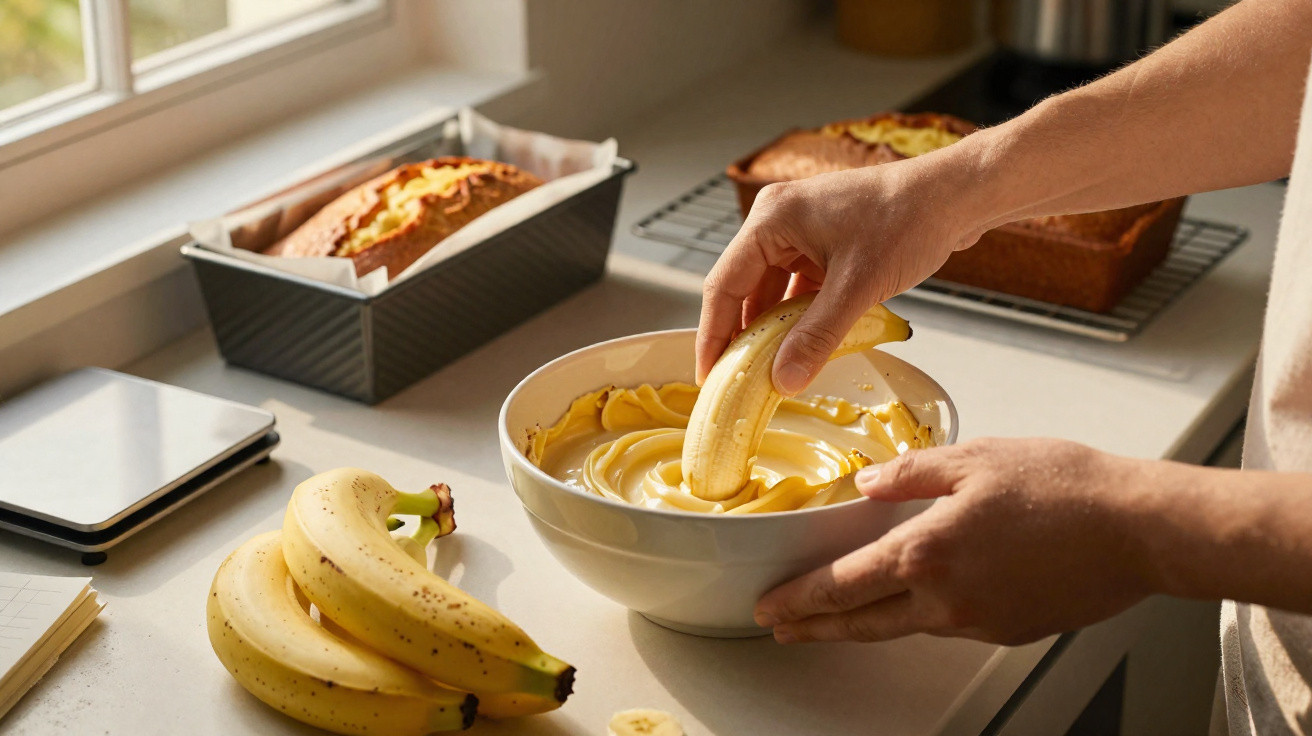
The first time I saw someone casually crush a banana into cake batter, I genuinely assumed they had gone mad. It was late on a Sunday, with that gentle end-of-week sunshine falling across a kitchen that was far too small. Empty coffee cups were dotted about, a podcast played half-heard in the background, and several speckled bananas sat on the worktop - bananas that really ought to have been binned two days before.
Instead, my friend picked one up, peeled it and squashed it with a fork straight into the bowl of eggs and sugar. There was no recipe and no weighing involved, just confidence and a shrug: “Trust me, it works.”
Fifteen minutes later, the scent reached the oven door: deeper, cosier and somehow more rounded than the smell of an ordinary cake.
That was when I understood that putting banana in cake is about more than flavour.
It is a small, quiet baking cheat code.
The unexpected magic of banana in a basic cake
When mashed banana is mixed into a plain cake batter, it is almost as though the mixture relaxes. Its consistency becomes looser, its colour mellower, and the whole bowl turns into a glossy, vanilla-fragranced promise. It can feel faintly rebellious, as if adding fruit to something meant to be all butter and sugar breaks the rules of “proper” baking.
There is a reason banana cake smells tempt people out of the hallway and into the kitchen. It touches the childhood-memory part of the brain, including for those who never ate it growing up. Mash a single ripe banana with a fork and stir it in, and a standard cake changes from “nice” into “oh, what did you put in this?”.
That is the transformation we are after.
I watched exactly this happen at a birthday party last year. The host had intended to make an impressive layered chocolate cake, but the oven schedule went wrong and the first batch emerged slightly dry. There were guests in the sitting room, candles waiting, and panic setting in.
For a backup, she tipped a boxed cake mix into a bowl, then noticed two nearly black bananas in the fruit basket. She quickly crushed them with a spoon and added them. There was no extra butter or elaborate technique, only banana. The replacement cake was almost outrageously moist, with a gentle banana-caramel flavour that sent people back for “just a sliver more.”
No one asked for the recipe. Instead, guest after guest repeated the same line: “This cake is weirdly good.”
There is a straightforward explanation for why banana delivers that “weirdly good” effect. Ripe bananas contain plenty of natural sugars and pectin, while also retaining moisture like a sponge. Folded into cake batter, they help the crumb remain soft for longer, leaving the cake tender for days rather than stale by the following morning.
Banana can also discreetly replace some of the fat and sugar. That does not turn cake into health food, but it does alter the balance. The result is a moister crumb, a fuller aroma and a softer sweetness that does not overwhelm your palate. It gives a cake more character without changing what it is.
Beneath that comforting scent is a clever piece of kitchen science.
How to add banana to cake with confidence
For the easiest starting point, take one very ripe banana for a standard cake recipe - the sort using 2 to 3 cups of flour - and mash it with a fork until largely smooth, leaving a few small lumps if you like. Aim for the consistency of baby food, without becoming too particular about it. Mix it into the wet ingredients, such as eggs, sugar, vanilla, oil or butter, before incorporating the flour.
Once you feel a little bolder, replace around a quarter of the recipe’s fat with mashed banana. If a recipe specifies 200 g of butter, for instance, use 150 g of butter plus about half a banana. The finished cake will be lighter and slightly more springy, carrying a faint note of banana rather than giving full banana bread vibes.
The important thing is to use banana as support, rather than making it the star.
Naturally, it is possible to get it wrong, usually in very human ways. Add too many bananas and the centre of the cake may sink or become gummy. Choose bananas that are not ripe enough and you risk an odd, starchy finish that no amount of icing will disguise.
Most of us have had that moment of mashing a banana that is still a little green because “it’ll probably be fine.” It rarely is.
Another familiar mistake is adding a generous amount of banana but forgetting to reduce another liquid, such as milk, slightly. That is how a moist cake becomes claggy. Usually, the ideal amount is one to two well-speckled or almost black bananas, alongside a small reduction in milk or oil.
Let’s be honest: nobody really does this every single day.
“Banana is like the friend you invite to the party at the last minute who somehow makes the whole night better,” laughs Léa Martin, a Paris-based home baker who quietly slips it into everything from pound cake to cupcakes. “I add half a banana when I think a cake will be dry. People never guess what it is, they just say it tastes ‘cozier’.”
- Use only very ripe bananas
Look for lots of brown spots, soft flesh and a strong fragrance. This is where the moisture and sweetness are found. - Mash, don’t blend
A fork or potato masher produces a better consistency than a blender, which may leave the mixture strangely slimy. - Reduce another element slightly
Remove 2–3 tablespoons of milk, oil or butter for every medium banana added, so the batter does not become overloaded with liquid. - Pair with warm flavours
Cinnamon, nutmeg, brown sugar and dark chocolate complement banana’s warmth while pushing its taste into “mystery flavor” territory. - Avoid overmixing
After the flour has been added, mix gently. Overworking banana batter can make the cake dense and tough.
Why adding banana changes your cake’s feel as well as its taste
There is something almost disarming about offering a cake with banana subtly folded through it. People may not know precisely what they are responding to, but they tend to find it more satisfying. The crumb is softer, the sweetness lasts a little longer, and each slice remains tender even when eaten cold the next day. That enduring comfort is what they remember.
Perhaps you begin adding banana because you dislike wasting fruit, or because you once tried a cake that seemed inexplicably better than its recipe had any right to be. Eventually it becomes routine: the fork crushing the fruit, the soft thump as it drops into the bowl, and the private knowledge that your “simple” cake contains a secret.
The unusual advantage is not purely practical - extra moisture, a longer shelf life, or slightly reduced sugar or fat. It is also emotional. It makes an uncomplicated cake smell like home, even if you are baking in a cramped rented kitchen with mismatched tins and an oven that is only half working.
Then, when someone takes a mouthful, pauses and asks, “What did you do to this cake?”, you can smile and reply, “Oh… just a banana.”
| Key point | Detail | Value for the reader |
|---|---|---|
| Use ripe bananas | Mash speckled or blackened bananas into the wet ingredients | Increases moisture and flavour without complicated methods |
| Adjust the recipe slightly | Replace some of the fat or liquid with banana | Produces a softer crumb and may gently lighten the cake |
| Keep it subtle | Use no more than 1–2 bananas and combine them with warm flavours | Creates a “mysteriously better” cake rather than banana bread |

















Comments
No comments yet. Be the first to comment!
Leave a Comment