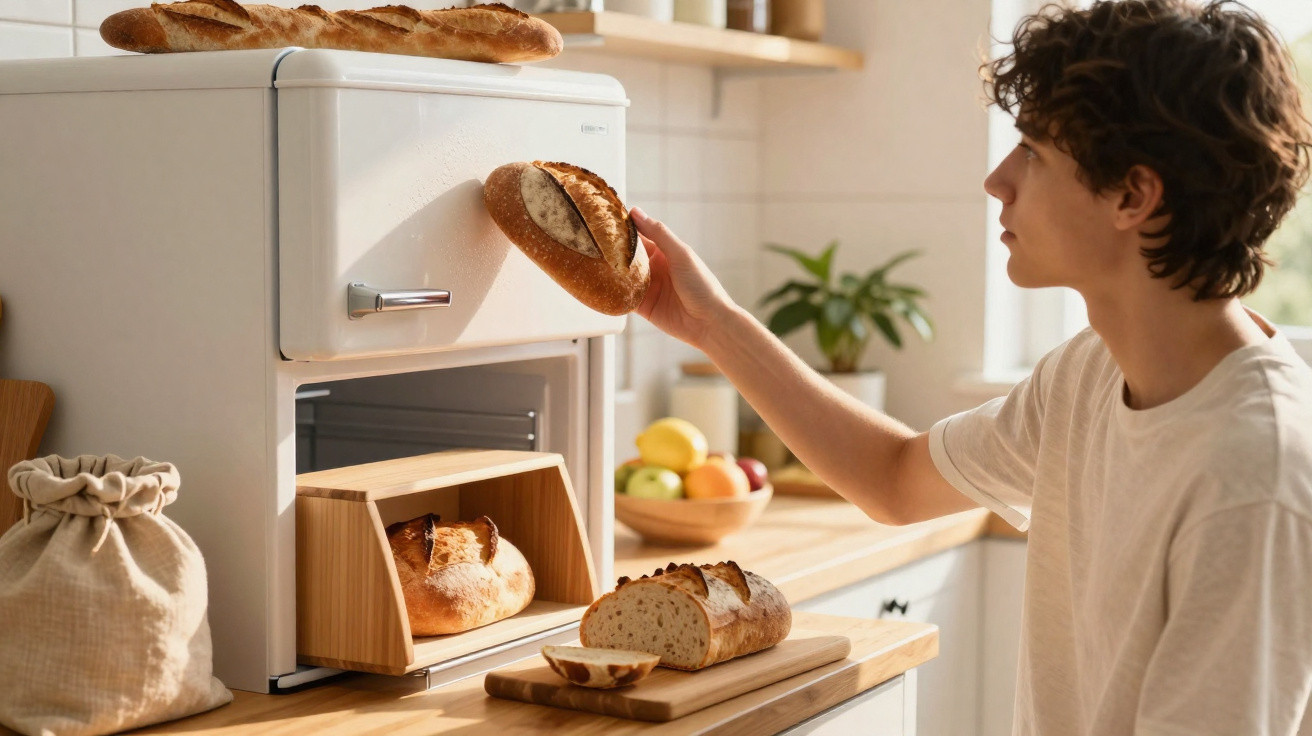
You drop the fresh loaf on top of the fridge, only half paying attention while dinner is already on your mind.
The kitchen is warm, the oven is still losing heat, the children want snacks, and your phone keeps buzzing. Bread on the fridge? Sorted: out of the way and one less thing to think about.
The following morning, you slice into it and the illusion disappears. The crust has lost its shine, the crumb seems weary, and the slices break apart beneath the knife. It is not mouldy, yet it already tastes as though it has been sitting there for several days.
The bakery is the same, the bread is the same, but the result is completely different.
Something in your kitchen has quietly let your loaf down.
Why the top of the fridge quietly ruins good bread
At first, the top of the refrigerator can seem like ideal storage space.
It is level, unused and high enough to avoid spills and little hands. Many of us place a bag of bread there automatically, without a second thought.
However, your fridge is not simply a cold box. It is an appliance that continually gives off warm air, and that heat rises directly towards your unsuspecting loaf.
Over time, that gentle warmth is enough to make bread stale at speed.
Imagine this.
A friend comes home proudly carrying a sourdough loaf that is still warm from a new bakery: the sort with a crisp, crackly crust, a chewy centre and a faint aroma of toasted grain. She enjoys two flawless slices, leaves the rest in its paper bag and sets it on top of the fridge “just for tonight.”
Two days later, she sends a message: “What did I do wrong? This bread is already sad.”
The loaf has not gone mouldy. Instead, it is dry around the outside, faintly rubbery within, and its flavour has become muted.
There was no kitchen disaster. The bread was simply left above a quietly humming source of heat.
Bread becomes stale through a straightforward process known as starch retrogradation.
After baking, the starches in the flour gradually reorganise and force out moisture, moving water into areas where your palate no longer experiences it as softness.
Heat accelerates that process.
Because your refrigerator constantly emits mild warmth, the space above it becomes a small microclimate in which bread ages more rapidly. The crust dries sooner, the middle becomes firm, and those appealing bakery aromas disappear days earlier than they ought to.
While your fridge works to stay cold inside, it directs heat straight at your loaf.
How to store bread so it stays soft, tasty, and alive longer
For bread, the ideal storage spot is cool, dry and protected from direct sunlight or heat.
In many UK homes, that may be a bread bin on the worktop, a cupboard or even a clean drawer.
Choose somewhere with a temperature that remains fairly steady throughout the day. Avoid shelves beside the oven, windowsills warmed by afternoon sun, and snug spaces directly against the dishwasher.
Cover the bread loosely with a paper bag or a clean cotton tea towel, giving it protection while allowing it to breathe.
Plastic holds in moisture; rather than genuinely preserving freshness, it can leave the loaf sweaty.
Few people have bakery-perfect conditions at home, and that is entirely understandable.
We deal with small kitchens, housemates, pets, children and groceries that never quite fit where they should. So we make do: bread on the fridge, the microwave, behind the coffee machine or crammed above the toaster.
The only small change needed is to ask: “Is this a hot spot?”
Place your hand there after cooking, or once the fridge has been running for a while. If the surface feels clearly warm, it is not a suitable place for bread.
Realistically, nobody turns their loaf every day with the attention of a wine sommelier. But taking it off the fridge is a simple habit that is genuinely easy to maintain.
“Bread is alive even after it leaves the oven,” explains a Parisian baker I spoke with.
“Every degree of warmth or chill changes the way it ages. If you treat it like a living thing instead of a packaged product, it will reward you.”
- Best for short-term (1–2 days): Keep it at room temperature, wrapped in paper or a clean cloth, in a bread bin or cupboard.
- Best for medium-term (3–5 days): Slice the loaf, leave one portion at room temperature and freeze the remainder in an airtight bag.
- Best for long-term: Freeze it in portions, then warm it from frozen in the oven or toaster to restore the crust and crumb.
- Places to avoid: The top of the fridge, beside the oven, next to the hob, on the microwave or in direct sunlight.
- Red flag signs: A dry crust after 24 hours, a rubbery middle, or bread that tastes strangely “tired” well before mould appears.
The small kitchen habit that quietly changes your bread life
After noticing what happens on top of the fridge, it is impossible to ignore.
There is the slight warmth, the almost imperceptible vibration and the cupboard above it that invariably feels more stuffy than the rest.
Taking bread away from that upward flow of heat is such a minor step that it can seem almost absurd. Still, it can immediately give you another day or two of good texture and flavour, particularly with quality bakery loaves.
We have all had that experience of binning a half-eaten, once-lovely baguette after it seems to have become a weapon overnight.
That little bit of waste hurts.
| Key point | Detail | Value for the reader |
|---|---|---|
| Heat ruins bread faster | Warm air from the fridge accelerates staling and dries out the crust | Helps you avoid a common storage mistake |
| Cool, stable spots are best | A bread bin, cupboard or drawer at room temperature | Keeps loaves soft and tasty for more days |
| Plan by time, not just place | Room temperature for 1–2 days, then freeze slices for longer | Reduces waste and saves money on bread |
FAQ:
- Question 1 Does the type of bread matter when storing it on top of the fridge?
- Question 2 Is the top of the fridge still a poor choice in winter when my kitchen is colder?
- Question 3 Should I store bread in the fridge to keep it fresh?
- Question 4 What is the best way to revive bread that has already become slightly stale?
- Question 5 Where is the best place to keep sliced supermarket sandwich bread?

















Comments
No comments yet. Be the first to comment!
Leave a Comment