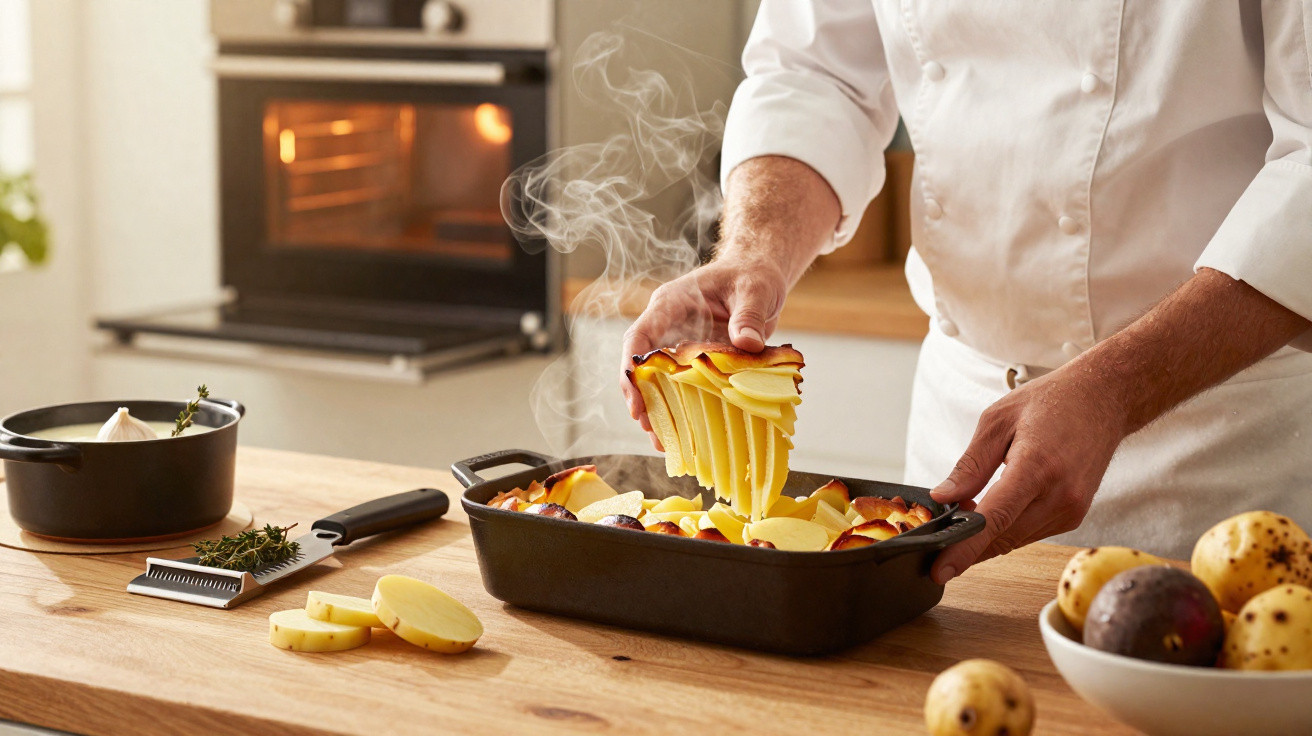
Across France, winter tables have one dish that discreetly takes centre stage, transforming an ordinary side into the star of the meal.
Gratin dauphinois may seem homely and familiar, but pastry chef Christophe Michalak turns it into an exercise in precision. Known primarily for polished éclairs and feather-light choux, he has earned another description: “king of gratin dauphinois”. His approach combines unhurried baking, exact layering and several surprising details, elevating this household favourite into a festive centrepiece.
The pastry chef captivated by potatoes
Christophe Michalak made his name in pastry kitchens rather than among roasting joints and sauces. He trained in some of France’s most exacting establishments, where success within the brigade depends on mastering timing and texture. He now applies that same rigour to one of the country’s best-known comfort dishes.
Gratin dauphinois generally plays a supporting role alongside roast poultry or a straightforward green salad. It features in many French households for Sunday lunch, skiing breaks and, ever more often, Christmas dinner. Michalak gives it the same attention he would devote to a plated dessert. The potato selection, oven heat and every other detail are carefully controlled.
Pouring cream over sliced potatoes is easy. Turning that into a sliceable, custardy block that stands on a plate like a cake takes real control.
There are no shortcuts in his version: no pre-cooking and no rapid blast in a fierce oven. Instead, the gratin bakes very slowly for three hours, developing the firm structure and soft, almost candied consistency he seeks.
The unexpected flavour in Christophe Michalak’s gratin dauphinois cream
Cheese is a frequent point of debate in gratin dauphinois. Purists favour only cream, milk and garlic, while more contemporary versions include Gruyère or Comté. Michalak takes a different path, altering the dish’s aroma rather than increasing its richness.
Selecting the best potato
The crucial choice begins with the potato variety. Michalak chooses Amandine, a firm, waxy potato that retains its shape during a long, gentle bake. Floury varieties are more likely to disintegrate, producing a mash-like layer that prevents the clean slices he wants when serving.
- Amandine: firm and smooth, it keeps its shape and is ideal for tidy layers.
- Charlotte or Nicola: similarly firm varieties that are also well suited.
- Russet or King Edward: more appropriate for mash, as they may collapse during lengthy baking.
He peels the potatoes before cutting them finely on a mandoline to ensure every slice is the same thickness. This is more important than many home cooks think: uniform slices cook at an even rate, allowing the whole gratin to soften together.
Cream used as a sauce
Michalak combines cream with salt, pepper and a little garlic, remaining close to the traditional foundation. He then introduces the ingredient that changes the dish’s character: anise seeds.
A few anise seeds infused in the cream give a discreet, aromatic lift that cuts through the richness without shouting over it.
The seeds infuse in warmed cream, adding a mild liquorice flavour. This aromatic note freshens the palate between mouthfuls of starch and fat. Cooks who favour more conventional flavours can use nutmeg, thyme or bay leaves, all familiar additions in French kitchens.
After infusing, the cream must fully submerge the potato slices in the baking dish. Nothing should be left exposed, as protruding pieces will dry out or burn too quickly over such a long cooking time.
Why the gratin dauphinois needs three hours in the oven
Many gratin dauphinois recipes recommend roughly an hour, or perhaps 80 minutes at 180°C. Michalak extends the baking time to a full three hours, reducing the oven temperature in stages as it cooks.
| Stage | Oven temperature | Duration | What happens |
|---|---|---|---|
| First phase | 170°C | 1 hour | The layers begin to soften and the cream starts to thicken. |
| Second phase | 160°C | 1 hour | The potatoes take in the cream while the starch is released gradually. |
| Third phase | 150°C | 1 hour | The texture settles, flavours combine and the edges become stable. |
For most of the cooking time, the dish remains covered with aluminium foil. This traps moisture, creating a steamy cooking environment. The gratin cooks almost “à l’étouffée”, gently suffocating in its own vapour instead of drying out under direct oven heat.
Covering the dish means the cream behaves like a low, simmering bath, not like a liquid under a grill. The potatoes confit slowly instead of boiling violently.
Around 30 minutes before cooking ends, he takes off the foil. The top can then brown and form a delicate golden crust. Since the potatoes are already tender, the last half-hour is devoted to colour and a slight crispness on the surface rather than finishing the cooking.
A gratin that can be unmoulded like a cake
The reward for this patience becomes evident once the dish comes out of the oven. After a brief rest, the potato starch and thickened cream bind the layers firmly together. The finished gratin has an almost architectural appearance.
Michalak occasionally loosens the inside edge with a knife before unmoulding the gratin onto a board or serving platter. It remains intact as a block, allowing perfect upright portions to be cut. Its overlapping potato pattern recalls an apple cake, with slender, uniform layers and defined edges.
On a Christmas table next to a roast capon or beef joint, this neat, layered block often attracts more attention than the meat itself.
For festive meals, a neat presentation is important. Clean portions reheat more uniformly and hold their shape better on plates filled with accompaniments. Home cooks aiming for this result should use a straight-sided dish, line its base with baking parchment and allow the gratin to rest briefly before unmoulding. As it cools slightly, the texture sets further and stands upright more easily.
Root vegetables beyond potatoes
While the traditional recipe uses potatoes alone, Michalak sometimes incorporates other root vegetables between the layers. Finely sliced carrot or turnip adds colour and a different kind of sweetness. Alternating creamy potato with orange and white rounds makes each portion resemble an edible cross-section.
This mixed approach preserves the essence of gratin dauphinois – cream, slow heat and closely packed layers – while reducing its sense of heaviness. Carrots bring natural sweetness, turnips provide a subtle bitterness, and both make each forkful seem less rich. For anyone concerned that a Christmas spread may feel too heavy, this variation offers a gentler side dish.
How slow baking transforms the texture
Technically, the three-hour bake gives the starches sufficient time to swell and release gradually. Rather than bursting forcefully under intense heat, they thicken the cream into a velvety sauce that moves back through every slice. This restrained process prevents graininess while keeping the individual layers defined.
The lower temperatures also prevent the dairy from splitting. Cream heated too quickly may separate, leaving an oily pool around chalky potatoes. Michalak’s method keeps the mixture in an almost custard-like condition, with fat and water remaining evenly suspended.
The goal is not just softness. It’s a custardy interior, a fine crust, and a gratin that cuts cleanly without oozing across the plate.
Adapting the method for home cooking
Domestic ovens differ, and three free hours before dinner are not always available. Even so, the principle behind Michalak’s technique can be adapted for everyday cooking. The essential consideration is not exact timing but the balance between moisture, heat and slice thickness.
Cooks can speed up the method by gently heating the cream and sliced potatoes together in a pan until they are just tender, then completing the cooking in the oven under foil at a slightly higher temperature. The consistency will be somewhat different, but the layered effect remains similar. Keeping the slices thin and evenly sized is still essential.
For smaller households, cooking the gratin in a loaf tin produces a slim block that can be sliced attractively the following day. Leftovers also fry well in a hot pan, creating an especially crisp edge while the centre stays soft and turning a festive accompaniment into a speedy weekday lunch.
Nutrition, safety and minor adjustments
A dish based on cream and potatoes naturally prioritises comfort over nutritional balance. People monitoring saturated fat can alter the dairy mixture by using some whole milk or reduced-fat cream, provided they accept the compromise. Lower fat produces a thinner sauce and a slightly less silky texture.
Food safety also merits consideration. Despite the extended low-temperature cooking, the centre should remain above 70°C for an appropriate period. An oven thermometer can confirm whether a dial set at 150–160°C is genuinely achieving that temperature. Christmas ovens packed with several dishes often operate more coolly than expected.
By approaching gratin dauphinois with the same seriousness he applies to a plated dessert, Christophe Michalak demonstrates that a humble accompaniment can be transformed through patience and technique. With anise-scented cream, precisely arranged Amandine potatoes and slow, phased baking, his “king of gratin” title depends not on showmanship but on a clear method that home cooks can adapt for their own winter tables.

















Comments
No comments yet. Be the first to comment!
Leave a Comment