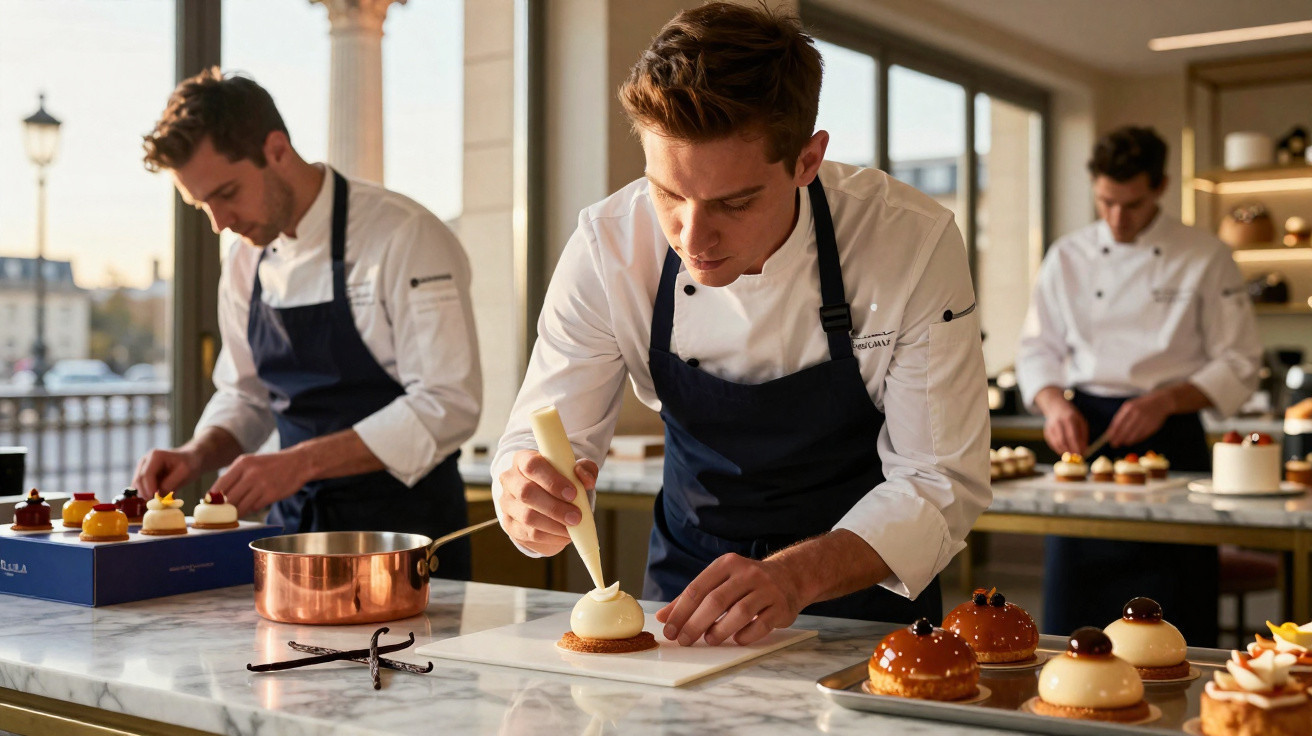
Behind the scenes at one of Paris’s most iconic hotels, a quiet change is set to reshape both its pastry displays and the business of luxury.
Following the departure of François Perret, a name that became a global reference in hotel pâtisserie, the Ritz Paris has chosen to recast its entire sweet offering, placing an internal duo in charge of its next chapter.
An unusual succession at the heart of place Vendôme
For years, the sweet creations at the Ritz Paris revolved around one man. When François Perret left at the end of August, the hotel could simply have named a direct successor and retained the traditional model of one great chef at the helm. Instead, it chose a different route.
From 1 January, two professionals trained within the house will formally take charge of the pâtisserie. The appointment represents a notable shift in the world of Parisian palaces: excellence can be built collectively, through distinct and complementary roles.
The Ritz’s haute pâtisserie is moving away from the “solitary genius” model and into a period of shared creation, without giving up its heritage.
One is already familiar to students of the École Ritz Escoffier. The other was Perret’s right-hand man at the Le Comptoir boutiques and now has the scope to express his own personality. Together, they make up the new sweet leadership team at place Vendôme.
Olivier Lainé, the teacher taking charge of palace desserts
To oversee the Ritz Paris restaurants and internal spaces, the hotel has looked inwards. Olivier Lainé, a discreet yet strategic figure who spent seven years teaching at the École Ritz Escoffier, becomes the new head of the palace’s dessert offering.
He will now lead the creations served at the L’Espadon restaurant alongside chef Eugénie Béziat, as well as those for Bar Vendôme, the traditional afternoon tea and the hotel’s sought-after breakfasts.
From the classroom to the pastry displays
A graduate in 2002, Lainé built a strong career before settling at the Ritz. He worked in Brittany, produced entremets at Café Pouchkine and served as deputy pastry chef at Shangri-La Paris. He knows the standards of Parisian luxury at close quarters: intense pace and the demand for consistent results.
In taking on the role, he has a significant advantage: he is already steeped in what Paris calls the “DNA of place Vendôme”, a phrase describing the blend of tradition, understated elegance and technical perfectionism associated with the great palace hotels.
Olivier Lainé promises precise pâtisserie that respects the hotel’s legacy while allowing contemporary adjustments in texture and form.
Tradition as the foundation, innovation through texture
The new chef enjoys revisiting classics, beginning with structured, thoroughly tested recipes and adding his own signature. He refers to “plays on texture” - crisp, soft and creamy - as a way to turn a familiar sweet into a different experience.
- Reinterpretations of French icons with a lighter finish;
- A balance of sugar, acidity and fat that highlights flavour;
- A search for contrasts: hot and cold, firm and velvety;
- Assemblies designed for restaurant service and the tearoom.
This focus on the sensation of eating, paired with classical foundations, is likely to appeal to an increasingly demanding clientele seeking something photogenic but also memorable on the palate. For the Ritz, it offers a way to honour decades of history without becoming confined by the past.
Joris Theysset, creative guardian of the Le Comptoir boutiques
While Lainé will oversee the palace’s restaurant side, Joris Theysset takes responsibility for the external boutiques. He will direct the two Ritz Paris Le Comptoir shops in the 1st and 6th arrondissements, the more accessible, urban-facing arm of the brand.
Theysset joined the hotel in 2019 as part of the boutique opening team alongside François Perret. He became Perret’s trusted deputy and took responsibility for production in 2021. It was only a matter of time before he put his name to his own range.
From Ardèche to Parisian displays
Born in Ardèche, in rural France, Joris trained in his home region before joining Ladurée in Paris, the address known for its macarons. The combination of rural roots and experience at major houses brought him to place Vendôme, where he followed every stage in the development of the Le Comptoir project.
Since November 2025, he has been signing his own creations, including the Sucre d’Orge bûche for the festive season: a Yule log playing on childhood memories of colourful sweets. The bûche acted as a manifesto, favouring comfort and emotional memory over formal rigidity.
In Theysset’s view, the best dessert is one that becomes an emotional memory rather than a photograph on a mobile phone.
A “sincere” pâtisserie for everyday luxury
Joris speaks of “sincere pâtisserie”, an expression widely used in France for sweet creations that do not conceal flavour behind effects. These are understandable preparations inspired by childhood desserts, yet made with high-level technique.
At the boutiques, the strategy is expected to combine three main strands:
| Type of creation | Proposition |
|---|---|
| Revisited classics | Fruit tarts, éclairs and mille-feuilles with distinctive touches. |
| Memory-led sweets | Cakes, brioches and bûches inspired by childhood flavours. |
| “Takeaway” items | Bars, cookies and portable desserts designed for customers passing through quickly. |
By describing himself as the “guardian of creativity” for Ritz Paris Le Comptoir, Theysset indicates that he intends to protect the house identity while supporting its expansion beyond the hotel walls, bringing luxury closer to people moving around the city.
What changes for people tasting Ritz desserts
For customers, this division of responsibilities could offer a practical benefit: greater consistency within each setting. At the palace, the experience is likely to centre on table service, desserts plated to order and finished in the kitchen, with freshness and temperature taking priority.
At the boutiques, the emphasis will fall on appealing displays, transportable pastries and products designed for travel, gifting or a quick snack. It is one brand serving two distinct consumption contexts.
The Lainé–Theysset duo points to a more segmented Ritz Paris, yet one united by the same pursuit of consistency, elegance and emotion on the plate.
Understanding “palace pâtisserie”
The term “palace pâtisserie” generally refers to the pastry departments of five-star hotels serving demanding guests throughout the day: breakfast, room service, brunch, afternoon tea, banquets and private events. It is not merely about making sophisticated sweets, but ensuring that every portion is perfect, often at near-industrial volumes.
That is why these laboratories operate almost like small high-luxury factories, with exacting weighing, meticulous organisation and daily production control. The pressure for consistency is considerable: a regular guest will not accept the same mille-feuille having a different texture from one day to the next.
When a hotel such as the Ritz divides leadership between two professionals, it reduces operational risks. One can focus on protocols and creativity for internal food service, while the other handles the boutiques’ logistics and identity, with their different customer flows and peak times.
Possible outcomes from this partnership
This new structure creates room for several interesting possibilities. One is the development of seasonal collections linking the restaurant and boutiques through a common theme, while giving each a different format. A flavour could, for example, debut on a tasting menu before being adapted into an individual version for travel.
Another likely direction is greater emphasis on French ingredients with controlled provenance, such as artisan butters, fruit from small producers and bean-to-bar chocolate. The duo could explore the same ingredient from different angles, an approach that often creates strong brand narratives and builds loyalty among curious customers.
For pastry professionals, following these developments helps explain how leading houses address concrete issues: volume, image, profit margin, storytelling and, naturally, public desire. The balance between technique, emotional memory and sensory experience has become the central factor in standing out in a market saturated with perfect photographs that are often lacking in flavour.

















Comments
No comments yet. Be the first to comment!
Leave a Comment