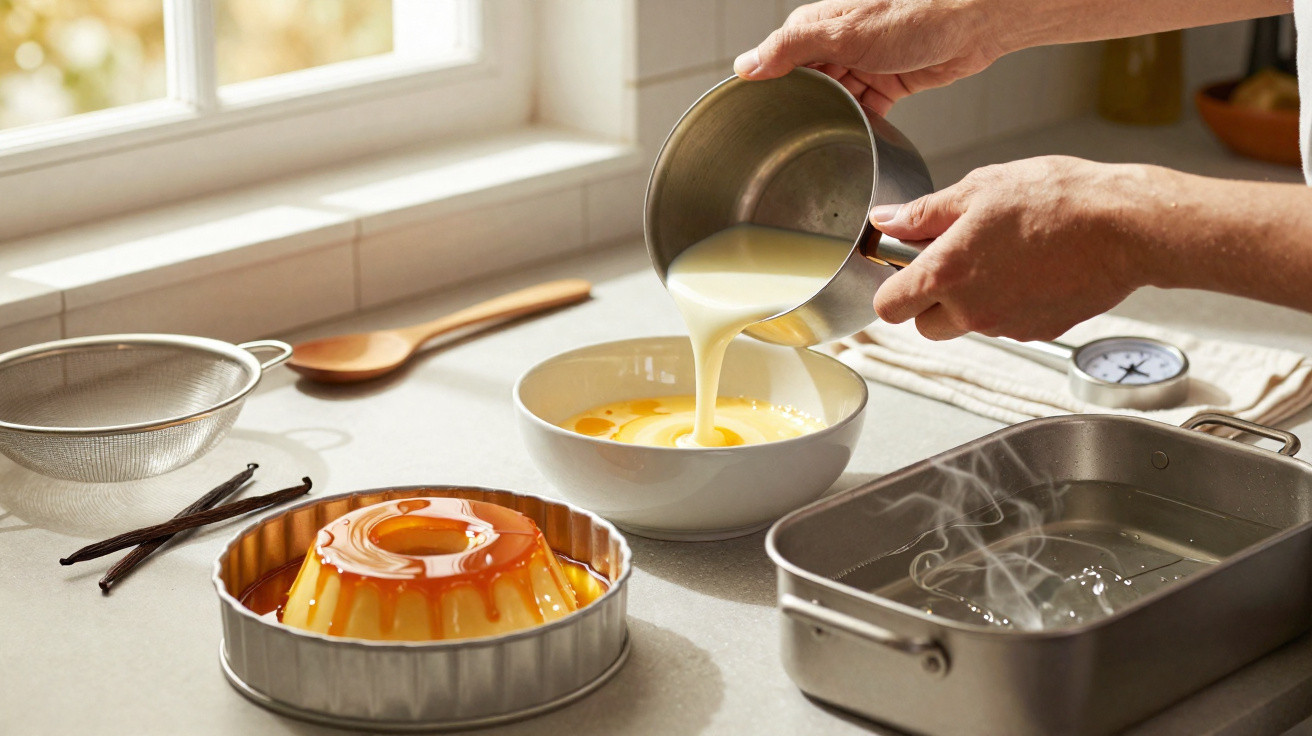
Crème caramel remains the nostalgic pudding that sparks debate around French family tables: everyone insists they know the “real” recipe, but plenty of attempts split, crack or develop an overly eggy flavour. Although it seems simple and rather traditional, this dessert reveals any weakness in technique. Fortunately, a dependable method based on precise heat management and one essential caramel step can make this demanding classic an easy winter favourite to prepare at home.
The understated charm of a timeless dessert
Crème caramel is not a showy dessert. Pale, unassuming and often presented in small ramekins, it nevertheless combines three compelling elements: silky custard, the sharp edge of caramelised sugar and the comforting fragrance of vanilla.
In France, it appears on bistro menus as regularly as apple tart. Food critic François-Régis Gaudry recently renewed interest in the dessert by sharing his family recipe, which depends on closely managed cooking. His technique underlines something many home cooks miss: success depends not merely on the ingredients, but on how the custard and caramel respond to heat.
Mastering crème caramel is less about fancy skills and more about respecting gentle heat, patience and timing.
The classic crème caramel formula
Ingredients in a traditional crème caramel
The traditional French recipe needs only a few kitchen essentials. There is no cream, no thickening agent and no shortcut involved.
- Whole milk, which gives the custard body and softness
- Eggs and additional yolks for richness and structure
- White sugar for the custard as well as the caramel
- A vanilla pod for a clear, fragrant flavour
Gaudry’s version starts with half a litre of whole milk, three whole eggs and three yolks, roughly 80 g of sugar for the custard and around 50 g for the caramel. The milk is slowly infused with seeds scraped from a split vanilla pod, adding depth without masking the caramel.
Why the ratios are important
Altering the proportions changes the nature of the pudding. A greater quantity of whole eggs produces a firmer texture, closer to a flan. More yolks create a creamier result, but introduce extra fat that may become grainy when overheated. Too much sugar in the custard can make it excessively sweet and rubbery.
| Texture goal | Egg balance | Cooking focus |
|---|---|---|
| Soft and wobbly | More yolks than whites | Low, slow baking |
| Sliceable and firm | More whole eggs | Slightly longer time, same gentle heat |
| Richer and custardy | Several yolks added | Strict temperature control |
The closer you get to just-set custard, the more precise your control of eggs, sugar and heat needs to be.
The reliable method: heat control from beginning to end
Heat the milk gently, without boiling
The first crucial stage is warming the milk slowly with the vanilla. It should become fragrant, warm and faintly steamy, then the heat should be stopped.
Problems begin when the milk boils. Intense heat alters the proteins, which can then tighten and separate during baking. This creates the tiny bubbles and grainy consistency associated with a “failed” crème caramel.
Whisk the eggs without overdoing it
Start the egg mixture with a whisk, the sugar and a little effort. You are aiming for a pale, smooth mixture in which the sugar has dissolved. Foam, however, should be avoided. A heavily bubbled surface becomes holes and cracks once the dessert is baked.
When the milk is warm, pour it gradually over the eggs while stirring steadily and gently. This slowly raises the temperature of the eggs, a technique known as tempering. Adding the hot milk too quickly can partially cook the eggs on contact, leaving tiny pieces of scrambled egg behind.
Caramel: the stage where you should not interfere
Caramel often causes the greatest difficulty: it may burn, crystallise or suddenly harden. Gaudry’s guidance is clear and uncompromising: melt half the sugar first in a heavy-based pan over high heat, and do not stir it.
Leaving the caramel alone at the start stops sugar crystals forming and keeps the texture glassy and smooth.
After the first half of the sugar has melted into a transparent syrup, add the remaining sugar and cook it until it becomes a deep amber colour. This shade matters: caramel that is too light lacks flavour, while overly dark caramel will overwhelm the custard with bitterness.
Immediately pour the hot caramel into the bottom of the mould or ramekins, then quickly swirl it before it hardens. Speed is important at this point, as it creates an even coating that will become the characteristic glossy surface after unmoulding.
Why the bain-marie determines the result
Even, gentle heat on every side
A bain-marie, or water bath, may seem unnecessarily professional, but it is central to this reliable method. Put the filled mould into a larger tray, add hot water to the tray, then transfer it to an oven set to 180°C.
The water provides a protective buffer. Rather than exposing the custard directly to the oven’s full heat, it keeps the cooking temperature close to water’s boiling point. This prevents the eggs from overheating and ensures an evenly smooth texture.
Without a water bath, the edges set too fast, while the centre stays undercooked and turns rubbery by the time it finally firms up.
Baking time and the essential resting period
A medium-sized dish will generally need around 30 minutes in the oven. When lightly shaken, the centre should still tremble softly, indicating that it will continue to set as it cools.
After baking, the dessert requires patience. Let it reach room temperature, then refrigerate it for at least three hours. During this chilling stage, the caramel gradually liquefies and runs down the sides, while the custard develops its final smooth, silky texture.
Only unmould it when ready to serve. Run a thin knife around the edge, turn it swiftly on to a plate and let gravity take over: the caramel cascades down, coating the custard with shine and forming a pool of sauce at its base.
Common errors and how to prevent them
- Boiled milk: produces a curdled, grainy finish. Warm it carefully and remove it from the heat before it simmers.
- Over-whisked eggs: excess bubbles create cracks and holes. Whisk only until the mixture is pale and smooth.
- Stirred caramel: stirring too early promotes crystallisation. Leave the initial sugar to melt undisturbed.
- No bain-marie: direct oven heat gives the edge a rubbery, overcooked texture. Always bake in a water bath.
- Undercooling: cutting short the refrigeration time leaves caramel stuck in place and the middle too soft.
What “custard” means in this dessert
Many English-speaking cooks understand “custard” to mean a pourable sauce, whereas crème caramel is a baked custard, closer to what Americans may call a flan. Its structure comes from egg proteins gradually setting in liquid, rather than from starch.
Because it contains neither flour nor cornflour, the result is lighter and more delicate, but it is also less forgiving. An oven that is a few degrees too hot, or an additional five minutes of baking, can turn a silky texture spongy.
Variations, serving suggestions and useful adjustments
Once the main technique is secure, the recipe can be adapted slightly without losing its identity. Some cooks swap part of the milk for single cream to achieve a richer mouthfeel, while others add grated citrus zest to the warmed milk for a fresher taste. Coffee beans, star anise or a pinch of cardamom can also be briefly infused, as long as their flavour does not dominate the caramel.
For smaller households, individual ramekins make serving simpler and reduce the resting time. The same principles remain essential: a water bath, low and gentle heat, and enough time in the fridge. Leftovers keep well for one or two days, although the caramel sauce becomes progressively thinner.
Learning this pudding also offers a practical benefit: it can be prepared a full day ahead. For hosts managing main courses, side dishes and visitors, having dessert already setting quietly in the fridge can ease last-minute pressure.
Food safety is also worth considering. Since crème caramel is egg-based, the centre must reach a safe temperature without losing its tenderness. This balance is another reason professionals favour the water-bath method. If available, a probe thermometer offers added reassurance: a centre temperature of around 80–82°C will usually provide a safe but silky set.

















Comments
No comments yet. Be the first to comment!
Leave a Comment