The customer ahead of you in the bakery is calculating baguettes in her head. One for this evening, perhaps another for tomorrow… then comes the familiar pause: “Should I freeze some?”
The worry never changes. You picture that lovely crust becoming limp and rubbery, sealed inside a miserable plastic bag and gathering moisture in the freezer like an abandoned leftover.
The same thing happens at home. You bring back an excellent sourdough, cannot finish it, and put it in a zip bag “just for a few days”. A week later, you find it again: frost around the edges, a flat aroma and the texture of a washing-up sponge. Into the bin it goes. Money gone, enjoyment gone. The frustrating part is that you suspected this would happen when you put it in the freezer.
There is a different approach. A simpler, quieter one.
Why frozen bread becomes a disappointment - and how to prevent it
The problem does not truly begin in the freezer. It starts earlier, the moment bread touches plastic or foil. A crust that was crisp and glorious starts to soften inside its airtight wrapping. With nowhere else to go, moisture travels into the crust and takes away its crunch.
When you finally warm the bread up, the harm has already been done. Your freezer did not spoil the loaf; its wrapping did.
One winter morning in London, I watched a small bakery open. The first customers arrived with tired faces and coffees in hand. A man bought a whole sourdough and then asked the baker, “How do I freeze this without killing the crust?” Instead of reaching for cling film, she took out an ordinary brown paper bag. She wrote on the date, folded the top and said, “Like this,” she said. “Straight in the freezer. Hot oven to wake it up.”
A week later, he returned and bought two loaves rather than one.
The science inside the bag is straightforward. Bread gradually loses moisture, which is what causes it to go stale. In plastic, water leaving the crumb is trapped, then absorbed again by the crust. The crust loses its crispness and becomes chewy. A breathable paper wrapper allows some moisture to escape, even in the freezer. That keeps the crust drier and the crumb more distinct.
Freezing stops staling in its tracks, but how you wrap the loaf determines how successfully it comes back to life.
The no-plastic, no-foil bread-freezing method that works
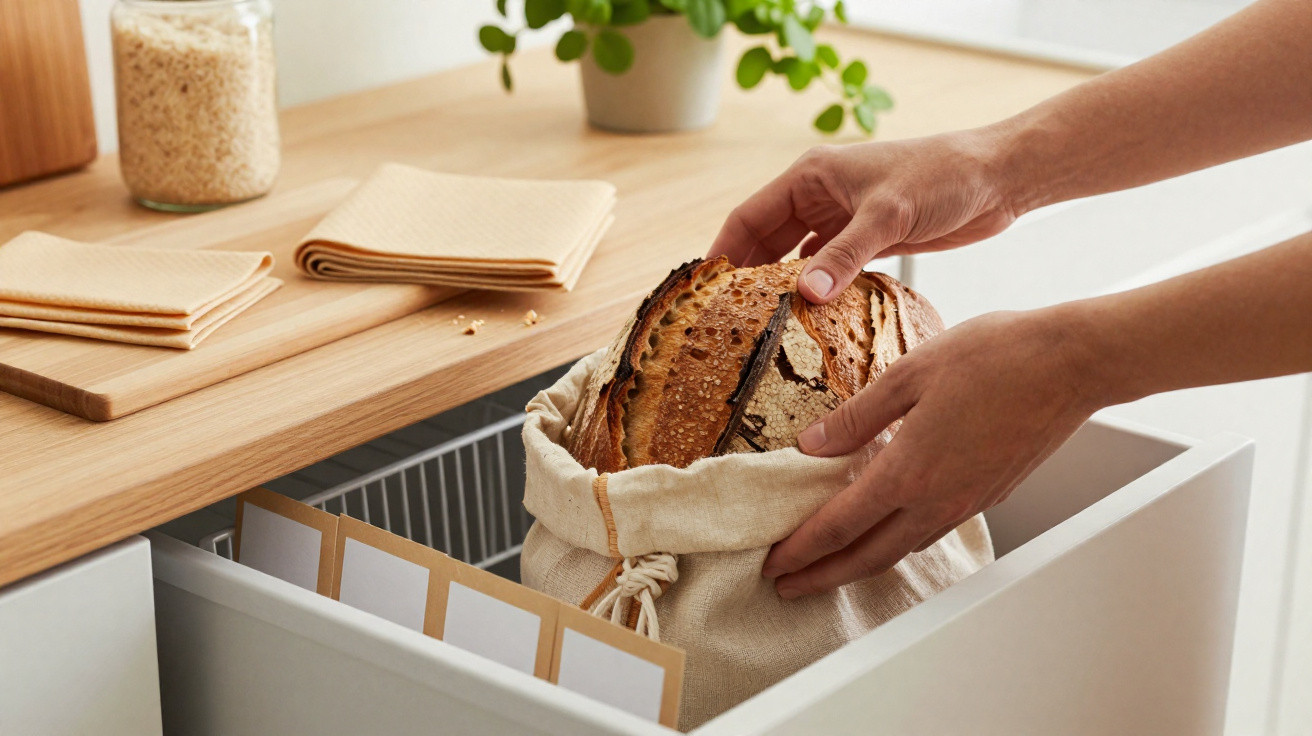
The essential step is this: allow the bread to cool completely, then use paper rather than plastic. Choose a brown paper bag, a bakery bag or plain parchment. Put the loaf or slices inside, fold the opening firmly and place it straight in the freezer. No shiny foil and no clingy plastic.
When it is time to eat it, take it from frozen to hot. Do not defrost it on the worktop and do not use the microwave. Put it directly into a very hot oven until the crust sings again.
People usually make mistakes at two moments. The first is enclosing warm bread in plastic or foil “to keep it fresh”. This locks in steam and softens every part of the crust before freezing has even begun. The second is letting it defrost slowly on the worktop. As moisture moves around unevenly, the bread becomes rubbery.
You are certainly not alone if this has been your routine for years. On a hectic weekday, shortcuts are understandable. Let’s be honest: nobody really does this every day.
For the best chance of crisp, plastic-free frozen bread, think of it as something living that you are carefully pausing rather than a leftover you are concealing. Slice into thick pieces, or halve, any bread you know you will not eat. Freeze the pieces on a tray for an hour so they cannot stick together, then transfer them to paper. Write the date on the bag, even if it seems slightly obsessive.
“The freezer is not a graveyard,” laughs Paris-based baker Juliette Martin. “It can be a second oven, if you send your bread there the right way.”
- Wrap with paper rather than plastic or foil
- Freeze bread while it is as fresh as possible, but only once it has cooled fully
- Reheat straight from frozen in a hot oven for a crisp crust
Make your freezer a bread ally
The more meaningful change lies in kitchen habits rather than technology. Freeze smaller amounts, but do it sooner, while the bread is still at its best. Reserve a small bread corner in the freezer: a bag of slices, another for crusty ends and perhaps half a baguette.
After arriving home tired and hungry, finding those portions waiting can feel like a discreet kindness from your earlier self.
On a Sunday evening, for example, you could divide a country loaf into eight thick slices. Put four into a paper bag for the week and leave four out for tonight and tomorrow. On Wednesday morning, take a frozen slice and put it straight into the toaster or oven. It will emerge fragrant, faintly crackling as it cools. It will not be quite bakery-fresh, but it may be close enough to make you stop halfway through a bite.
We have all known how one good slice of toast can turn a hurried breakfast into something almost calm.
Freezing bread this way can also alter your view of waste. A stale heel once seemed like a failure. Now it is an ingredient: tomorrow’s croutons, breadcrumbs or the foundation for a comforting bread pudding. Instead of becoming a cold drawer full of forgotten items, the freezer turns into a small archive of previous meals and future possibilities.
No plastic, no foil, and much less guilt. It is a small, useful act of resistance against food waste and excessive packaging, which can crackle around your conscience as much as it does around your bread.
| Key point | Detail | Benefit for the reader |
|---|---|---|
| Wrapping method | Use paper bags or parchment rather than plastic or foil | Maintains a crisp crust and reduces household plastic |
| Freezing timing | Freeze bread when it is fresh and fully cooled | Improves texture and flavour after reheating |
| Reheating approach | Put it from frozen into a hot oven or toaster, without defrosting on the worktop | Fast, convenient results that are close to bakery quality |

















Comments
No comments yet. Be the first to comment!
Leave a Comment