The heel of the loaf was still soft that morning, while the rest had become a miniature science project. Green specks dotted the crust, and opening the bag released a faint smell. It is the sort of small betrayal that has you throwing three-quarters of a perfectly good sourdough into the bin, muttering as you go.
You had bought it only two days before, promising yourself that this time you would “store it properly”. Then life got in the way: the door opened, the bread landed on the worktop, the plastic was loosely twisted, and that was that.
Bread can go from pleasure to waste so quickly that it feels almost personal.
But what if that small mouldy disaster is not unavoidable?
The real reason your bread goes mouldy so fast
Bread does not simply “go off” - it is gradually being colonised.
A loaf contains starch, some moisture and, in some cases, sugar: precisely the combination mould thrives on. The moment bread leaves the warm oven and meets room-temperature air, mould spores in your kitchen begin treating it like an open buffet.
That is why its location, the amount of air around it and the warmth of your kitchen can determine whether a loaf lasts three days or seven.
Picture a shared flat kitchen in July. One housemate leaves sliced white bread in a sealed plastic bag on top of the fridge, beside the window. Another puts a crusty bakery loaf, still wrapped in paper, into a dark cupboard.
By the third day, the first bag is already developing small pale marks. The heat and plastic have created a tiny greenhouse: moisture from the crumb rises, condenses and gives mould the water it needs.
The loaf in the cupboard may be slightly firmer around the edges, but it will often still smell fresh and bready. Same city, same supermarket, entirely different results.
It may sound almost mysterious until you look at the basics. Mould requires three things: spores, moisture and warmth. Spores cannot be eliminated completely; they are in the air, on your hands and on the worktop. The other two factors, however, can be managed.
Cooler places slow mould growth considerably. A drier crust makes moisture harder for mould to access. Some airflow also prevents condensation from accumulating.
The ideal storage method is not a single miracle container. It is about maintaining enough moisture to stop bread becoming rock hard, while avoiding the warm, damp conditions mould loves.
The best practical ways to store bread - and what actually works
For most homes, the most effective approach is remarkably straightforward: keep bread at room temperature, away from direct sunlight and in breathable wrapping.
For a crusty sourdough or baguette, choose a clean cotton bag, tea towel or its original paper bag, folded shut. Place it in a bread bin or cupboard, well away from heat from the oven or steam from the dishwasher. This helps the crust remain reasonably crisp while reducing surface drying.
For soft sandwich bread, leave it in its bag, squeeze out excess air and seal it firmly. Keep it in the coolest, driest area of the kitchen rather than on top of the fridge, where heat collects.
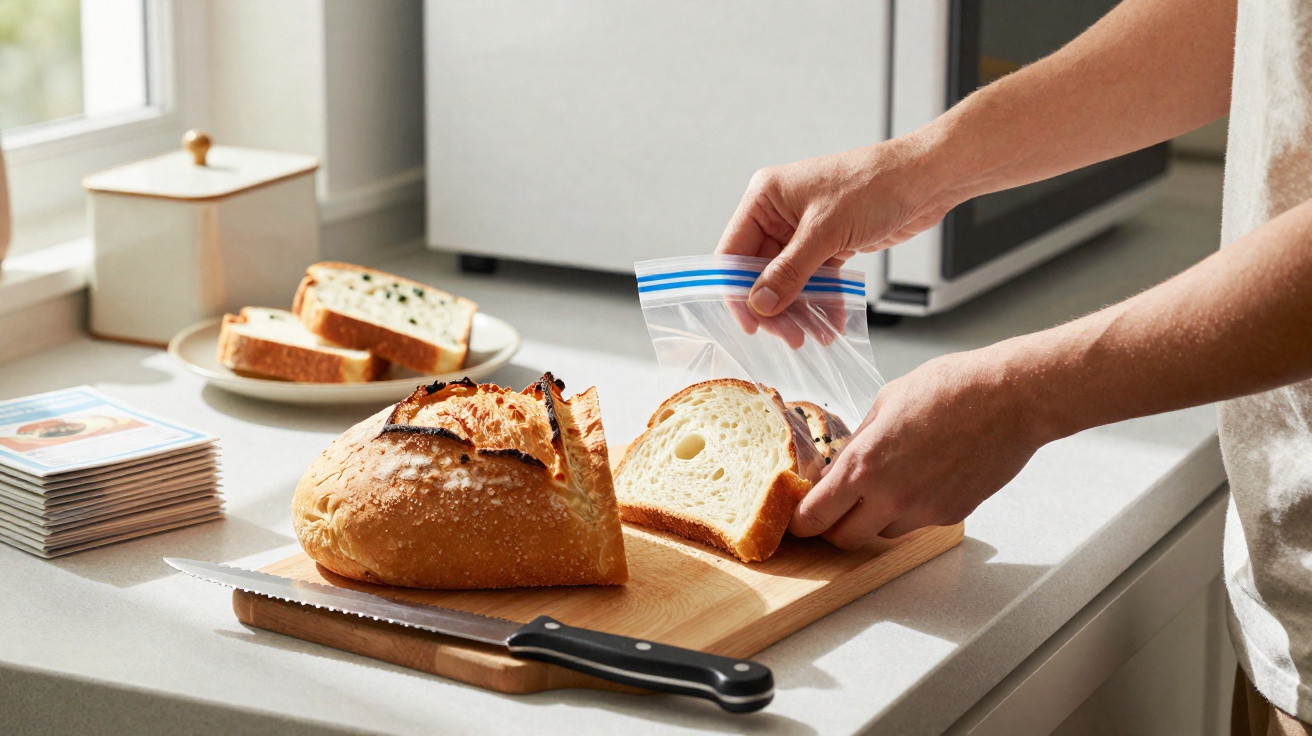
Freezing is the understated solution many people overlook. On the day you buy or bake a loaf, slice it once it has cooled completely, then freeze the slices in a freezer bag or container with as little air trapped inside as possible.
You can take out two slices for toast or a packed lunch straight from the freezer. There is no need to struggle with a solid half-loaf, and no dispiriting mouldy heel waiting for you a week later.
Let’s be honest: hardly anyone does this every day, but once it becomes routine, you will notice how seldom bread ends up in the bin.
One baker I spoke to in London put it bluntly:
“Bread hates extremes. Too hot, too cold, too wet, too dry – that’s when it punishes you.”
His home routine follows the same principle: store bread at room temperature for 1–2 days, then freeze what remains. No fridge.
A quick guide is useful when you are half-awake on a Sunday, looking at yesterday’s loaf:
- Crusty bread: paper or cloth + bread bin, then freeze any leftovers after 2 days
- Soft sliced bread: a tightly sealed bag in a cool cupboard, or freeze some on day one
- Never: leave bread on the oven, by a sunny window or in a steamy corner
Why the fridge is not your friend - and what to do instead
The fridge may seem like the logical solution, but it gradually spoils bread. Cold temperatures trigger starch retrogradation, in which the starch molecules in the crumb rearrange and force out water. This is why refrigerated bread becomes firm and stale so quickly, even before it turns mouldy.
The result is a loaf that technically “lasts longer” but tastes like cardboard. It is the worst of both outcomes: fewer visible spots and far less enjoyment.
If you have been putting bread in the fridge and wondering why it feels miserable the next day, the science is against you.
On a rainy Tuesday in Manchester, a family I visited had found a routine that worked beautifully. They bought a fresh bakery loaf on Saturday and kept it in a cotton bag in a shaded corner. Anything left by Monday night was sliced and frozen.
They never purchased more bread than they could eat within two days at room temperature. There were no elaborate preservation methods or specialist containers - just a simple pattern and a freezer doing the hard work.
They said they almost never discovered mouldy bread at the back of a cupboard any more. At most, they found an occasional crust, which they turned into breadcrumbs.
There is also a small change in mindset that can make all the difference: stop viewing bread as one single item and start thinking of it in portions. Eat some while it is fresh, freeze some, and repurpose the final stale pieces as croutons or French toast.
As one home cook said while we chatted over coffee:
“The day I stopped trying to ‘save the whole loaf’ and just froze half on day one, I stopped binning bread. Simple as that.”
And because life happens, it is useful to have a straightforward plan for those moments when you forget about the loaf again:
- If you notice the very first speck of mould, throw away the loaf; mould spores spread further through the bread than you can see.
- If it is dry but not mouldy, toast it, make breadcrumbs or soak it for soup.
- If you already know you will not finish it, slice and freeze it immediately rather than waiting until day three.
Living with bread, not fighting it
Storing bread properly is less about following a rigid rulebook and more about working with the way a loaf behaves once it leaves the bakery. It needs a cool, calm spot, a little airflow and not too much time passing.
When your habits reflect that - cloth instead of sweaty plastic for crusty loaves, a freezer rather than a fridge, and smaller loaves instead of buying too much - mould becomes an occasional nuisance rather than a weekly problem.
On an ordinary weekday morning, that means opening the bread bin or cupboard, taking out a soft slice that does not smell strange, and continuing with your day without giving microbiology a second thought.
At a human level, this is also about waste and everyday rituals. We have all pulled out a half-loaf dotted with green, felt a small pang of guilt and thrown it away rather too quickly.
Changing the way you store bread will not save the planet overnight, but it does interrupt that frustrating little cycle. You begin to have faith in your kitchen again.
Perhaps you buy that lovely bakery sourdough more often, knowing that three days later you will not be scraping mould from the edges and pretending it is acceptable.
The amusing part is that, once you settle into a rhythm, you begin to spot your own habits: which days you genuinely eat toast, how quickly children get through sandwiches, and which kitchen corner remains coolest during a heatwave.
Bread storage becomes less about finding “the right container” and more about understanding how you actually live.
That is the quiet secret: the most effective way to prevent mould is not a gadget. It is a collection of small decisions that suit the way you really eat, rather than the way a label assumes you do.
| Key point | Detail | Benefit for the reader |
|---|---|---|
| Avoid the fridge | Cold speeds up staling without completely stopping mould | Maintains better texture and flavour for longer |
| Choose freezing | Slice and freeze early, taking out portions as needed | Reduces waste and keeps “fresh” bread readily available |
| Store at room temperature | Keep it somewhere cool, dry and out of sunlight, in breathable wrapping | Limits mould growth without sacrificing the crust or softness |

















Comments
No comments yet. Be the first to comment!
Leave a Comment