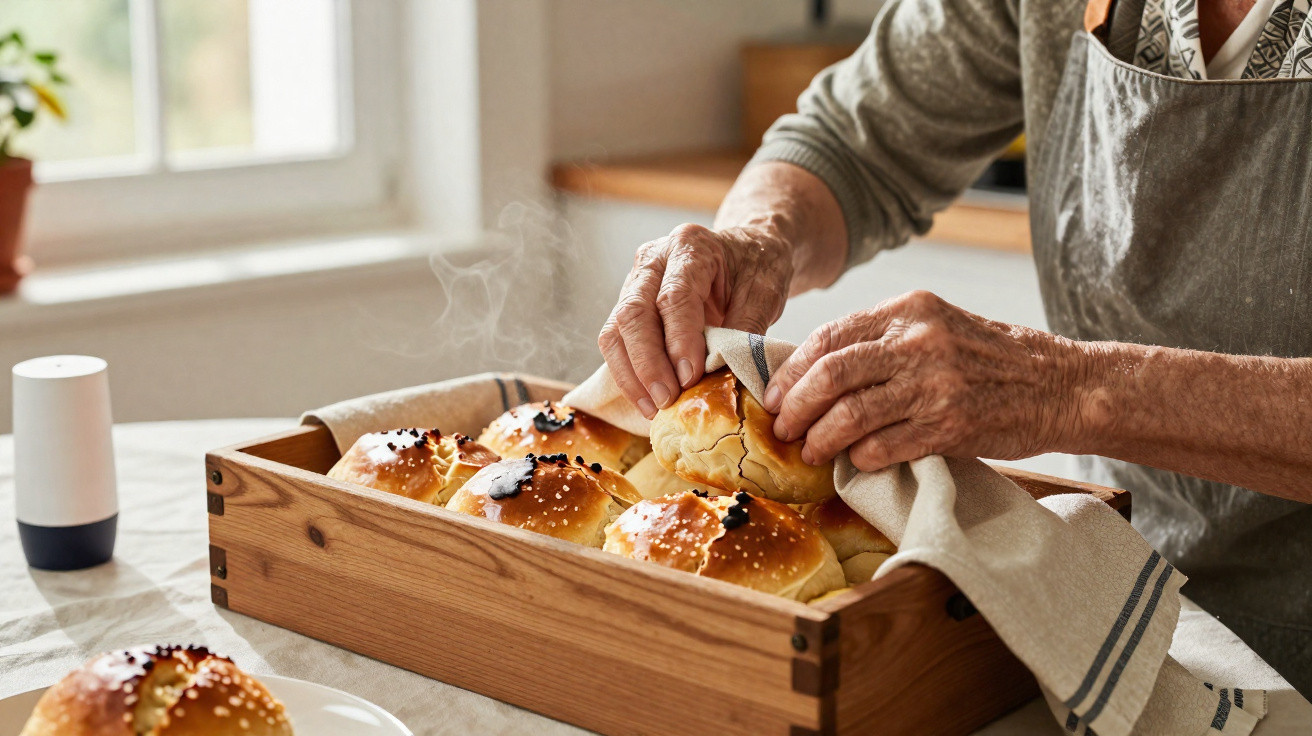
Golden, proud and singing as its crust crackled through the silent kitchen, the loaf looked perfect. Yet two hours later, it had already become a little forlorn: the crumb was drying around the edges and the magic was slipping away into “just bread”. It was a familiar, minor disappointment - hardly enough to mention, but always present.
At the far end of the table, an older woman observed with a knowing half-smile. She waited as if she had watched the same scene unfold hundreds of times. Then she crossed to the worktop, opened a drawer and picked up something so commonplace that it almost seemed comical. Such a tiny, nearly ridiculous action.
“Try this,” she said. By the following morning, the bread remained soft.
This grandmother’s tiny ritual that keeps bread soft for days
Some kitchen tips seem magical precisely because they are so unremarkably simple. They are the sort of habits a grandmother follows without explanation, simply because she has always done so. This always-soft bread trick belongs firmly in that category: an ordinary cotton tea towel and an unassuming piece of boiled potato.
The principle could scarcely be more modest. Before the bread has cooled completely, the grandmother loosely wraps the loaf in a clean tea towel that is still slightly warm. She then places half a cooled potato in the bread bin beside it. It must not touch the loaf; it simply sits there, a quiet guard against dryness.
It may sound superstitious, but the outcome is remarkably reliable: a soft, moist crumb even on the third day, when most homemade loaves are already heading towards crouton territory.
In a small bakery on a quiet Leeds street, the ritual has become a behind-the-scenes secret. Its owner, Amy, learnt the method from her Polish grandmother. She still chuckles at the memory of first seeing a potato placed in the bread cupboard beside a line of loaves that were still warm.
Initially, she tested it at home only to be polite. The next morning, her children ate slices that were still tender, without that disappointing stale resistance. “It shouldn’t work, but it does,” she told us, shrugging with flour on her forearms. The idea soon travelled. A few regular customers tried it and insisted that their Saturday loaves stayed fresh until Tuesday, without that “day-old” texture.
The potato-and-tea-towel method also quietly took off in a small online baking group. Members shared comparison photographs: one loaf stored plainly in plastic and another kept with a nearby towel and potato. By the second day, the contrast in crumb texture was clear, even on a phone screen. Responses combined disbelief, pleasure and the familiar tenderness that emerges whenever someone says, “My grandmother used to do the same thing.”
There is straightforward logic beneath its old-fashioned charm. Bread does not turn stale merely because it “dries out”; the starches within it also rearrange themselves and force moisture out. Dry surroundings accelerate this change. A firm crust and cool air work together to draw water away from the crumb.
The tea towel provides a gentle barrier. It reduces the crust’s contact with air while allowing the loaf to breathe, preventing it from sweating and becoming rubbery. Meanwhile, the potato in the bread bin creates a small pocket of humidity around the bread. It is not sufficient to make the loaf wet, but it is enough to prevent the crumb from losing its moisture too quickly.
It is like making a tiny microclimate for your bread, somewhere between a dry worktop and a damp fridge. It is science meeting grandmotherly instinct, all wrapped in a faded tea towel.
How to recreate the bread trick at home without overthinking it
The process is almost absurdly easy. Bake or buy your loaf as normal. Leave it to cool until it is merely warm when touched - not steaming hot, as that would trap condensation. Once the bread is warm but comfortable to hold, loosely wrap it in a clean cotton or linen tea towel.
Place the wrapped loaf in a bread bin, a large saucepan with its lid slightly open, or even a straightforward paper bag. Next, boil a small potato, allow it to cool fully, halve it and put one half in the bin or container without letting it touch the bread. Think of them as housemates rather than lovers. Close the lid, leaving the smallest gap for air to circulate.
As the cooled potato releases moisture, it lightly humidifies the air inside. The towel absorbs any wandering droplets and stops the crust becoming hard enough to challenge your jaw. The loaf remains soft at its centre, while its crust stays chewy rather than rock hard.
This is where many people go wrong: they hurry. They wrap the loaf while it is still piping hot, or reach for cling film because it is readily available. That locks in too much moisture, leaving the crust rubbery within hours. It is soft, certainly, but in a dispiriting way rather than the pleasant way of fresh bakery bread.
Others miss out the potato-cooling stage and add it while it is still steaming. This creates a humid cave that promotes condensation on the surface of the loaf. The result is a gummy slice that rips rather than cuts. Let’s be honest: nobody really does this every day while following every step to the letter.
The ideal balance lies somewhere in between: warm bread, cooled potato and a breathable wrap. No plastic, fridge or high-tech container is needed. All it takes is a little patience and a spot in the kitchen away from direct sunlight. On a hectic weekday, you might take shortcuts, and that is perfectly fine. This is a ritual for the occasions when you care about the loaf a little more than usual.
“My grandmother never measured anything,” Amy told us. “She just knew when the bread was cool enough and the potato was ready. I used a thermometer at first. Now I just listen to the loaf.”
The science is not the only reason this trick resonates. On a peaceful Sunday evening, wrapping a loaf in your softest tea towel can feel like putting something to bed. Practically speaking, the mix of fabric and mild humidity gives you a useful defence against the usual 24-hour window of freshness.
- Wrap the loaf while it is warm, rather than hot or completely cold.
- Choose cotton or linen; never use synthetic materials or plastic.
- Let the boiled potato cool completely before placing it in the bread bin.
- Position the potato beside the loaf, never against it.
- Replace the potato and wash the tea towel every few days.
Why this tiny bread ritual stays with people long after the loaf has gone
There is something more meaningful inside this modest practice. Bread is never only bread. It brings to mind mornings before school, late-night toast after a difficult day, and the first slice cut from a steaming loaf when friends visit. We savour memories as much as we savour the crumb. In that sense, the thought that a basic potato and tea towel can preserve that softness is quietly comforting.
During a busy week, most of us leave the loaf in its plastic bag, shove it into a corner and forget about it until it is too late. This grandmother’s ritual moves more slowly. It asks you to spend 30 seconds considering tomorrow’s breakfast rather than only tonight’s meal. It is one small domestic gesture that wordlessly says the loaf matters, as do the people who will eat it.
We all know the feeling of reaching for bread in the morning and realising it has already betrayed us. Its edges are dry, its crumb snaps instead of flexing, and children leave half a slice uneaten. Passing on this method feels rather like sharing a quiet resistance to that everyday disappointment. It is not a grand life hack, only a slight improvement to a very ordinary pleasure.
Perhaps that is why the idea spreads so readily among home bakers and casual toast lovers. It is not elaborate. It requires neither a new gadget nor special flour. All it needs is a potato that is probably already rolling around in the kitchen drawer, along with a tea towel that may be patched but remains soft. It is a small, human ritual that outlives algorithms and trends because it sits at the delicate meeting point of science, habit and affection.
| Key point | Detail | Benefit for the reader |
|---|---|---|
| The tea-towel technique | Wrap bread that is still warm in a cotton or linen tea towel | Maintains a pleasant crust and tender crumb without excessive moisture |
| The half potato | Put a boiled, cooled potato beside the loaf | Creates mild ambient humidity that slows staling |
| The bread “microclimate” | Combine air, fabric and gentle humidity in a breathable container | Extends freshness for several days through a simple, low-cost step |

















Comments
No comments yet. Be the first to comment!
Leave a Comment