Some desserts behave exactly as expected.
Others land on the table in untidy pieces and immediately become the centre of attention.
From Vienna’s historic coffee houses to TikTok feeds in London and New York, an old-fashioned dessert is making a subtle return: kaiserschmarrn. This torn, cloud-like pancake may resemble a kitchen mishap, yet it tastes like a modest celebration.
What exactly is kaiserschmarrn?
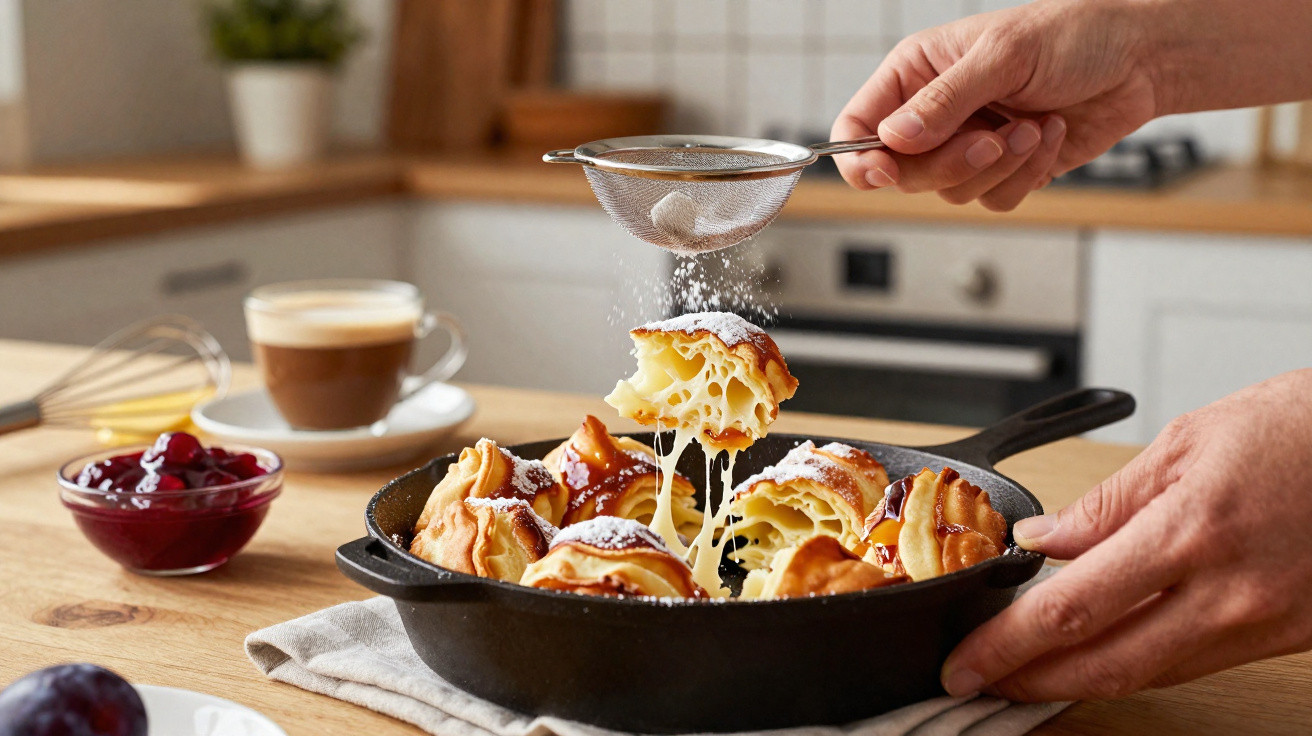
Kaiserschmarrn originated in Austria, where it has long appeared on café menus alongside sachertorte and apple strudel. At first glance, it can seem slightly odd. Rather than a tidy circular crêpe or a stack of American pancakes, it consists of uneven golden batter pieces, split apart in the pan and heaped into a warm, sugary mound.
Its batter falls somewhere between a French crêpe mixture and that of a thick pancake. Flour, eggs, milk and sugar are used, with one important difference: the egg whites are whipped separately until light before being folded through. That straightforward technique adds air to the mixture, giving the finished dessert a delicate, almost soufflé-like consistency.
Think of kaiserschmarrn as the rule-breaking cousin of crêpes: intentionally torn, extra fluffy and designed to be shared straight from the pan.
Cafés traditionally serve it warm beneath a generous scattering of icing sugar, usually accompanied by a small pot of fruit compote. Visitors to Vienna soon discover that ordering kaiserschmarrn is almost a rite of passage, as familiar an experience as having a slice of sachertorte.
A royal story behind the “messy” crêpe
Although its name appears complicated, the meaning is fairly straightforward. “Kaiser” means emperor, while “Schmarrn” is an Austrian German term that can refer to nonsense, a mess or a scrambled dish. Culinary historians connect it with Emperor Franz Joseph I, who is said to have become fond of the rustic torn pancake and helped establish it as a fixture of imperial-era cooking.
A number of origin stories surround the dish. In one account, a chef attempted to prepare an elegant crêpe for the empress, but failed to turn it cleanly. He then served it in torn pieces, covered with sugar to disguise the damage. The emperor reportedly enjoyed it so much that the “mistake” remained on the menu.
A different version claims alpine farmers prepared substantial pancakes from leftover ingredients, shredding them in the pan to feed workers quickly. In time, the dish travelled from mountain huts to palaces and eventually into city cafés.
How this Austrian “scrambled pancake” differs from what you know
Texture over perfect shape
French-style crêpes are all about accuracy: thin, round and smooth, then carefully folded. Kaiserschmarrn takes the opposite approach. The batter is cooked more thickly, rather like one large pancake. Halfway through, rather than neatly transferring it to a plate, the cook uses a fork or spatula to break it into rough pieces.
By tearing the pancake, more of its surface meets the heat. This creates greater caramelisation, additional crisp edges and a stronger contrast between the soft middle and the browned exterior.
With kaiserschmarrn, the “failed flip” becomes the goal: the dessert celebrates broken pieces rather than hiding them.
Egg whites that act like a secret weapon
One technical step has a major effect: whisking the egg whites separately. When they are beaten with a pinch of salt until soft peaks form, then carefully folded into the batter, home cooks hold air within the mixture. That air expands during cooking, producing a result much fluffier than most ordinary crêpes.
The method is similar to techniques used by pastry chefs for soufflés, chiffon cakes and certain waffles. Anyone accustomed to dense pancakes may find a well-made kaiserschmarrn unexpectedly light on the first bite, almost like a sweet omelette combined with sponge cake.
Inside a classic kaiserschmarrn recipe
Recipes made at home differ, but the foundation of a traditional batter is usually close to the following:
- 3 eggs, separated into yolks and whites
- 150 g flour
- 2 tablespoons sugar
- 250 ml milk
- A pinch of salt for the whites
- Butter for the pan
The process has a clear sequence. First, the egg whites are beaten with salt until airy and able to hold their form. In a separate bowl, flour, sugar, egg yolks and milk are whisked together into a smooth batter. The whites are then gently folded in over several additions, preventing the foam from being knocked out.
The resulting mixture is considerably lighter than a usual pancake batter. It is poured in one thick layer into a buttered pan. The pan is covered for several minutes, allowing the batter to rise and firm up, before the entire pancake is turned as though it were a giant omelette.
Rather than serving it whole, the cook deliberately uses a fork or spatula to tear the pancake into irregular pieces while it remains in the pan. The chunks cook a little longer, absorbing butter and colouring around their edges before being served immediately.
Toppings that matter more than presentation
Plain kaiserschmarrn is already rich, but toppings firmly place it in dessert territory. In Vienna, it is often presented with a heavy dusting of icing sugar and lightly sweetened plum or apple compote on the side. The tender fruit helps balance the richness of the buttery batter.
Contemporary versions extend well beyond the traditional approach. Home cooks and social media bakers serve the torn pancake with whatever ingredients they have available:
- Quick raspberry jam with chia seeds
- Runny honey or maple syrup
- Hazelnut or chocolate spreads
- Peanut butter and sliced bananas
- Caramel sauce and toasted nuts
The dish works almost like a blank canvas: not pretty in a classic sense, but ready to carry fruit, sauce, spices or chocolate.
Its small, uneven pieces take on sauces in a different way from a flat crêpe. Certain edges remain crisp while the centres absorb cream or compote, so every forkful offers a slightly different combination.
Why this “broken” crêpe fits current food trends
Kaiserschmarrn is arriving at a time when social media feeds increasingly favour food that looks real rather than overly styled. Posts featuring imperfect, tactile dishes can create more engagement than precisely symmetrical pastries. A pan filled with torn golden pieces and dusted with sugar suits this appetite for texture and spontaneity.
The recipe also reflects a wider move towards comfort food with a sense of heritage. It brings together nostalgia, a place-based story and a technique that beginners can manage. For parents, it can become a weekend breakfast that children help to tear up. For hosts, it works as a dessert designed for sharing from the middle of the table.
From Vienna coffee houses to home brunch tables
In Austria, kaiserschmarrn comfortably sits between dessert, an afternoon snack and fuel for the mountains. Skiers order it in alpine huts, office workers have it with coffee at 4 p.m., and families make it on unhurried Sundays. This flexibility also makes it simple to fit into British or American routines.
For brunch enthusiasts already alternating between pancakes, waffles and French toast, kaiserschmarrn provides another choice without requiring specialist equipment. A single pan, a bowl and a whisk will do. The recipe is forgiving of small mistakes: should the pancake flip badly or tear at an awkward moment, the outcome still suits the dish’s character.
| Dish | Texture | Typical shape | Serving style |
|---|---|---|---|
| French crêpe | Thin, flexible | Round, flat | Folded or rolled, individual |
| American pancake | Fluffy, cakey | Round, stacked | Portion per person |
| Kaiserschmarrn | Airy, torn, slightly crisp at edges | Irregular chunks | Shared plate or pan in the centre |
How to adapt kaiserschmarrn to modern kitchens
Alongside the classic recipe, cooks have started adapting kaiserschmarrn for dietary requirements and individual preferences. Some replace part of the wheat flour with ground almonds or spelt for a nuttier taste. Others use less sugar in the batter and rely on fruit sauce for sweetness, an approach that may appeal to people monitoring their sugar intake.
Gluten-free alternatives use buckwheat or rice flour. The whipped whites continue to provide structure, keeping the texture comparatively light. Those avoiding dairy use oat or almond milk along with plant-based butter alternatives, with reasonable results, particularly when the dish is paired with bold toppings such as berries or citrus.
Home bakers also experiment with additions, including rum-soaked raisins, lemon zest stirred through the batter or cinnamon combined with sugar for added fragrance. The essential point is not to overload the mixture, as too many additions can reduce the lift produced by the whipped egg whites.
What kaiserschmarrn says about our changing attitude to “failed” food
This dessert gently challenges a familiar concern in home cooking: the worry about getting things wrong. Many people avoid making crêpes because they fear ragged edges, patchy colouring or a disorderly first try. Kaiserschmarrn turns that concern into part of its appeal. It succeeds precisely because it does not remain in one smooth, intact piece.
That attitude offers practical advantages. Beginners can concentrate on taste and texture rather than visual symmetry. Children can help pull the pancake apart in the pan, learning that deliberately breaking something can be a recipe step. Content creators get a dish that looks good on video, with visible steam and movement rather than an unmoving plate.
Kaiserschmarrn gives home cooks a rare permission: you are supposed to tear it, not fix it.
For anyone who likes crêpe batter but rarely manages an Instagram-perfect circle, this Austrian cousin provides an alternative centred on comfort, shared dishes and the occasional crumb on the table. The technique remains approachable, the ingredients are familiar, and the finished dish works equally well for mornings, slow afternoons or late-night raids on the kitchen.

















Comments
No comments yet. Be the first to comment!
Leave a Comment