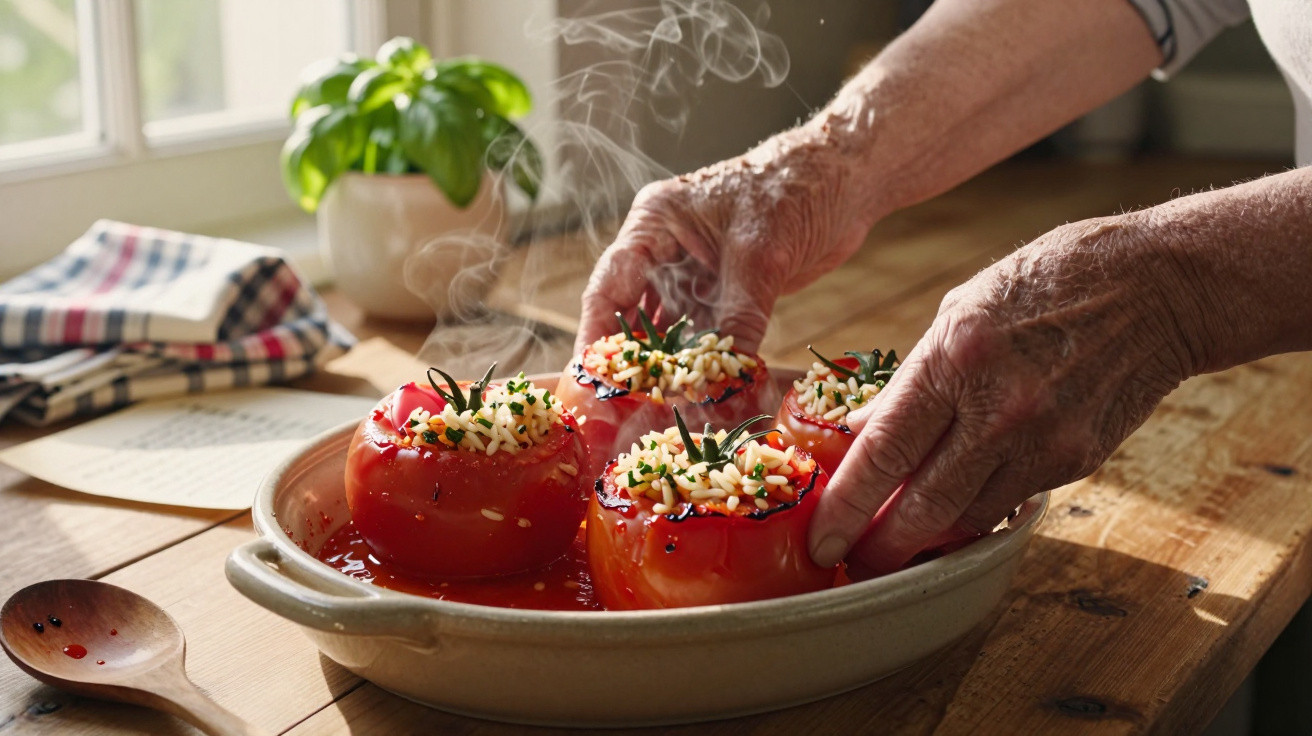
There are dishes that quieten the whole house before they even reach the table. Stuffed tomatoes are one of them: the oven breathes softly, the juices stain the base of the dish, and someone invariably asks whether the rice has properly cooked in the sauce. In my grandmother’s kitchen, the tomatoes were never arranged in perfect rows. Some leaned to one side, others had lost their little lids, yet they smelled of garlic, parsley and slow-cooked meat in a way no sophisticated dish could match. We all know how one simple scent can take us back twenty years. The secret here is not a complicated method, but plenty of juices, a filling that stays moist, and the unhurried patience of Sunday meals. This is a dish worth taking time over.
Why grandmother’s stuffed tomatoes remain impossible to imitate
A proper batch of grandmother’s stuffed tomatoes is not trying to look photogenic; it is made to taste wonderful. The skin wrinkles slightly in the heat, the flesh turns meltingly soft, and the filling gently rises beneath its red lid. With the first forkful, what stands out is the contrast between the richly flavoured meat and the tender, almost confit rice, which has absorbed everything that matters: tomato juice, a little stock, the roasting juices and, sometimes, a splash of white wine. The rice does more than accompany the dish: it becomes its memory.
In many households, this recipe was also a way of wasting nothing. A slice of stale bread soaked in milk, leftover sausage meat, a few herbs from the garden and very ripe tomatoes were enough to feed six people. My grandmother would usually allow two tomatoes per adult and one for each child, with around 180 grams of uncooked rice in the bottom of the dish. There was seldom anything left the following day. If one tomato did remain, it was even better cold, tucked between two slices of bread with a pinch of salt.
The difference comes down to a detail that is easy to overlook: the tomatoes need to be ripe enough to release juice, but not so soft that they collapse. Ribbed varieties or good round market tomatoes both work beautifully, provided they feel heavy in the hand. Never discard the scooped-out flesh; add it to the filling or the bottom of the dish, where it provides valuable moisture. A dry stuffed tomato is often one that has been hollowed out too thoroughly or not basted enough. Family cooking knows these small truths without needing to write them down.
The generous stuffed tomatoes recipe: juicy filling and rice cooked in the juices
For six people, you will need twelve medium tomatoes, 500 grams of sausage meat, 250 grams of minced beef, two onions, two garlic cloves, a generous handful of parsley, one egg, two slices of stale bread, 20 centilitres of milk and 250 grams of long-grain rice. Slice off the lids, scoop out the tomatoes with a spoon, then lightly salt their insides before turning them upside down on a rack for twenty minutes. It may seem an ordinary step, but it stops the dish from becoming too watery. Keep the removed pulp, roughly chop it, and use it to create the cooking juices.
Soften the sliced onions in a drizzle of olive oil until translucent, then stir in the garlic and tomato pulp. Take the pan off the heat and combine this mixture with the meats, squeezed bread, parsley, egg, salt and pepper. Fill the tomatoes without packing the mixture in too firmly: the filling should remain loose enough to cook through without becoming dense. Arrange them in a large oiled oven dish, then scatter the rinsed rice around them. Pour in roughly 60 centilitres of hot stock, a little of the reserved pulp and a spoonful of diluted tomato purée.
Bake at 180 °C for around one hour, checking the liquid level halfway through cooking. My grandmother’s rule was simple:
“The rice must drink the juices, not swim in them.”
To achieve that balance, keep these pointers in mind:
- baste once or twice with the juices from the bottom of the dish;
- add a little hot stock if the rice appears dry;
- cover the dish with foil for the first 30 minutes if the tomatoes are browning too quickly;
- leave it to rest for ten minutes out of the oven before serving.
Let us be honest: nobody really makes this every day. But when they do, the meal feels quite different.
The small details that genuinely transform the result
The most common mistake is cooking the rice separately, then spooning it around the tomatoes at the last minute. It is convenient, of course, but it loses the almost magical part of the recipe: grains becoming fragrant through direct contact with the juices. You must also resist the urge to flood the dish with water or stock. Too much liquid produces bland rice and washed-out tomatoes; too little leaves the rice crunchy and stuck to the base. The right balance is visible: a lively, thick, orange-red layer of sauce that is still gently bubbling when the dish comes out of the oven.
If the filling seems too compact, stir in a spoonful of tomato pulp or a little milk, without turning the mixture into a purée. A successful filling stays moist and slightly uneven, with noticeable pieces of onion and herbs. Some people add veal, while others replace part of the sausage meat with minced pork; these variations work well as long as they retain the fat needed for cooking. Fat is not a flaw here: it carries flavour. With meat that is too lean, the dish can become disappointing despite every effort.
This meal also welcomes each household’s own habits. A bay leaf in the stock, a few sprigs of thyme, a touch of sweet paprika or even a small piece of chopped courgette in the filling: nothing is off limits as long as tomato remains the central flavour. Serve the tomatoes piping hot, straight from the dish, with a crisp green salad and bread for mopping up the juices. Children often start with the rice, adults with the tomato, and then everyone ends up scraping up the sauce. It is not especially formal. That is precisely what makes it precious.
| Essential point | Detail | Benefit for the reader |
|---|---|---|
| Ripe, firm tomatoes | Choose weighty, juicy tomatoes that can hold their shape in the oven | Melting flesh without collapsed tomatoes |
| Loose filling | Mixed meats, soaked bread, tomato pulp and fresh herbs | A juicy filling that never dries out |
| Rice cooked in the dish | Slow cooking with stock and tomato juices | A fragrant accompaniment that absorbs every roasting juice |

















Comments
No comments yet. Be the first to comment!
Leave a Comment