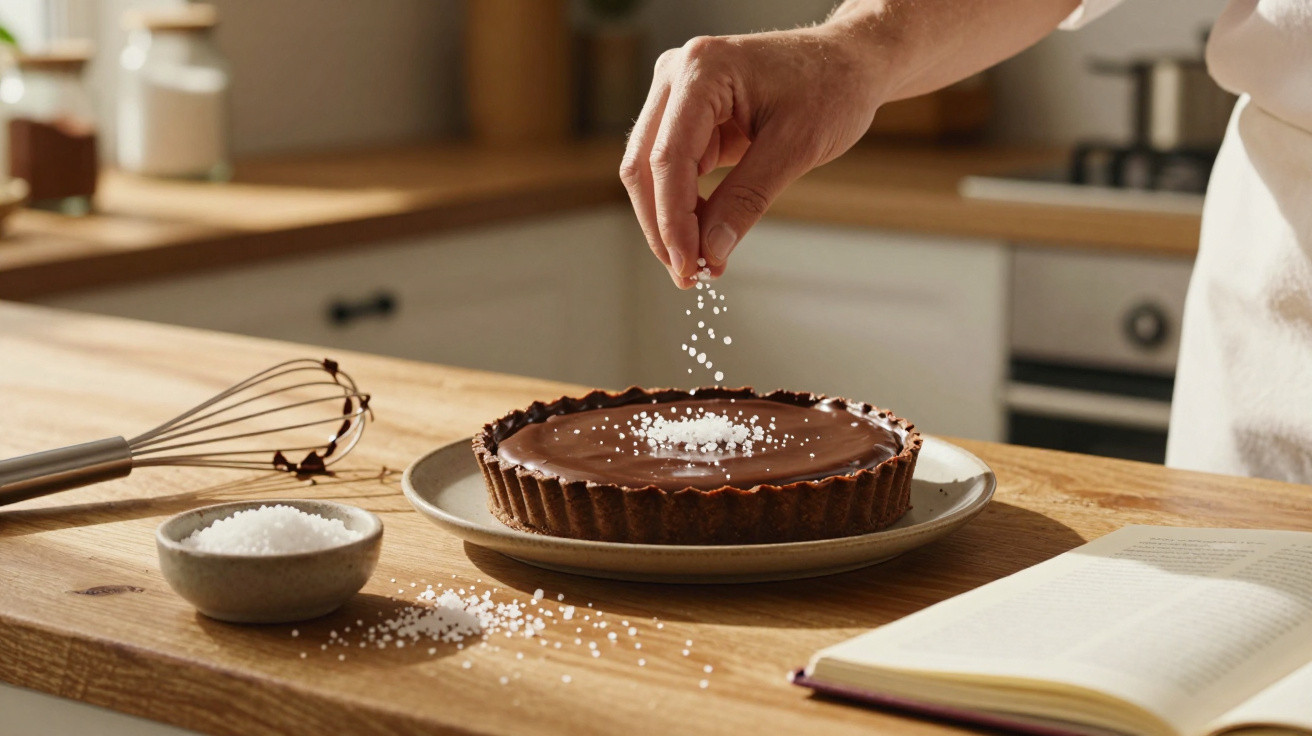
Fresh from the oven, the cake fills the kitchen with the scent of warm butter and vanilla. Yet the first bite reveals that something is not quite right: it is sweet-very sweet, in fact-but not especially good. We have all had that experience, when a recipe followed exactly still seems to lack depth. Then we check the ingredients list and spot an understated instruction: a pinch of salt. Not enough to be recognisable on the tongue, but enough to transform the whole result. In professional kitchens and family homes alike, pastry chefs value it almost as highly as eggs or flour. This tiny addition is far from a chef’s whim; it is based on a surprisingly precise mechanism.
A pinch of salt can transform a dessert
Salt is not meant to steal the show in baking. It works quietly in the background, rather like soft lighting that makes a tart look more tempting in a shop window. A salted caramel cream without salt can taste heavy and almost one-dimensional; add a carefully measured few grains, and the butter comes through more clearly, the caramel gains depth, and sugar stops overwhelming everything else. Salt brings out flavours that are already present, without turning a financier into a savoury biscuit. It often creates that hard-to-describe feeling that “there is something extra”. And that extra is very often sitting on the tips of your fingers.
The effect is especially noticeable in chocolate desserts. A sensory study frequently cited in the food industry suggests that a small amount of sodium can lessen the perception of bitterness while boosting certain aromatic notes. This is why a lightly salted brownie can sometimes taste more intensely chocolatey than one packed with cocoa. Well-loved classics have recognised this for years: Breton salted butter caramel, American cookies scattered with flakes of sea salt, and dark chocolate served with a few crunchy crystals. The contrast appeals because it simply wakes up the palate.
Our tongues detect several basic tastes, including sweet, salty and bitter. Used sparingly, salt partly disrupts bitterness signals and makes sweetness seem cleaner and rounder, without the need to add more sugar. It is particularly useful in recipes containing cocoa, coffee, underripe fruit or nuts. Salt does not necessarily make a dessert salty: it makes it more lively. It also changes the mouthfeel, adding a slight edge that prevents the second spoonful from becoming tiresome.
The right salt at the right stage: details make the difference
For cake batter, custard or sponge, fine salt is the simplest option. Add it with the dry ingredients so that it disperses evenly throughout. A pinch generally equals around 0.5 grams, although the amount will depend on the size of the recipe and the product being used. For a cake serving six to eight people, a quarter teaspoon is often enough. Salt should support the other ingredients, not overpower them. When in doubt, start with a modest amount, taste the mixture where possible, then adjust carefully.
Butter is the most common source of confusion. A recipe developed with unsalted butter will not behave in the same way if salted butter is used, particularly for shortbread, cookies or pastry. Many people have had this minor mishap: they add the stated pinch without considering the butter, and the dessert takes on an odd character. It is not disastrous, but the sugar then loses its balance. Let us be honest: hardly anyone weighs out 0.6 grams of salt every day. Simply keeping this in mind can prevent plenty of disappointments.
Flaked sea salt, meanwhile, is often best added at the end: just before baking certain biscuits, or when plating a chocolate mousse. Its crystals provide occasional, almost unexpected bursts, whereas fine salt disappears into the mixture.
“In patisserie, salt is punctuation: you should not read it in every word, but you should feel that the sentence stands up,” summarises a pastry chef.
- Fine salt: ideal for doughs, creams and smooth mixtures.
- Flaked sea salt: excellent as a finishing touch for chocolate, caramel or cookies.
- Salted butter: factor it into the calculation before adding another pinch.
Salt in desserts does more than enhance flavour: it also affects texture
Salt’s purpose goes beyond flavour. In yeasted doughs, it slows and regulates the action of yeast while helping the gluten network become more structured. A brioche made without salt may rise quickly, yet lack structure and taste surprisingly flat. In shortcrust pastry, it can also highlight the butter while making the finished result feel less greasy. Professionals understand this: a successful recipe rarely depends on one spectacular ingredient. Instead, it comes from a succession of tiny details, repeated with care.
This principle also explains the renewed popularity of sweet-and-salty desserts. Vanilla ice cream with a drizzle of salted caramel, apple tarts sharpened with a touch of miso, and dark chocolate ganaches finished with a few flakes of sea salt are all increasingly common. The aim is not to follow a trend for the photograph. It responds to a very real desire for clear, less uniform flavours that linger in the memory. A dessert does not need to be sweeter to feel indulgent; it simply needs to make you want another bite.
The next time a loaf cake tastes bland or a mousse seems overly sweet, the answer may not be another spoonful of sugar. A pinch of salt can put flavours back in their proper place and restore character to a familiar recipe. Everyone has a memory: Sunday pancakes, a grandmother’s pound cake, or a still-warm cookie eaten standing in the kitchen. Trying this small adjustment also means learning to listen to what you eat. And sometimes, a table-side debate begins with barely three grains.
| Key point | Detail | Benefit for the reader |
|---|---|---|
| Salt reveals flavour | It softens some bitterness and highlights the aromas of chocolate, butter and caramel. | A dessert can seem more intense without automatically increasing the amount of sugar. |
| Dosage matters | Fine salt is mixed into preparations, while flaked sea salt is often used as a finishing touch. | Choosing the right type prevents an overly dominant salty flavour. |
| Butter changes the rule | Salted butter already contains salt, so the recipe needs to be adjusted. | A simple habit that preserves the balance of a cake, pastry or cream. |

















Comments
No comments yet. Be the first to comment!
Leave a Comment