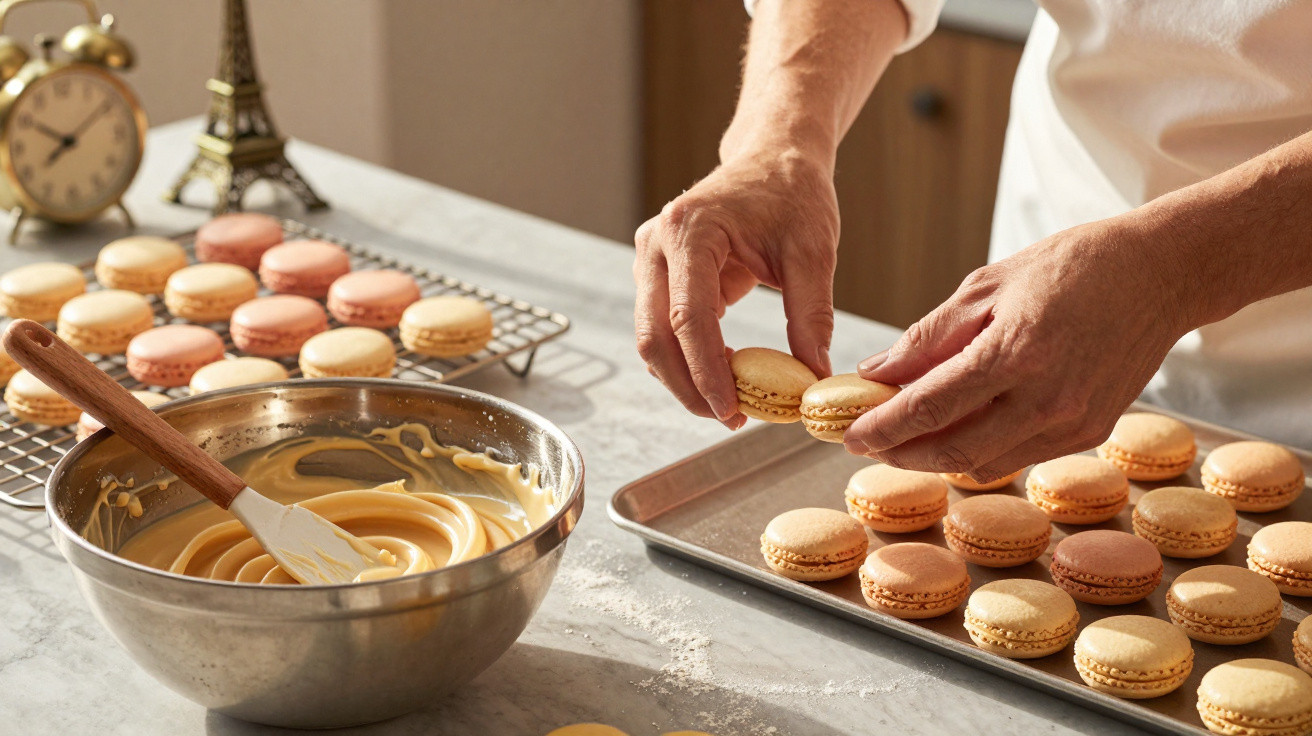
On a rainy Sunday, the kitchen fills with the scent of warm almonds and sugar. On the baking tray, the shells have just left the oven: some are cracked, two have slipped sideways, while three have developed a lovely pied... and then doubt sets in. We all know that moment when we wonder why the macarons in shop windows look flawless while ours seem to be on an adventure of their own. Pierre Hermé has turned this small round confection into an exercise in precision and pleasure. His secret is not a magic formula reserved for professional chefs. It lies in a sequence of unhurried movements, respected ingredients and, above all, an acceptance of time. Macarons cannot be rushed. They have to be earned. That is precisely what changes everything.
Pierre Hermé’s real secret begins before the oven
At Pierre Hermé, a macaron is never regarded as a mere sweet to make between appointments. Success starts on the worktop, with carefully prepared dry ingredients and egg whites that have not come straight from the fridge. This care may seem tiny, almost obsessive, yet it prevents many failures. Almond flour that is too damp, compacted icing sugar or egg whites that are too cold can each upset the texture. The outcome is immediately visible: dull shells, an uneven surface, or that famous pied that simply refuses to appear.
In pastry kitchens, every gram matters. For a standard batch, quantities are often around 100 grams of almond flour, 100 grams of icing sugar, 100 grams of egg whites and 100 grams of sugar, depending on the method used. At home, the most common mistake remains approximating. One extra spoonful may seem harmless, until the mixture becomes too runny. Macarons are not very forgiving, but they teach a great deal to those who try again. Even a basic set of scales soon becomes the home baker’s most valuable tool.
The method Pierre Hermé helped make famous also relies on balance. The shell should be thin and lightly crisp, with a tender, almost soft centre that holds the ganache without collapsing. This texture is not the result of luck. It comes from a controlled combination of meringue and the tant pour tant, the pairing of almond flour and icing sugar. Macaronage must remove some air without destroying the entire structure. If it is worked too little, the mixture keeps a peak and cracks. If it is overworked, it spreads like a rather sad pancake.
Macaronage and resting: the Pierre Hermé techniques that matter
To master this essential macaronage, Pierre Hermé suggests a simple principle: watch the mixture rather than blindly counting spatula turns. Using a silicone spatula, bring the mixture from the sides towards the centre, then gently press it against the bowl. When it falls, it should form a supple, glossy, unbroken ribbon. It must neither remain stiff nor flow like a sauce. This ribbon is the real green light: it tells you more reliably than a timer whether the mixture is ready for piping.
Next comes the stage many people want to skip: resting the shells. The piped macarons are left in the open air until a thin skin forms and the surface no longer sticks to a fingertip. Depending on the humidity in the room, this can take 20 minutes, 40 minutes or sometimes longer. Let us be honest: nobody manages this every day with perfect patience. Even so, this rest helps the shells rise neatly in the oven and encourages the pied to form. On rainy days, beside a pan of boiling water or in a poorly ventilated kitchen, the wait will be longer. That is entirely normal.
Baking also calls for a little humility. Every oven has its own personality: one runs hot at the back, another browns the tops too quickly, while a third displays 150 °C when it is actually reaching 165 °C. An oven thermometer can save many batches from being sacrificed.
“Precision takes nothing away from indulgence: it simply gives it a chance to exist.”
- Use egg whites at room temperature.
- Sift the almond flour and icing sugar together.
- Tap the baking tray to release air bubbles.
- Leave the shells to rest until the surface feels dry to the touch.
- Allow the shells to cool completely before removing them.
Filling and resting: the detail too often overlooked
The final secret associated with the Pierre Hermé signature comes after baking. Attractive shells alone are not enough: a macaron becomes truly memorable once it has rested after filling. Chocolate ganache, lemon cream, intensely flavoured jam or salted butter caramel slowly transfer their moisture to the shells. After 24 hours in the fridge, the magic happens: the contrast between the crisp exterior and melting centre becomes more distinct. The best macaron is rarely the one tasted straight away. Take it out around twenty minutes before serving so that its aromas can return.
This patience also changes how we view minor imperfections. A shell that is slightly less round does not diminish the pleasure of sharp raspberry or deep praline. Pierre Hermé’s patisserie is often admired for its appearance, but it remains above all a story of flavour, texture and memory. Begin with a straightforward ganache made from chocolate and hot cream before trying more daring pairings. An imperfect first batch will often disappear very quickly around the table. Children, after all, never study symmetry for very long.
Making reliable macarons does not therefore mean producing forty identical pieces on the first attempt. It means understanding what happened, noting the temperature, assessing the consistency and adjusting one detail next time. Pierre Hermé’s secret is less a dramatic trick than a gentle discipline: weigh, observe, wait and taste. There is something reassuring about this approach in our hurried kitchens. It reminds us that indulgence can also be an exercise in being present. And that a slightly uneven pied can become the start of a wonderful habit.
| Essential point | Detail | Added value for the reader |
|---|---|---|
| Precise weighing | Ingredients measured to the nearest gram | A more stable mixture and even shells |
| Observed macaronage | A mixture that falls in a smooth ribbon | Fewer hollow or spread shells |
| Resting after filling | 24 hours chilled, then brought back to temperature | A melting texture and clearer flavours |

















Comments
No comments yet. Be the first to comment!
Leave a Comment