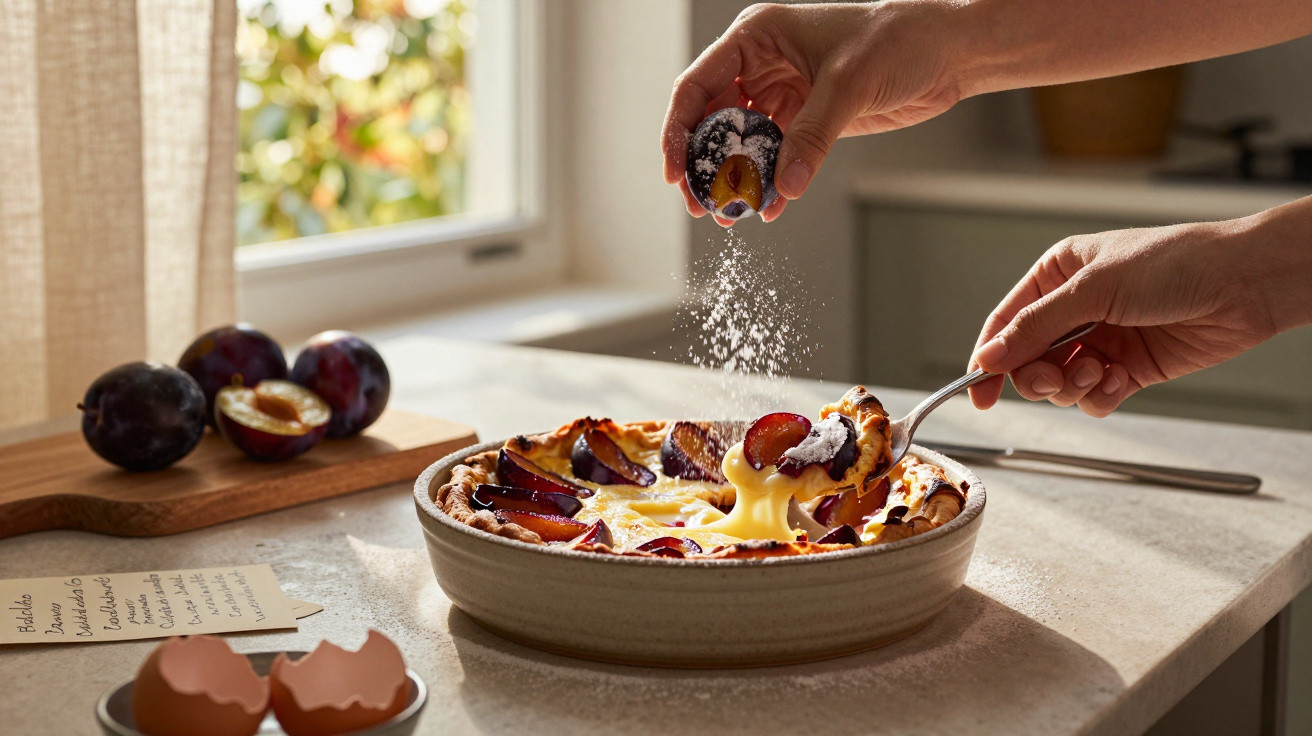
At the market, plums often appear with the unassuming presence of fruit that has no idea how much we will miss it. They still spill from crates in shades of purple, red and pale yellow, while the first cool mornings send us looking for jumpers at the back of the wardrobe. Then, within days, they become scarcer and more expensive, and we wish we had bought that small kilogram we noticed the week before. We all know the moment: arriving home with fruit that is a little too ripe and no clear plan for using it. Plum clafoutis turns that chance purchase into a genuine pleasure at the table, with its tender batter, lightly tart fruit and scent that makes summer seem to linger a little longer. Now is the time to make it.
Plum clafoutis, the dessert that holds on to summer's final days
There is something deeply comforting about a dish of clafoutis coming out of the oven, particularly once the plums have begun to release their juices around the edges. The recipe may look unremarkable on paper, yet it has the special appeal of a family dessert: it welcomes bruised fruit, leftover milk and even the urge to bake that arrives late in the day. With plums, it has a sharper character than it does with cherries, and is less sweet too. Their skins wrinkle, their flesh melts, and their colour gently seeps into the batter. One spoonful explains why this dessert returns every year.
In many kitchens, clafoutis begins with a very practical urgency: the fruit needs using before it spoils. A study from ADEME notes that almost 30 kg of still-edible food is wasted per person each year in France, with fresh fruit often among the main casualties. Three or four plums that are too soft to eat as they are can be ideal beneath a light batter. One reader recently recalled making her first damson clafoutis with fruit left forgotten in her mother's shopping bag. It has been their September ritual ever since.
This dessert also succeeds because of its balance. Plums bring a natural acidity that offsets the richness of eggs, milk and sugar, while a touch of vanilla or almond is enough to create the fragrance of a Sunday cake. It is not a display-case dessert, and that is precisely why it is so endearing. Eat it warm or cold, at teatime or after a slightly improvised meal. Let us be honest: nobody really makes it every day. Yet the simplest recipes are often the ones remembered longest.
The easy plum clafoutis recipe that lets the fruit shine
For a generous plum clafoutis serving six to eight people, use around 600 g of plums, damsons or greengages, depending on what you can find. Wash them, halve them and remove the stones, then arrange them in a buttered baking dish with the cut sides facing upwards so they hold some of their juice. Next, whisk 3 eggs with 80 g of sugar, then add 100 g of flour, 25 cl of whole milk and a pinch of salt. Pour the batter gently over the fruit without trying to cover it completely. Bake at 180°C for 35 to 40 minutes, until the top is golden while the middle remains soft.
The most common mistake is adding too much sugar for fear that the plums will be tart. Yet that lively edge is exactly what makes the dish appealing. If the fruit is very ripe, 60 g of sugar may be enough; if it is firm and tangy, increase the quantity slightly, but keep a light hand. A little ground almond works particularly well in the batter, as does a spoonful of dark rum or a few vanilla seeds. Simply avoid piling on too many flavours. Clafoutis does not need a disguise to win people over.
The detail that makes all the difference comes before baking: leave the plums in the dish for ten minutes with a spoonful of sugar and a few drops of lemon juice. They will start to produce a light syrup, flavouring the batter without making it soggy. Plum season is short, so it is better to rely on their true flavour than on unnecessary embellishments.
“A good clafoutis does not aim for perfection: above all, it should taste of the fruit you wanted to save.”
- Choose ripe plums that are still firm enough to cut cleanly.
- Butter the dish thoroughly so that the edges develop that much-loved thin golden crust.
- Leave the dessert to rest for twenty minutes after baking: it will hold its shape better and develop more flavour.
- Serve with a spoonful of crème fraîche if the plums are particularly tart.
Small touches that turn this dessert from good into memorable
A plum clafoutis may look extremely straightforward, but it does not respond well to haste. Batter mixed too vigorously can become elastic, fruit piled in carelessly releases too much water, and opening the oven every five minutes makes the mixture sink. Stir only until the lumps have disappeared, then trust the baking process. The centre should still have a slight wobble when you take the dish out; it will continue to set as it cools. That brief wait is often the hardest part, especially when the kitchen already smells of warm butter and caramelised fruit.
If you enjoy contrasting textures, scatter a few flaked almonds over the top five minutes before the end of baking. They add crunch without stealing attention from the plums. For a more rustic version, replace one third of the flour with ground hazelnuts: the pairing is especially successful with damsons. Children sometimes prefer greengages, which are rounder and sweeter, while adults often return to purple plums for their bolder flavour. There is no single correct version, only the one that suits the fruit on your worktop.
This dessert also saves you from hunting for complicated recipes when guests announce themselves at the last minute. It uses few utensils, takes around fifteen minutes to prepare and can go straight to the table in its baking dish, without delicate decoration or intimidating plating. Plum clafoutis forgives almost everything, including batter that is not perfectly smooth or unevenly cut fruit. Just watch the colour: if the top browns too quickly, lay a sheet of baking paper loosely over it. The finished result should stay tender, never dry.
A seasonal dessert that tells a story beyond the recipe
Making a plum clafoutis often means accepting that summer will not remain at the table forever. Days grow shorter, market stalls change colour, and sun-filled fruit soon gives way to apples, pears and the first citrus fruits. This recipe offers a modest way to mark that transition, without forced nostalgia. It brings together familiar actions: cutting, mixing, waiting and sharing. It is also a reminder that the finest desserts are not always those requiring the greatest effort, but those that arrive at exactly the right time.
The dish can be passed around the table while still warm, with a spoon for everyone and a little icing sugar if the mood takes you. Some prefer it cold for breakfast the next day, once the batter has firmed up and the plum juices have soaked into every mouthful. Others do not even wait for it to cool. That small debate deserves to exist, just like memories of orchards, meals at grandparents' homes or fruit picked too early. A living recipe is rarely passed on unchanged, and that may be its finest quality.
| Key point | Detail | Benefit for the reader |
|---|---|---|
| Choosing the right plums | Ripe, fragrant fruit that is still firm limits excess juice while retaining a real presence after baking. | A more balanced clafoutis, with melting pieces of fruit and batter that does not turn watery. |
| Not adding too much sugar | The natural acidity of damsons, mirabelles or greengages gives the dessert definition and prevents heaviness. | The fruit remains at the heart of the flavour, with a fresher sensation in every mouthful. |
| Resting before serving | Twenty minutes is enough for the batter to settle and for the flavours of butter, milk and plums to develop. | Cleaner slices, a more pleasant texture and a dessert that is even better the following day. |

















Comments
No comments yet. Be the first to comment!
Leave a Comment