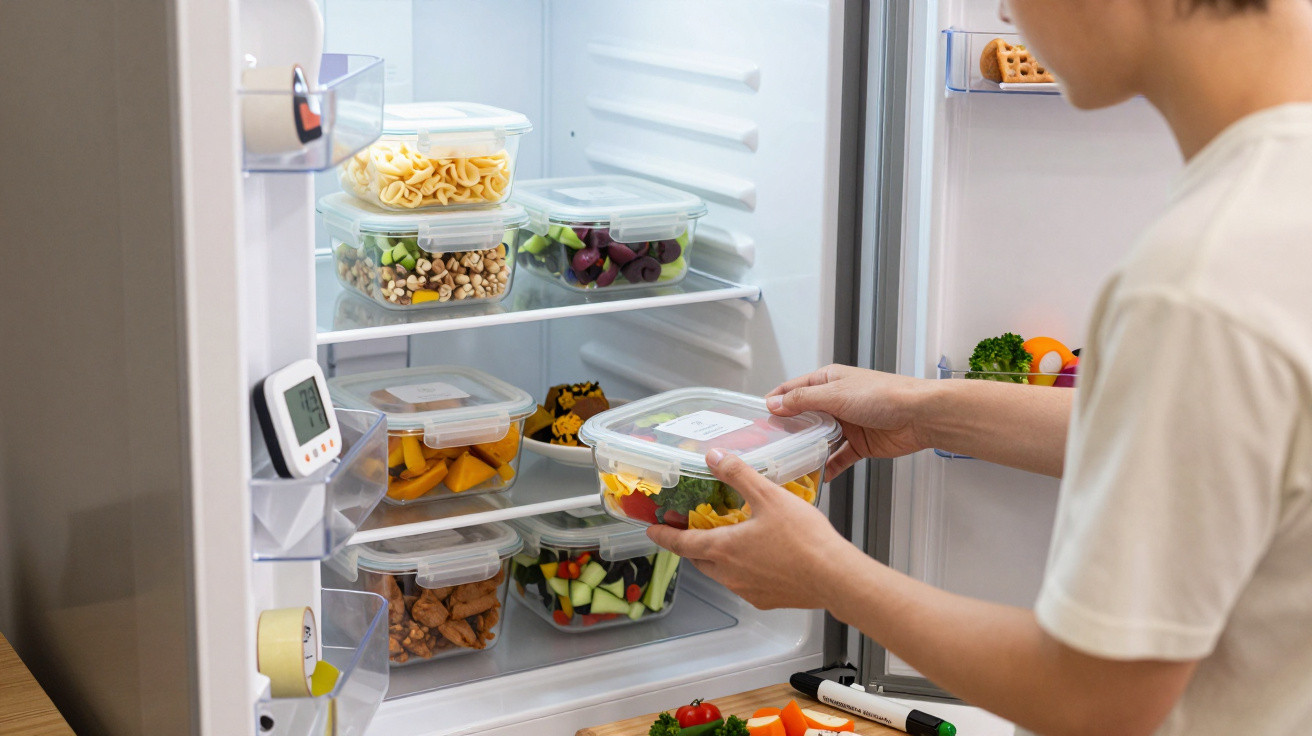
By Sunday evening, the fridge can often look like a miniature waiting room: leftover gratin in its dish, half a roast chicken hastily wrapped up, and a tub of rice that nobody can quite remember opening. We all know the moment: lifting the lid, pausing, and looking for a date that was written on a Post-it note now nowhere to be found. It smells fine and looks fine… but is that enough? Between not wanting to waste food and the very real risk of food poisoning, the gap can be narrow. Knowing the right storage times is not simply a matter of caution: it could also save Monday’s lunch. Here is what to remember.
Cold temperatures slow bacteria down, but do not eliminate them
A fridge is not a food safe. At 4 °C or below, it slows bacterial growth, yet some bacteria can still continue to develop, albeit very slowly, in sauce, pasta dishes or cooked meat. The key habit starts well before putting food away: leftovers should not sit on the table for two hours after a meal, let alone all evening in summer.
Picture a chilli con carne cooked on Tuesday night, then left in its casserole dish until midnight because the conversation carried on. The next day, it may still look completely appetising, but it has already spent too long in a temperature range that encourages microbes: between 10 and 60 °C. Risk does not always come with a smell. The most misleading cases of food poisoning are often those where food still looks immaculate.
Cautious guidance rests on a straightforward principle: the more water and protein a food contains, the more perishable it becomes after being cooked or opened. Washed green salad, fish, homemade dessert cream and cooked rice are not in the same category as a piece of bread. Storage time also depends on the actual temperature inside your appliance: many fridges display 4 °C, while the back section can sometimes reach 7 °C.
Food storage habits that genuinely extend fridge life
After eating, divide leftovers into small, shallow containers instead of allowing one large pan to cool for hours. Heat escapes more quickly, the middle of the dish reaches a safe temperature sooner, and portions are ready for the following day. Put them on the coldest shelf, which is often at the back, just above the salad drawer depending on the model.
Writing the date on a container can seem excessive when you are in a rush. Honestly, hardly anyone does it every day. Even so, a simple “lasagne, Tuesday” in wipe-clean marker prevents that familiar Friday-night uncertainty-the kind that ends with an entire container going in the bin when it could have been eaten in time.
Reheating matters just as much as storage: food should be steaming hot all the way through, then served straight away, and it is best not to reheat it more than once. One useful household rule comes down to three easy actions:
“When in doubt about a food’s history, let doubt keep it off the plate.”
- Cool leftovers promptly, ideally within two hours.
- Seal containers to prevent contamination and drying out.
- Keep in the fridge only what will genuinely be eaten over the next few days.
Leftovers in the fridge: a clear guide to safe storage times
The storage period most commonly recommended for a home-cooked dish is three days in the fridge, provided it was cooled and stored properly. This applies to gratins, soups, sauced dishes, cooked vegetables and prepared pasta. For delicate foods, such as fish or preparations containing raw eggs, the timeframe becomes much shorter: sometimes just one day.
It is important to separate the use-by date of a packaged product from the actual lifespan of food once it has been opened. Vacuum-packed ham may show several days remaining before it is opened, then last only three days afterwards. An opened pot of crème fraîche will not necessarily keep until the date printed on the tub, particularly if it has spent time on the worktop during cooking.
The freezer is a practical solution for dishes that will not be eaten quickly enough. Freeze them in portions, labelled with the date, while the food is still fresh; do not freeze a dish on its fourth day when you no longer even want to look at it. Freezing stops the clock; it does not reset it. Once defrosted in the fridge, leftovers must be eaten promptly and should not go back into the freezer unless they have been cooked again.
What you can see, what you cannot, and what should be thrown away
A sour smell, slimy texture, swollen packaging or mould are non-negotiable warning signs. In those cases, throw the food away, however frustrating that may be. The difficulty is that no visible sign guarantees safety: some harmful bacteria change neither the flavour nor the appearance of a dish, making storage times far more dependable than relying on a sniff test alone.
Pregnant people, young children, older adults and people with weakened immune systems should be particularly strict about these time limits. For them, a small lapse that has no effect on a healthy adult can lead to a genuinely unpleasant day, or even require medical advice. A waste-reducing meal must never become a health gamble. This caution matters especially for cured meats, seafood and ready-to-eat foods.
The good news is that being vigilant can make cooking easier. Cooking a little extra, planning two lunches, labelling three containers and keeping the food that needs eating first in plain sight: these habits cut waste without demanding military-level organisation. The fridge also tells the story of the week-impromptu meals and overfilled schedules. Sharing your own storage tips may help other households find a still-good lunch in a forgotten container rather than avoidable waste.
| Food or leftover | Recommended fridge storage time (4 °C or below) | Useful guidance for readers |
|---|---|---|
| Home-cooked dish: gratin, lasagne, quiche, sauced dish | 3 days | Transfer to a shallow container within two hours of cooking. |
| Cooked meat: roast chicken, steak, pork roast, meatballs | 3 to 4 days | Chicken and meat in sauce must be reheated thoroughly all the way through. |
| Cooked fish and cooked seafood | 1 to 2 days | Eat quickly: these are among the most delicate leftovers. |
| Cooked rice, pasta, couscous or potatoes | 3 days | Rapid cooling is essential, especially for rice. |
| Cooked vegetables, ratatouille, soup, mash | 3 to 4 days | Avoid leaving the entire pot to cool at room temperature for a long time. |
| Mixed salad with dressing, mayonnaise or eggs | 24 hours | Dressing and moist ingredients speed up deterioration. |
| Washed green salad | 2 to 3 days | Dry carefully and store in a container or bag with kitchen paper. |
| Peeled hard-boiled eggs | 2 days | Up to 7 days if kept in their shells. |
| Homemade preparation containing raw eggs: mousse, tiramisu, mayonnaise | 24 hours maximum | Reserve for people who are not vulnerable and keep chilled without interruption. |
| Opened cured meats | 3 days | Reseal carefully and do not exceed the date stated after opening. |
| Opened vacuum-packed ham | 2 to 3 days | Also follow the specific instruction shown on the packaging. |
| Opened fresh cheese, cream cheese or ricotta | 2 to 3 days | Use a clean utensil every time you serve it. |
| Opened crème fraîche | 3 to 4 days | Return to the fridge immediately after use; do not leave it on the table. |
| Pizza or takeaway dish | 3 days | Refrigerate as soon as you get home, not at the end of the evening. |

















Comments
No comments yet. Be the first to comment!
Leave a Comment