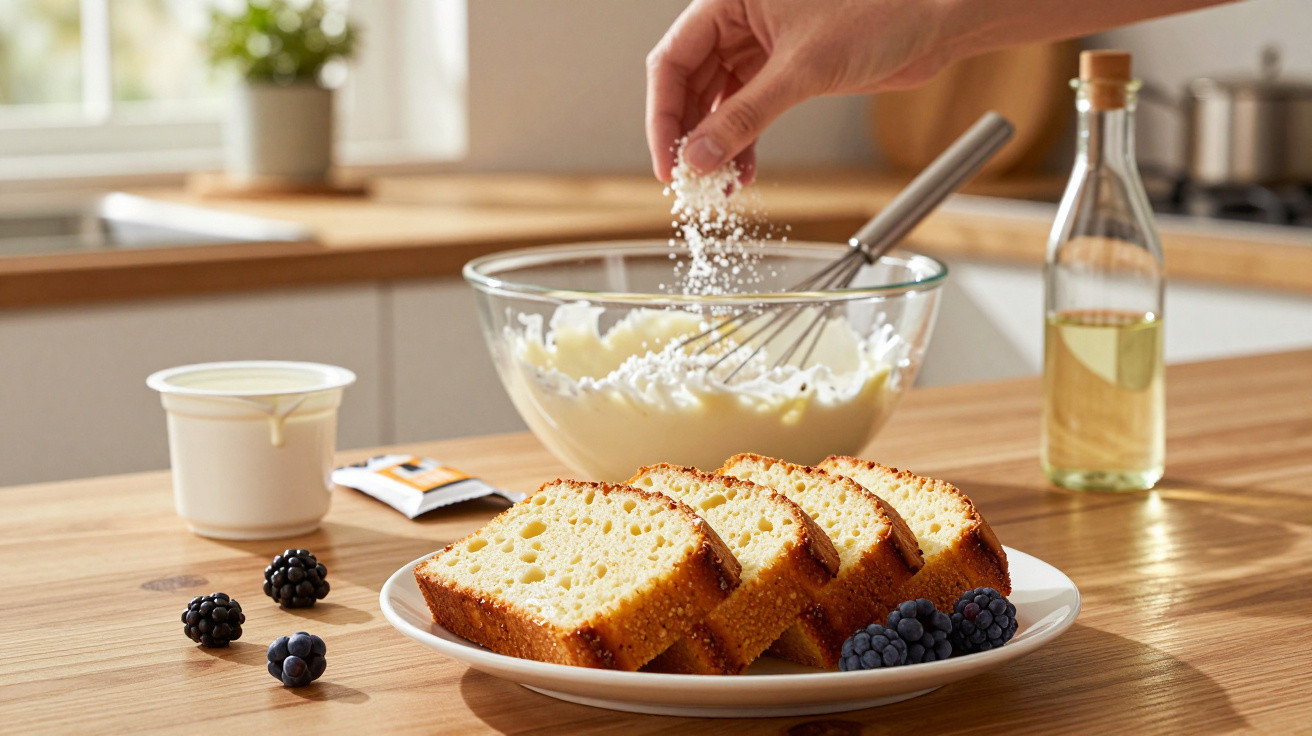
Many people will recognise this: straight from the oven, a yoghurt cake is wonderfully soft, yet by the following day it can be dry and crumbly. Preventing this does not require a professional oven, a stand mixer or an exotic superfood. One modest powder from the supermarket shelf is enough to help the cake stay surprisingly moist for longer.
Why a classic yoghurt cake so often turns out dry
The basic mixture is straightforward and popular, especially because it does not require a measuring jug. The familiar yoghurt-pot method typically uses:
- 1 pot of yoghurt
- 2 pots of sugar
- 3 pots of flour or other dry ingredients
- 1/2 pot of oil
- 3 eggs
- 1 sachet of baking powder
Even so, the result can easily go wrong. On baking day, the cake may seem light and fluffy, but by the next morning the crumb can be cracked, heavy and dry. Two common mistakes often combine to cause this: mixing for too long and baking at excessive heat.
Wheat flour contains gluten. When a batter is beaten vigorously, it develops a strong gluten network. That is ideal for bread, but it can create too much structure in a soft sponge cake. The texture then becomes rubbery and the crumb turns dense.
"The answer is not an elaborate technique, but an inconspicuous powder: cornflour made from maize."
The “mysterious” packet: cornflour as the game changer
The key lies in what is known as the 50 per cent rule. Rather than using wheat flour for the entire flour portion, replace precisely half of it with maize-based cornflour. Products such as Maizena are the classic choice, although any pure maize cornflour will do the same job.
For a yoghurt-pot cake, the formula is:
- 1.5 pots of wheat flour
- 1.5 pots of cornflour (maize starch)
- making 3 pots of dry ingredients in total
Put the flour, cornflour and baking powder into a bowl, then sift them together thoroughly once. Sifting not only aerates the blend; it also distributes the baking powder evenly and prevents lumps of flour. Only after this should the dry mixture be added to the batter.
How to mix the yoghurt cake batter step by step
The method remains exceptionally simple, but a few details make all the difference:
- Place the yoghurt and sugar in a bowl, then mix briefly.
- Add the oil, followed by the eggs one at a time.
- Tip in the sifted flour, cornflour and baking powder mixture all at once.
- Using a balloon whisk or spoon, stir only until no pockets of flour remain visible.
Avoid overbeating at this point. The more gently the batter is handled, the lighter its crumb will remain.
Next, transfer the batter to a greased tin. Preheat the oven to 180°C conventional heat. Depending on the tin and oven, the cake will need about 30 to 35 minutes.
"Stop baking as soon as a wooden skewer inserted into the centre comes out clean – not five minutes later."
What really happens in the bowl: a little kitchen chemistry
There is a clear physical effect behind the simple packet-based trick. Wheat flour provides gluten: protein structures that form an elastic network when mixed. This network traps gas bubbles and gives baked goods their shape. It is excellent for bread, but can quickly become too substantial for a light cake.
Cornflour consists almost entirely of starch and contains no gluten. When it replaces a substantial proportion of the flour, it interrupts the gluten network. The crumb becomes finer, breaks down more readily in the mouth and feels lighter. Its texture is closer to a delicate Madeira cake than a heavy loaf cake.
There is also a second benefit: starch binds water extremely efficiently. While the cake bakes, it absorbs moisture and then releases it gradually afterwards. As a result, the cake still feels soft after a day rather than becoming straw-dry.
Anyone wishing to give the rise an extra boost can add a small pinch of bicarbonate of soda to the baking powder mixture. The acidity in the yoghurt reacts with the bicarbonate of soda, producing fine carbon-dioxide bubbles. This helps the crumb rise more quickly without making it firmer.
How the cake stays moist for two days
With the 50:50 ratio of flour to cornflour, the yoghurt cake develops a texture that remains soft and stable for up to 48 hours. This is particularly useful when baking the day before a trip, for a school lunchbox or for a children’s birthday party.
Once baked, allow the cake to cool completely before wrapping it. An airtight container or cling film is ideal. Inside, the starch retains the moisture and gradually returns it to the crumb. This keeps the middle soft without making the cake soggy.
"Cornflour acts like a small moisture battery inside the cake – it buffers the drying process."
Vary the flavour without spoiling the fluffy texture
The basic batter is easy to flavour if you want something more interesting. Its structure stays reliable provided the ratio of dry ingredients remains unchanged. Suitable additions include:
- finely grated lemon or orange zest
- vanilla extract or ground vanilla
- chocolate chips or chopped chocolate
- a pinch of cinnamon or tonka bean
Care is only needed with particularly wet additions, such as pieces of fruit. Too much juicy fruit can make the crumb unstable. In that case, bake the cake slightly longer and, if necessary, add an extra teaspoon of cornflour to bind the fruit juices.
Common mistakes that can still make the cake tough
Even with cornflour, the cake can fail if a few familiar errors occur. Here is a brief overview:
| Mistake | Effect |
|---|---|
| Batter mixed for too long | Gluten develops strongly despite the cornflour, making the crumb dense |
| Oven too hot | The edges dry out while the middle may still be damp |
| Too little baking powder | The cake barely rises and feels heavy and compact |
| Dry ingredients unevenly distributed | Holes or “concrete islands” appear in the crumb |
Keeping these points in mind allows you to get the greatest benefit from the cornflour trick.
Practical tips for everyday baking, children’s parties and picnics
For everyday use, this cake offers several advantages: it can be made well in advance, requires very little specialist equipment and is forgiving for inexperienced bakers, provided it is not beaten wildly. The yoghurt-pot method is especially convenient for families, as children can help with measuring.
For a picnic, a loaf tin or tray bake is worthwhile. Both are easier to portion and transport than a round tin. If you are taking the cake with you, slice it beforehand and stack the pieces in containers. Thanks to the cornflour, the slices are unlikely to fall apart when lifted.
A closer look at the ingredients: the roles of oil and yoghurt
Alongside cornflour, both oil and yoghurt are important. Unlike butter, oil distributes fat more evenly through the batter. This also supports a moist texture, particularly once the cake has cooled.
Yoghurt adds moisture and gentle acidity. That acidity works particularly well with the combination of baking powder and bicarbonate of soda. It increases the lightness of the crumb while also creating a fresh, rounded flavour. Depending on preference, you can use natural yoghurt, vanilla yoghurt or a mild fruit yoghurt. If using a very sweet yoghurt, it is better to reduce the sugar slightly in return.
Once you understand these mechanisms, you can apply them to many other sponge cakes: part of the flour can almost always be replaced with cornflour. The outcome is similar each time: a finer crumb, a softer bite and a cake that stays pleasantly moist for much longer.

















Comments
No comments yet. Be the first to comment!
Leave a Comment