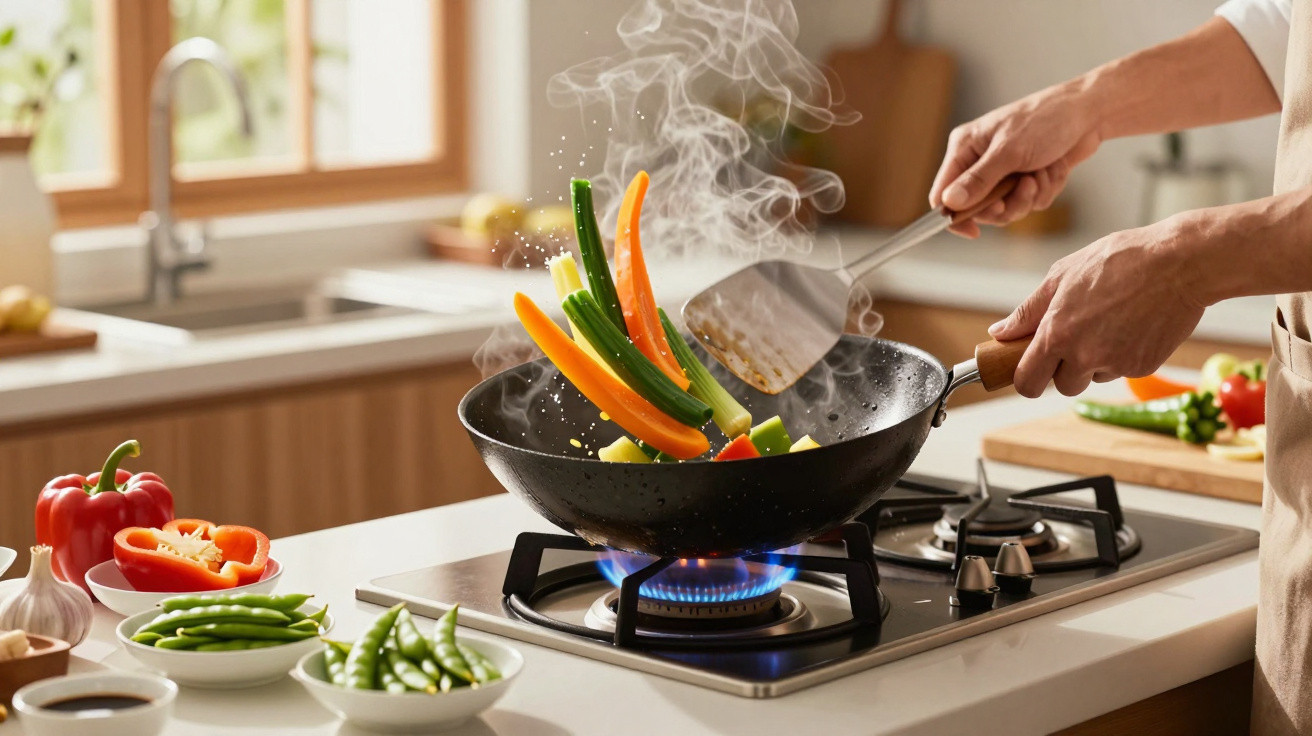
On a Sunday evening, when the fridge contains three carrots, a slightly tired pepper and a handful of broccoli, a wok often feels like the answer to a quick meal. Then comes the disappointment: the vegetables release water, turn soft, and the kitchen does not quite smell like the little Asian eatery where everything sizzles behind a steamed-up window. We all know that moment of wondering why the same Chinese cabbage looks so vibrant at a restaurant yet so forlorn at home. The answer is neither an unreachable secret sauce nor expensive equipment. It comes down to heat, timing and a few straightforward moves. That makes all the difference.
The real wok secret lies in the heat
In an Asian restaurant, cooks almost never leave vegetables sitting in a merely warm pan. They drop them into a fiercely hot wok, creating that sharp sound which makes heads turn: the distinctive sizzle that signals intense, almost brutal, but very brief cooking. This fast searing keeps their colour, crunch and the lightly smoky flavour we all want to recreate. A wok does not gently stew vegetables; it brings them to life.
For a sensible family-sized portion, successful cooking often takes less than five minutes. Mangetout may need only two to three minutes over high heat, whereas carrot strips generally require closer to four minutes, depending on how thinly they are cut. In professional kitchens, the flame can reach striking temperatures, sometimes above 300°C where it meets the pan. At home, we work with what is available, but thorough preheating already makes a considerable difference.
The principle is simple: when the wok surface is extremely hot, the vegetables’ moisture evaporates quickly rather than creating a puddle in the bottom. Their natural juices can then caramelise slightly without the pieces losing their shape. This is where that deeper flavour, sometimes known as “wok flavour”, develops. There is no magic involved; it is about using a few seconds properly. High heat is not a minor detail: it is the foundation of the technique.
Prepare before lighting the hob: the step that prevents soft vegetables
The most dependable approach starts well before cooking begins. Wash the vegetables, dry them carefully, then cut them into evenly sized pieces so that they cook at the same pace. Put the oil, aromatics and sauce into small bowls within easy reach of the hob too: once the wok is hot, there is no time to hunt for the soy sauce bottle at the back of a cupboard. Professional kitchens call this organisation mise en place.
The most common mistake is treating the wok like a large saucepan and filling it to the brim. It is understandable: you want to save time, feed everyone and avoid washing twice as many dishes. Yet a heap of vegetables immediately lowers the temperature and causes them to steam. Let us be honest: nobody really wants to do this every day, particularly after a busy day. Still, cooking in two batches delivers a noticeably tastier result.
Start with an oil that can withstand high temperatures, such as groundnut, sunflower or grapeseed oil, then add the firmest vegetables before the most delicate ones.
“A good wok must be hot before the ingredients, and empty before it is full.”
Keep these simple guidelines in mind:
- Preheat the wok for two to three minutes, until a faint wisp of smoke appears.
- Add only a little oil, just enough to coat the surface.
- Cook small batches and keep stirring continuously.
- Add the sauce right at the end, never at the start.
Movement, vegetable order and a small measure of boldness
Cooking with a wok requires an almost playful level of attention. Stir, lift and, if the handle allows, shake it, without letting the vegetables sit in one spot for too long. A spatula movement every few seconds lets the pieces sear without burning. Begin with broccoli, carrots or green beans; follow with mushrooms and peppers, then bean sprouts, herbs and spring onions. Every vegetable should go in at its own proper moment.
Sauce also calls for a little restraint. One or two tablespoons of soy sauce, a dash of sesame oil and a few drops of rice vinegar are often enough for four people, especially when the vegetables have already been properly seared. Too much liquid undoes the work in moments. A pinch of sugar, fresh ginger or a clove of garlic added late in the cooking can turn the dish into something far more lively without drowning it.
What makes a home wok stir-fry appealing is that it does not demand restaurant-level perfection. Slightly over-charred cabbage, a less evenly cut carrot or a flame that drops for a moment are all part of the meal’s story. Next time, try it with whatever remains in your vegetable drawer and pay attention to the colours, aromas and sounds. Your children, friends or the person sitting beside you may notice that unusual crunch. They will almost certainly ask what you changed.
| Key point | Detail | Benefit for the reader |
|---|---|---|
| Maximum heat | Preheat the wok before adding the oil and vegetables. | Achieve fast searing and reduce water collecting at the bottom of the pan. |
| Small batches | Cook in two batches if the wok is overcrowded. | Retain the vegetables’ crunch and colour. |
| Sauce last | Add liquids just before serving. | Keep vegetables glossy, aromatic and never soggy. |

















Comments
No comments yet. Be the first to comment!
Leave a Comment