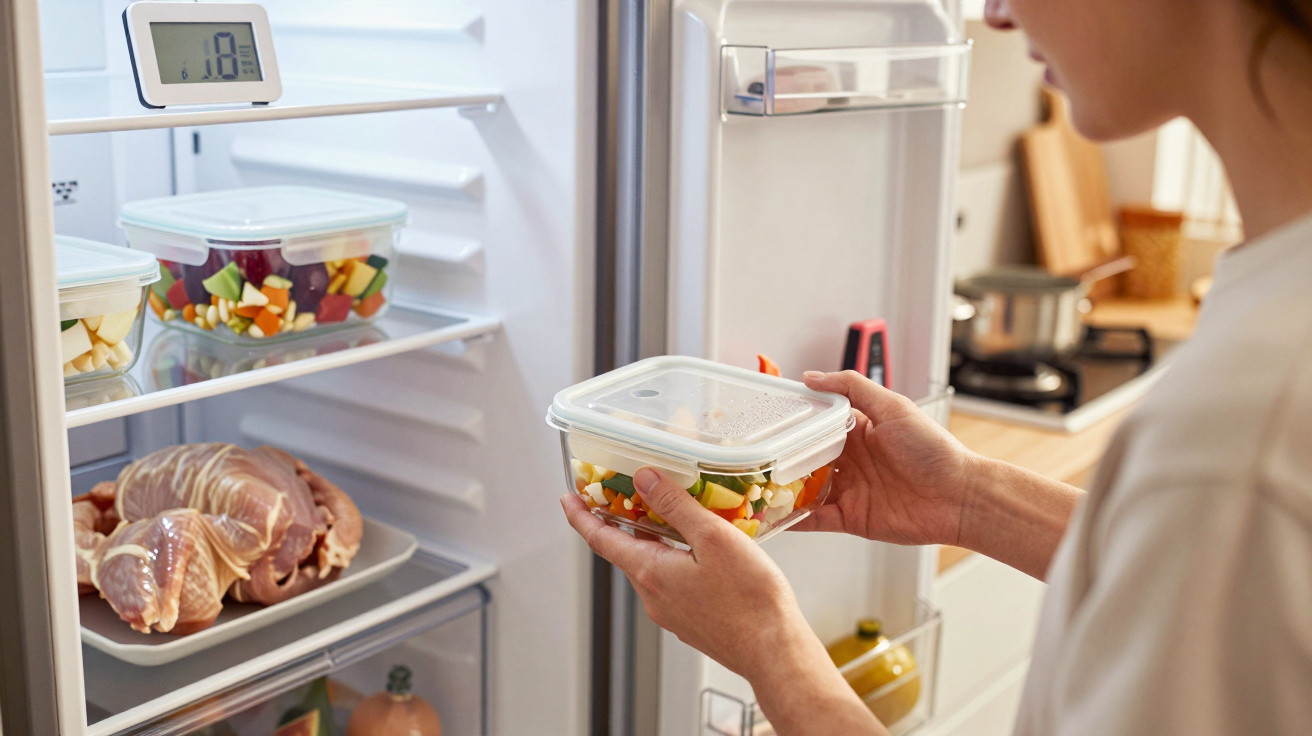
The bag of prawns has spent the night in the fridge, the roast is waiting on a plate and, suddenly, dinner is cancelled. Standing in front of the open freezer, the same question comes up: can you really put this food back in the freezer without taking a risk? We all know that moment when a rule heard from our parents turns into a small domestic worry. “Never refreeze a thawed product”: the statement is clear, almost solemn. Yet the reality depends less on an absolute ban than on the precise journey the food has taken between the freezer, the worktop and the fridge. That detail changes everything.
The “never” rule stems from a genuine fear, but it oversimplifies matters
The issue is not refreezing itself, as though the freezer suddenly becomes dangerous the second time around. What really matters is how long food has spent in a temperature range where bacteria can multiply: roughly between 4°C and 60°C. Minced beef that has thawed slowly in the fridge has not had the same experience as a pack of meat left on the table for two hours while someone answered messages. Cold slows microbes down; it does not eliminate them.
A very ordinary example makes this easier to understand: a tray of chicken is taken from the freezer in the morning, remains in a fridge at 3°C all day, then the planned meal is postponed. In this case, some international guidance, particularly American advice, permits refreezing provided the cold chain has never been broken. The texture may suffer: more moisture will escape during cooking and the meat may become slightly drier. From a food-safety perspective, however, the situation remains under control when the time involved is short.
In France, precautionary advice is often stricter: health authorities generally recommend not refreezing a thawed product unless it has been cooked first. This wording protects households from handling mistakes, which are very common in real life. Let us be honest: nobody measures the temperature of their kitchen or records the precise time at which salmon began to thaw. The simple rule prevents unnecessary risks, even if it does not tell the whole scientific story.
Fridge, cooking and temperature: the three details that change the answer
The safest approach remains straightforward: if food has thawed in the fridge, in an appliance set to 4°C or below, it may be possible to refreeze it promptly, ideally on the same day or after cooking. Put it in a clean container or airtight packaging, label it with the date and return it to the freezer rather than waiting until the following evening. Food that has been forgotten is never food that must be “saved at all costs”. It is best to be even more cautious with minced meat, fish and delicate prepared foods.
Cooking provides a particularly useful alternative when the menu changes. Thawed chicken escalopes can be turned into a curry, Bolognese sauce or a slow-cooked dish, then frozen once cooled quickly. The food must be thoroughly cooked, divided into small portions and chilled without being left sitting around. This option does not “fix” a product that has spent too long at room temperature: it is suitable for food that has been stored correctly, not food that is already questionable.
The most common mistake is believing that smell alone can settle the matter. Bacteria that cause food poisoning may be present without noticeably changing a product’s appearance or aroma.
“If there is any doubt about whether the cold chain has been maintained, the most sensible response is not to eat the food.”
A few simple guidelines prevent a great deal of hesitation:
- food thawed in the fridge and kept cold can be cooked and then frozen;
- a product thawed on the worktop must not go back into the freezer;
- after two hours or more at room temperature, it is better to throw it away;
- after thawing in the microwave or in cold water, cooking must be immediate.
What refreezing really costs: often quality, sometimes peace of mind
Refreezing does not merely break a family rule; above all, it can spoil the meal. With every freezing cycle, ice crystals form inside the food’s cells. When it is thawed again, those cells release more liquid: bread becomes more crumbly, strawberries softer and fish less firm. This is not necessarily unsafe, but it is less enjoyable on the plate. In a soup, gratin or sauce, the difference often goes unnoticed.
Highly perishable raw products require particular care: minced meat, poultry, fish, shellfish, and prepared dishes containing cream or eggs. A fridge temperature that is too high, a door opened repeatedly or leaking packaging can all make matters more complicated. The date matters just as much as the temperature. If meat was already close to its use-by date before freezing, putting it back in the freezer does not make it young again. Frost does not erase the product’s timetable.
In many kitchens, the right decision also comes down to organisation. Freezing food in small portions avoids thawing a kilogram of sauce for two plates, while a clear label prevents mysteries at the back of the drawer. The date, contents and quantity can be written down in ten seconds, just before sealing the bag. At the time, this may seem almost excessive. Three weeks later, when facing an anonymous frozen block, it becomes genuinely valuable.
A rule to adapt without ever gambling on uncertainty
The phrase “never refreeze” has the advantage of being easy to remember, but it conceals a useful nuance: the food’s journey should guide the decision. Did it thaw slowly in the fridge? Has it remained wrapped, clean and away from raw foods that might leak? How long has it been out? These questions are less dramatic than a blanket prohibition, but they are also closer to what actually happens between returning from the shops and serving the evening meal.
It is worth distinguishing caution from panic. Throwing away a product whose cold chain has been broken is sensible, not guilty waste. Conversely, cooking and then freezing a portion that has remained perfectly chilled avoids filling the bin simply because dinner was cancelled. The freezer is not a time machine. It remains a superb ally when used methodically and with a little common sense.
| Key point | Detail | Benefit for the reader |
|---|---|---|
| Thawing under refrigeration | Product kept at 4°C or below for a short period | The option to cook it and then freeze it with greater confidence |
| Room temperature | Two hours or more outside the fridge: increased bacterial risk | A clear benchmark for avoiding a risky decision |
| Product quality | Each cycle can make food more watery or less firm | Better choices about which foods to refreeze and which recipes suit them |

















Comments
No comments yet. Be the first to comment!
Leave a Comment