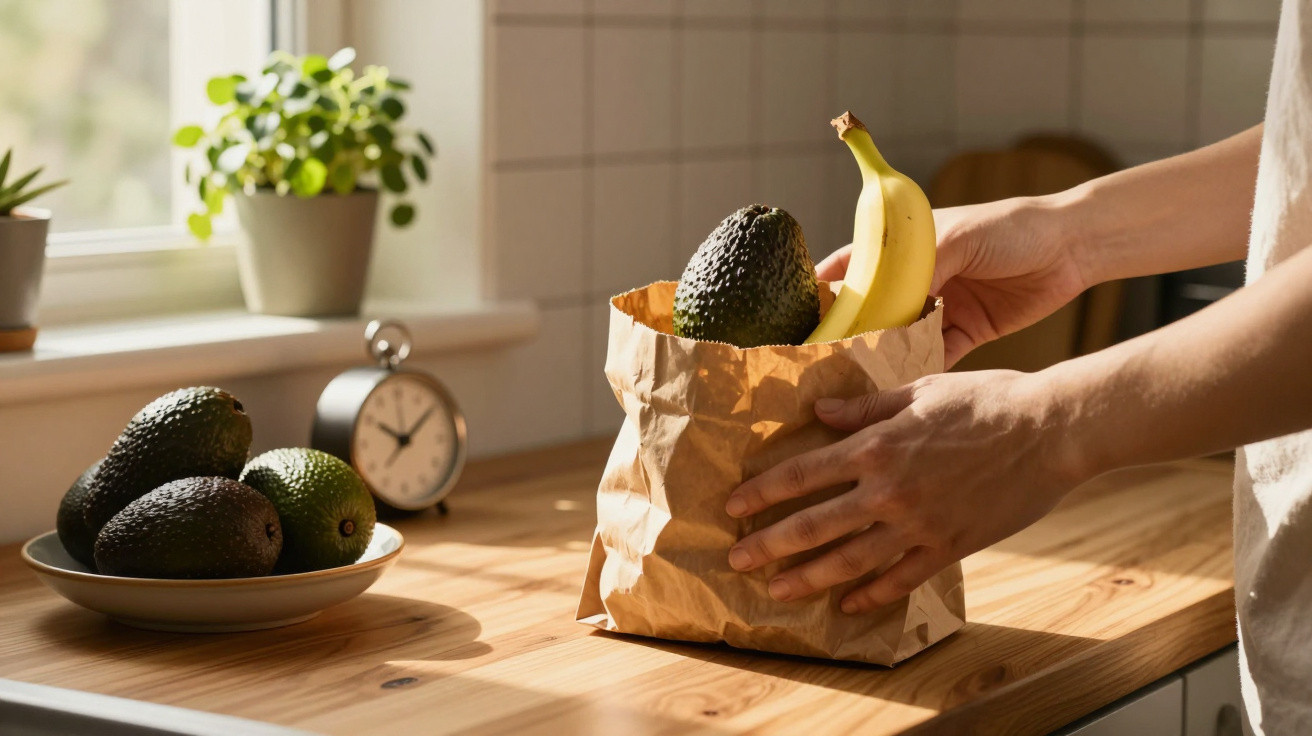
It is 7.30 pm, guests are due for lunch tomorrow, and the avocado bought rather hastily at the supermarket still feels like a small green stone when squeezed. We have all faced this situation: guacamole is on the menu, as are open sandwiches, yet the fruit seems determined not to cooperate. One tip regularly comes up on the kitchen worktop, passed between neighbours, colleagues and family members: a paper bag, a banana and a night of patience. It can seem almost too straightforward to work. Yet there is a genuine reason behind it, provided you are not expecting miracles from an avocado picked too early. The crucial detail is the fruit placed alongside it.
A paper bag gives the avocado the boost it needs
An avocado that is still firm is not necessarily poor quality, nor is it destined to stay hard for days. It continues ripening after harvest, gradually, thanks to a natural gas called ethylene, which fruit releases as it matures. The paper bag simply keeps some of this gas around the avocado without sealing it in completely. Left in the kitchen, away from direct sunlight and cold draughts, it creates a small, favourable environment. Naturally, there is nothing visible happening. But as the hours pass, the flesh begins to soften. It is a subtle, almost invisible kitchen process, but a very real one.
Bananas are the fruit most commonly suggested, particularly once their skins start developing brown spots. They release plenty of ethylene, helping the avocado speed up its natural ripening process inside the bag. A ripe apple can work too, although results may be slightly slower depending on its variety and degree of ripeness. In a very simple kitchen test, a firm avocado put in a bag with a very ripe banana in the evening may be pleasant to eat the next morning or early afternoon. Everything depends on its starting point: if it is entirely green and hard, one night will not always be enough.
The term “ripen” can be somewhat misleading, as an avocado does not suddenly become perfect after eight hours in a bag. This method speeds up a process that is already under way; it cannot replace either time or the quality of the fruit you selected. An avocado harvested before reaching sufficient maturity may remain stringy or bland, even after several days. Let us be honest: nobody really does this every day. The trick becomes invaluable on the evening when you realise, slightly too late, that tomorrow’s recipe depends on two avocados as hard as tennis balls.
The paper bag and banana method, without unpleasant surprises
The process could not be simpler: put the avocado into a brown paper bag, add a ripe banana, then fold over the top without sealing it airtight. Keep it at room temperature, ideally between 18 and 22 degrees, on a shelf or in a dry kitchen cupboard. Paper is better than plastic, which holds too much moisture and can encourage unappetising condensation. If the avocado already yields slightly, check it after six to eight hours. If it remains very firm, leave it until the following day, then test it gently. Use only light pressure, close to the stem.
The most common mistake is leaving the bag untouched for two or three days in the hope of achieving a perfectly buttery avocado. The outcome can disappoint: beneath an apparently sound skin, the flesh may be browned, overly soft or streaked with fibres. It is best to inspect it regularly, even if you have better things to do than monitor a piece of fruit all evening. Do not put it in the fridge before it has ripened either: cold temperatures greatly slow the process. Once it has reached the desired texture, refrigeration becomes useful for buying yourself an extra day or two.
Some people try the oven, microwave or hot water to speed things up, especially when mealtime is near and the avocado will not give way. These techniques can sometimes soften the flesh, but they do not truly develop the creamy flavour expected from an avocado, the quality that makes all the difference in a salad or guacamole.
“A ripe avocado should give slightly under your finger, without collapsing or leaving a deep indentation.”
- Choose a clean, dry paper bag.
- Add a very ripe banana, or an already fragrant apple.
- Check the avocado first thing the following morning.
- Refrigerate it as soon as it reaches the right softness.
The best approach, then, is to observe rather than force the process. An avocado is not a timer: two fruits that look identical can respond very differently, depending on their origin, variety and how long they have spent on the shop shelf.
A simple kitchen trick that prevents plenty of disappointment
Ripening an avocado with a banana in a paper bag is not magic, and that is exactly what makes the method reassuring. It works with the natural rhythm of fruit, requiring no appliance, specialist product or wasted energy. It is also a reminder that the most effective kitchen solutions are sometimes the ones already within reach: a crumpled bag, a forgotten piece of fruit in the bowl and a few hours to spare. Once the avocado finally turns soft, you can slice it over eggs, mash it with lemon or add it to a still-warm salad. The sense of relief is genuine.
This habit can also help you shop more wisely. Buying one or two firm avocados for the following days, alongside one that is nearly ready for that evening’s meal, avoids last-minute dashes to the shops and fruit lost at the back of the vegetable drawer. The very ripe banana, often ignored because it looks too spotted, gains a second purpose before ending up in a cake. It is not a kitchen revolution, merely a smart way to work with nature. And if your avocado still refuses to ripen after one night, give it more time: it simply has not finished its journey.
| Key point | Detail | Benefit for the reader |
|---|---|---|
| The right fruit to put in the bag | A very ripe banana releases plenty of ethylene; a ripe apple can work too. | Naturally speeds up the ripening of an avocado that is still firm. |
| The right container | The paper bag retains the gas while limiting excess moisture. | Prevents condensation and reduces the risk of damaged flesh. |
| The right time to check | Inspect it after one night, then refrigerate the ripe avocado. | Achieves a creamy texture without allowing the fruit to become too soft. |

















Comments
No comments yet. Be the first to comment!
Leave a Comment