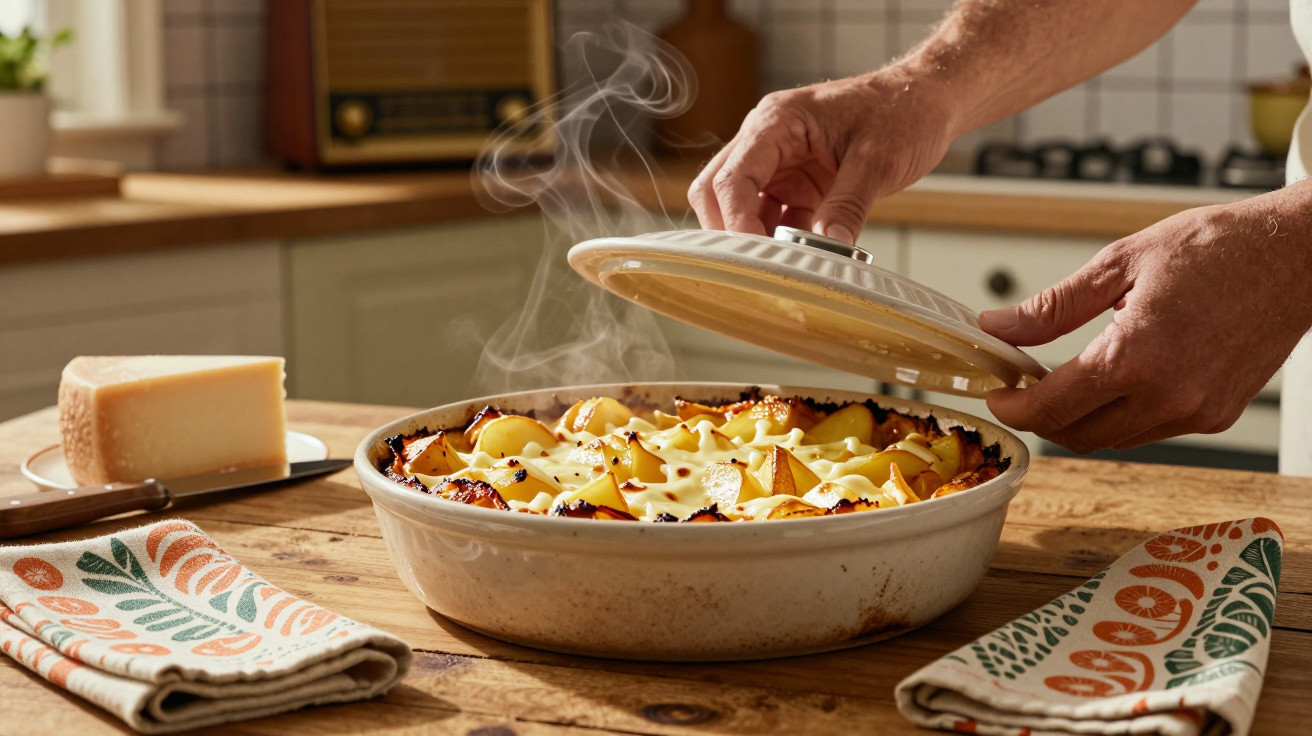
The tale begins not in an upmarket restaurant, but in a compact 1960s kitchen: a yellowing lino floor, a radio murmuring from the corner and a metal casserole dish taking pride of place on the Sunday table. There are layers of potatoes, cream, a touch of onion and a topping that cracks slightly as the serving spoon cuts in. No microgreens, no foam and no twelve-stage technique. It is simply food that smells of comfort, lingering in the room well after everyone has cleared their plates.
Jump ahead to 2024 and this very style of dish is appearing everywhere on TikTok and Instagram Reels. It may have fresh names and updated toppings, but its foundations remain unchanged.
One recipe in particular has travelled from a family notebook into the algorithm.
The humble 1960s potato bake that social media has rediscovered
Browse food TikTok this week and it would be easy to believe that “layered baked potatoes with crispy cheese” had just been invented. Look more carefully, however, and you will spot something any grandmother would know immediately: an uncomplicated 1960s potato casserole, sitting somewhere between scalloped potatoes and gratin, bubbling in countless small ovens. One creator describes it as “retro church-potluck potatoes.” Another writes, “Grandma’s funeral potatoes, but make them aesthetic.”
The formula is familiar: finely sliced potatoes, a creamy sauce, some onion and a golden topping. There is nothing groundbreaking about it. Even so, these old-fashioned bakes are drawing millions of views. Viewers tag siblings, send clips to their mums and then head to the shops “just for potatoes and cream.”
One clip truly set the trend in motion. A home cook in her thirties filmed in a small rented kitchen while recreating what she called “Mom’s 1967 potato bake.” There was no flawless lighting, only a lightly scratched ceramic dish and an unsteady hand with the pepper. She built layers of potato, added a mixture of cream, milk, fried onions and garlic, then covered everything with grated cheese and breadcrumbs.
The video was almost uncomfortable in its lack of polish. Her neighbour’s television could be heard through the wall. Still, the comments poured in: “My nana made this.” “This is literally my childhood.” “I forgot this existed.” Within a week, other creators were sharing their own takes, with bacon, plant-based cream, leeks or smoked paprika. The comforting foundation was identical, while the variations multiplied.
Why has this recipe caught on, and why at this moment? Food fashions are cyclical, yet this one reaches beyond appearance. Potatoes are inexpensive. Cream is indulgent, but recognisable. A meal made in one dish suits the way many people genuinely cook after a tiring day, particularly when money is tight and energy is limited.
We are also living through a period when “retro” feels cosy and reassuring rather than stale. Following years of rapid hacks, endless traybakes and weekday meals engineered for speed, there is a subtle desire for recipes with roots. This 1960s potato bake occupies that meeting point: nostalgic yet adaptable, straightforward yet photogenic. It does not demand attention, but it can take over the entire dinner table.
What exactly is this forgotten potato recipe?
At heart, the recipe is uncomplicated. Imagine thin potato slices arranged in a buttered dish, with every layer receiving a little salt, pepper and the faintest hint of onion. A simple sauce is then poured over: commonly milk and cream, sometimes lightly thickened with a spoonful of flour or cornflour, and sometimes left loose so that the potatoes’ own starch can work its magic.
The oven is where the transformation occurs. Gentle, prolonged heat softens the potatoes until they nearly sink into one another. Cheese and breadcrumbs on top become a blistered golden crust that crackles as you break through it. Beneath, the filling remains soft and comforting, rather like a savoury pudding that still recalls its origins as a stack of sliced potatoes.
A woman I spoke with in Lyon called it “le gratin de ma mère” and insisted that her method had not altered since 1964: waxy potatoes, raw onion, a splash of cream, a low oven and no hurry. In the American Midwest, closely related versions returned under names such as “company potatoes” and “Sunday scalloped potatoes”, often baking beside a roast or ham.
On Reddit, someone shared a faded index card headed “Potato Delight – 1962”, discovered in a charity-shop cookbook. Its recipe was almost the same as the viral versions: 4 potatoes, 1 onion, 1 ½ cups cream, some grated cheese, salt, pepper and one looping handwritten instruction: “Bake until it smells like people should come over.” That sentence alone attracted almost as many upvotes as the photograph of the finished dish.
From a culinary viewpoint, the revival is entirely logical. The 1960s home kitchen relied on a small selection of dependable ingredients and plenty of oven cooking. Potatoes helped meals go further, cream was a welcome treat and casseroles were the first “one-pan dinners”, long before that label existed. Today, the same approach appeals to busy home cooks wanting food that feels properly cooked rather than merely assembled.
There is a psychological appeal too. This casserole rewards patience rather than technical ability. You do not need showy knife skills or costly equipment. You layer, pour and wait. The recipe succeeds because of time, not perfection. In a world driven by haste and optimisation, a slow and slightly old-fashioned dish can feel quietly rebellious.
How to make the 1960s potato bake at home
For the version quietly taking off online, begin with the potatoes. Pick a variety that stays intact, such as Yukon Gold, Charlotte or another waxy type. Peel them if preferred, then slice them finely, roughly coin thickness. A mandoline will create uniform slices, although a sharp knife and some patience work just as well.
Butter a baking dish. Arrange a layer of potatoes, scatter over finely sliced onion or shallot, then add salt, pepper and perhaps a small grating of nutmeg. Continue with potatoes, onion and seasoning until the dish is around three-quarters full. Combine cream and milk - or use only cream if you want maximum richness - then pour it in until the liquid nearly reaches the uppermost layer.
This is the point at which many cooks begin to worry. Is the liquid sufficient? Are the layers overly deep? Has too much onion gone in? The reality is that you will probably only know after it enters the oven, and that is perfectly fine. Making this bake partly by instinct is part of its appeal.
A frequent error is trying to hurry it at too high a temperature. Some people set the oven to 220°C for a quick crust, only to burn the top while the middle remains firm. Take it slowly instead. Aim for 170–180°C and allow at least an hour, sometimes longer. The potatoes will tell you when they are ready: a knife should pass through without resistance, as though slicing warm butter. Honestly, hardly anyone makes this every single day. That is what makes it feel special when they do.
At roughly the halfway point, or during the final 20–30 minutes, add cheese to the top. A mild, melting cheese such as Emmental, Gruyère or cheddar was the classic 1960s option. Use breadcrumbs or crushed crackers as well if you prefer extra crunch. One creator put it perfectly:
“Don’t overthink it. This is poor-people luxury food. Potatoes, cream, heat, and patience.”
To make the dish adaptable, consider each layer of choice:
- Type of potato: waxy for slices that retain their form; floury for a softer centre that is almost mashed.
- Base flavour: onion, garlic, leek or a little of all three.
- Fat: traditional dairy cream, evaporated milk or plant-based cream for a lighter version.
- On top: cheese and breadcrumbs, cheese alone or a crunchy dairy-free topping.
- Bonus twist: small pieces of ham, bacon, smoked tofu or leftover roast tucked between the layers.
Why this old potato dish resonates today
There is something unexpectedly touching about seeing strangers worldwide take the same bubbling, lightly browned bake from their ovens. Caption languages differ, as do the brands of cream on the worktop, but the gentle sigh as the spoon breaks the crust is the same.
Food trends arrive and disappear, but this feels less like a passing fashion than an act of shared remembrance. Most of us know the moment when a taste makes time fold in on itself. All at once, the 1960s kitchen, a 1990s holiday meal and tonight’s late supper in a tiny flat merge into one extended, welcoming table.
What stands out most is the way this casserole is discussed online. People seldom call it “epic” or “next level.” Instead, they describe it as “real,” “simple” and “like home.” Beneath one viral Reel, a commenter wrote: “My mom passed last year and I forgot this recipe existed until now. I’m making it tonight.” Someone else replied: “Send me a picture, my mom made this too.” Food becomes memory, exchanged through comments and direct messages, one pan at a time.
You may look at it and think, “It’s just potatoes and cream.” For many people, though, this recipe forms a link between generations: a dish once recorded on a stained index card that now sits in a saved Instagram folder. Perhaps that is its understated strength. It never aimed to become iconic; it simply continues to do what it always has: feed people, gently.
| Key point | Detail | Value for the reader |
|---|---|---|
| Select the right potatoes and bake slowly | Waxy potatoes, low to medium heat and a long cooking time | Ensures tender slices and that dreamy, creamy texture |
| Build layers with simple flavours | Onion, cream, salt, pepper, optional cheese and breadcrumbs | Creates a rich, nostalgic dish without unnecessary complexity |
| Adapt it to your life and cupboard | Works with plant-based creams, leftovers and cupboard toppings | Helps you recreate a 1960s classic in a practical modern way |

















Comments
No comments yet. Be the first to comment!
Leave a Comment