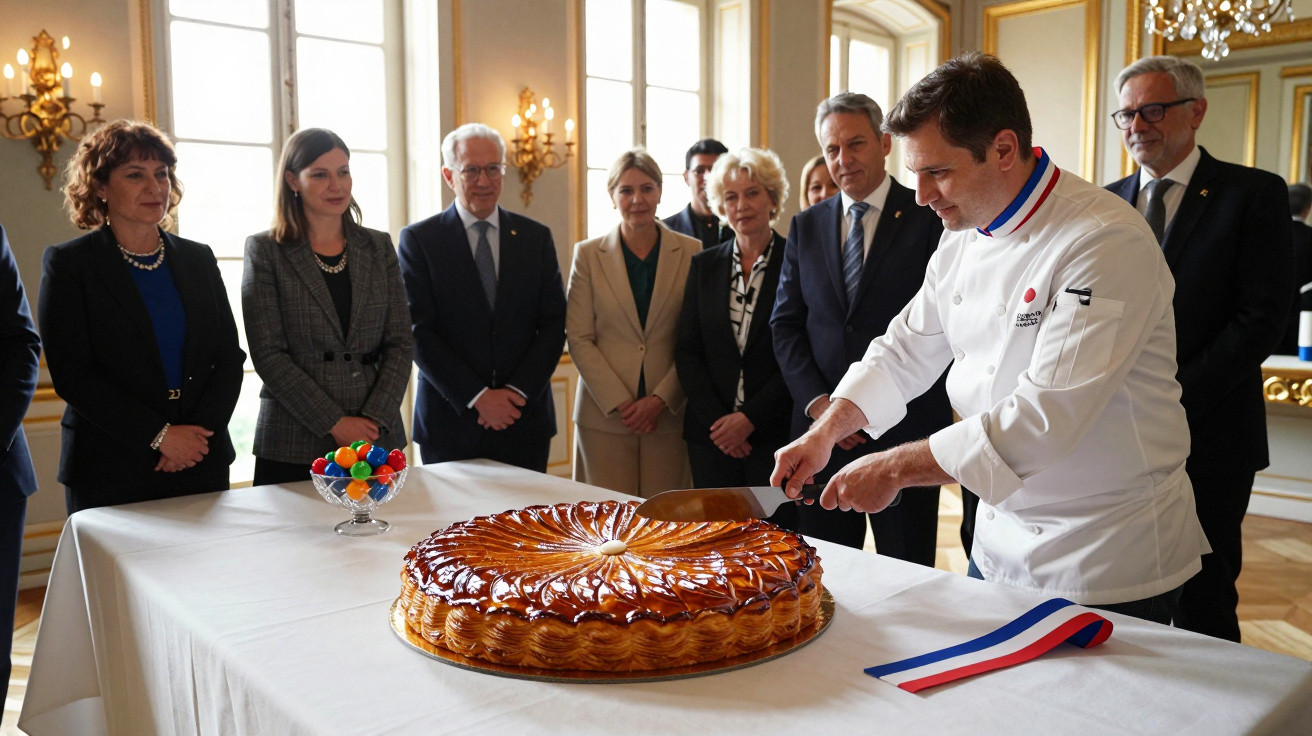
Every January, an enormous king cake is brought into the opulent salons of the Élysée Palace, but with one remarkable difference.
Across France, families debate who will receive the piece containing the lucky charm. At the presidential table, however, an entirely different convention applies. It quietly reflects France’s history, its relationship with power and the careful handling of republican symbols behind palace doors.
A royal cake at a republican palace
Epiphany, celebrated on 6 January, is among France’s best-loved culinary customs. Millions of galettes des rois - buttery, flaky king cakes filled with frangipane - are sold in bakeries and supermarkets. At the Élysée, however, the tradition takes on a far grander scale.
Every year, the French presidency welcomes bakers from around the country to present an oversized galette celebrating their profession. The occasion is not chiefly about pudding; it honours the artisan boulanger, a central figure in French gastronomy.
This season, Paris baker Jean‑Yves Bouiller, owner of Le Moulin de la Croix Nivert in the 15th arrondissement, received that distinction. His team made two vast pastries, each weighing roughly 12 kilos and measuring more than a metre across. Their preparation required over two days of painstaking work, including laminating the dough and piping a consistent layer of almond cream.
At the Élysée, the king cake is super-sized and ceremonial, but it follows one uncompromising rule: no one can be “king”.
These galettes bear little resemblance to the small round cakes placed in cardboard boxes at a local bakery. Created to serve a sizeable gathering of guests, photographers and staff, they also project an image of French excellence to the world.
The deliberate omission of the fève
In French homes, the fève - the small charm concealed inside the cake - is the centrepiece of the Epiphany custom. It may take the form of a porcelain figure, a cartoon character or a tiny metal object. The person who discovers it in their portion wears a cardboard crown and is named “king” or “queen” for the day.
That does not occur at the Élysée Palace.
No fève is ever baked into the presidential galette. Not once. Not by mistake. Not as a joke.
The policy is absolute and has been observed since this modern Élysée practice began. There is neither a crown nor a symbolic monarch, and no light-hearted coronation takes place in the palace’s reception rooms.
The decision can seem surprising to visitors, and even to some French people, because the fève appears inseparable from the festivities. But the issue has nothing to do with food safety or the practicalities of baking. It concerns politics, symbolism and the Republic’s historical relationship with monarchy.
From “king cake” to “cake of equality”
The link between the galette des rois and French power stretches back centuries. Originally, the pastry had an explicit purpose: it marked Epiphany, the Christian feast commemorating the visit of the Three Kings to the baby Jesus. Whoever discovered the bean - the first fève - briefly assumed royal status.
The French Revolution at the close of the 18th century changed everything. Allusions to kings and crowns became profoundly uncomfortable, particularly in public settings. France was remaking itself as a republic rather than a monarchy.
Against that backdrop, even the name galette des rois became troublesome. Bakers and citizens therefore began modifying it. In certain areas, it was called galette de l’égalité - the cake of equality. The symbolic aim was straightforward: preserve the custom while removing the king.
The Élysée’s galette without a fève is the heir to this revolutionary reflex: celebrate together, but never crown anyone.
Today, official terminology commonly favours neutral descriptions such as galette de l’Épiphanie. Galette des rois remains the everyday name heard throughout France, but institutions use more cautious language and rituals.
Why nobody can be “king” at the Élysée
The Élysée Palace is more than a home. It is the symbolic centre of the Fifth Republic, where presidents receive foreign leaders, sign legislation and speak to the country. Each action there is examined, photographed and given meaning.
In such surroundings, a pastry can acquire political significance. The prospect of a guest, a minister or - more awkwardly still - the president being randomly crowned “king” for a day would conflict with a key republican principle: nobody is above the people.
- The president is an elected representative rather than a monarch.
- The Élysée is a republican palace, not a royal court.
- Official ceremonies steer clear of symbols that might suggest hereditary or absolute authority.
Prohibiting the fève prevents a playful crowning from becoming an uncomfortable photograph or a headline claiming that somebody “became king at the Élysée”. It may appear a small gesture, but it carries weight within France’s highly codified political culture.
Practical considerations reinforce the symbolism
History and politics are joined by practical concerns. Cutting a pastry more than one metre wide into dozens of portions, sometimes quickly, is difficult enough. Leaving out a hard item such as a porcelain charm removes the possibility of someone breaking a tooth or choking in front of the cameras.
Nevertheless, bakers and palace employees agree that this is not the primary reason. The overriding motive is respect for republican principles and a desire to prevent any clash between ceremony and constitution.
How the Élysée galette is prepared
Although the palace remains discreet about precise recipes, its basic construction follows traditional French pâtisserie methods. What makes it exceptional is its scale and its setting.
| Element | Typical family galette | Élysée galette |
|---|---|---|
| Weight | 600–800 g | ≈ 12 kg per cake |
| Diameter | 25–30 cm | Over 1 metre |
| Preparation time | Half a day | More than two days |
| Fève | Always included | Strictly forbidden |
The pastry is laminated with butter layers to form puff pastry. Inside is frangipane, a smooth blend of ground almonds, sugar, butter and eggs. Its upper crust is glazed and often decorated with an elegant pattern cut into the surface before it goes into the oven.
After baking, the giant cake is carefully delivered to the Élysée. There it serves as both a dessert and a political statement: France honours tradition while reshaping it around republican values.
What the tradition shows foreign visitors
International visitors unfamiliar with Epiphany often receive a brief explanation of the Élysée galette from French aides. They describe the public custom: children sheltering beneath the table to allocate slices randomly, adults enjoying an informal coffee-time gathering and the excitement of finding the fève.
Then comes the unexpected detail: no charm is placed between the layers at the Élysée. The cake represents togetherness rather than rank. It offers a succinct illustration of how France continually revisits its royal past while upholding its republican present.
In a palace built on kings’ ruins, the cake keeps the flavour of tradition but leaves the crown behind.
Understanding the key terms
Several terms can be confusing for readers outside France. Galette des rois generally means the puff-pastry cake with almond cream found in northern and central France. In many southern areas, Epiphany is instead celebrated with a brioche crown decorated with candied fruit.
The word fève literally translates as “bean”. Before porcelain figurines became customary, a plain dried bean was hidden in the pastry. Its finder became king of the celebration. Modern collectable charms - ranging from cartoon heroes to miniature landmarks - descend from that modest seed.
How families can follow the Élysée approach
Prompted by conversations about inclusivity and history, some French families have begun adjusting their own traditions. Some call the cake galette de l’amitié when serving it in culturally mixed or non-religious settings. Others select neutral figurines in place of kings, queens or baby Jesus.
Parents may also modify the “king for a day” custom. Rather than crowning one person, they can announce that everyone around the table is an “equal winner”, particularly when young children are involved. The Élysée’s no-fève policy can provide a useful way to discuss republican values, even at a kitchen table thousands of miles from Paris.
For anyone arranging an Epiphany celebration abroad, the presidential version provides a workable option. Serve an attractive almond galette, recount the history of French kings and the Revolution, but omit the fève to avoid damaged teeth, disputes or uncomfortable symbolism. Its absence becomes a conversation point, just as it does each year in the Élysée salons.

















Comments
No comments yet. Be the first to comment!
Leave a Comment