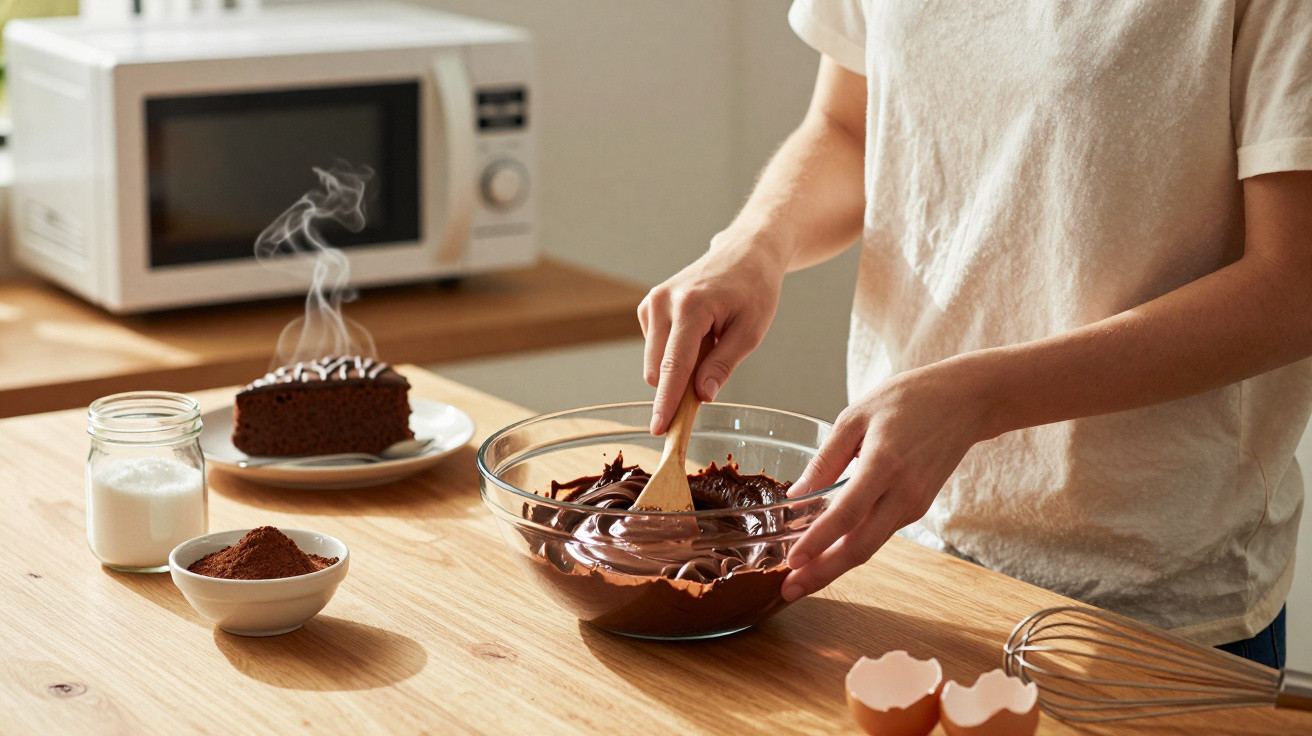
Picture the scene: you arrive home late, want something sweet, and switching on the oven seems completely out of reach.
Rather than reaching for a delivery app, you can transform the evening with a mug, three everyday ingredients and a microwave. Rooted in French home cooking and mug-cake culture, this exceptionally soft chocolate cake delivers a proper dessert in about as long as it takes to brew a cup of tea.
A three-ingredient cake that genuinely feels like dessert
Fast recipes frequently compromise on flavour or texture, but this one does not. It draws on traditional French methods while requiring only cupboard basics:
- 3 eggs
- 6 tablespoons unsweetened cocoa powder
- 3 tablespoons plain flour
Just three ingredients, no added sugar, no butter – yet you still get a tender, chocolatey cake with a gently melting centre.
The eggs provide natural richness, while the cocoa brings intensity. Together, they reduce the sugar hit without taking the result out of proper-dessert territory.
How the 10-minute promise breaks down
The claimed timing may sound ambitious, yet it is realistic. Many readers will see it as a far-off relative of the mug-cake craze of the early 2000s, with one significant improvement: egg whites that have been properly whipped.
| Step | Action | Approx. time |
|---|---|---|
| 1 | Separate eggs | 1–2 minutes |
| 2 | Whip whites to stiff peaks | 2–3 minutes |
| 3 | Fold in yolks, cocoa and flour | 2–3 minutes |
| 4 | Microwave cooking | 3.5–4 minutes |
With a hand mixer and a little basic coordination, the entire method remains comfortably within 10 minutes.
The method: French technique, microwave speed
Separating and whipping: where the magic happens
Begin by separating the egg whites from the yolks. Because even the smallest amount of fat can prevent the whites from expanding, the mixing bowl must be clean and dry.
Using an electric whisk, beat the whites until they reach stiff, shiny peaks. A very small pinch of salt can help make the foam more stable. There is an easy test at home: gently tip the bowl to one side. If the whites stay in place, they are ready.
The air trapped in well-whipped egg whites is what replaces butter and baking powder, giving the cake its lift and cloud-like crumb.
Folding, not stirring: protecting the air
Add the yolks directly to the airy whites, then incorporate the cocoa. From here, each motion matters. With a spatula, fold the mixture from the bottom upwards instead of stirring it in circular movements. The aim is to retain the air rather than deflate all the bubbles.
Add the flour last, scattering it lightly across the top to minimise lumps. Any small clumps generally disappear as the batter cooks in the microwave, so there is no reason to work the mixture excessively.
From bowl to microwave in seconds
Individual servings are most effective. Lightly grease four ramekins, or choose flexible silicone moulds, and fill each one to roughly three-quarters full so there is room for the cake to rise.
Four minutes is sufficient in a standard 800W microwave. In more powerful microwaves, reducing the time to about 3 minutes 30 can help avoid overcooking. Once heated, leave the cakes to rest for 30 seconds, allowing their structure to settle before loosening the edges and turning them out.
Small tweaks that change the texture
Home cooks will quickly notice that the basic mixture is adaptable. Two straightforward adjustments can alter the finished texture:
- Replace one tablespoon of flour with cornflour (cornstarch) for added lightness
- Add a pinch of salt to the whites to reinforce the foam and bring out the cocoa flavour
For a result that is almost soufflé-like, when you eat it is as important as what goes into it.
Why eating it warm makes such a difference
Food scientists often refer to “setting”, the point at which egg protein networks solidify and starches become firm. This cake is at its best before those networks have tightened completely.
Served within about 15 minutes of cooking, the centre stays slightly soft, the edges are just set, and each spoonful feels closer to a chocolate fondant than a microwave snack.
After an hour, it takes on more of the character of a light sponge. It remains enjoyable, but is much less unexpected.
What to drink with a 10-minute chocolate cake
The right drink can take this dessert from a comforting weekday indulgence to something approaching restaurant standard. A number of pairings work especially well:
- Cold milk for a nostalgic, child-friendly pairing
- A sharp espresso to offset the sweetness and intensify the cocoa notes
- Strong black tea, such as Earl Grey, for a more refined bitter and fragrant match
- Spiced hot chocolate for a rich dessert-on-dessert occasion
- A small glass of sweet wine, such as Banyuls or Port, for a dinner-party finish
Presenting the cakes in small ramekins also makes portioning simple: one can suit a late-night treat alone, while several can be prepared for guests.
From mug cake fad to “modern” French classic
This recipe brings together two distinct trends. One is the microwave mug cake that appeared across social media feeds during the 2000s. The other is the established French practice of beating egg whites for mousses, soufflés and génoises.
Because it uses whites whipped to stiff peaks instead of baking powder and substantial amounts of fat, this hybrid dessert feels lighter in the mouth. That does not turn it into a health food, but it does alter its nutritional profile.
Nutritional angle without the marketing gloss
At first glance, having no added sugar or butter is appealing. The cake chiefly provides:
- Protein from three eggs, which supports satiety
- Cocoa containing natural antioxidants, provided that a good-quality unsweetened powder is used
- Moderate carbohydrate from the flour and the natural sugars in eggs
For anyone monitoring blood sugar, unsweetened cocoa in place of chocolate bars can help prevent hidden sugar, although portion control remains important.
Real-life situations where this recipe earns its place
Its appeal goes beyond the novelty of a three-ingredient cake: this dessert works in several everyday settings. Parents can make it as a last-minute pudding when friends remain for dinner. Students in halls equipped only with a microwave can finally prepare something more satisfying than instant noodles and biscuits.
It may also offer a first step into baking at home. Anyone daunted by conventional recipes with lengthy ingredient lists can practise essential skills, including separating eggs, whipping whites and folding carefully, without investing much time or money.
Common questions and small risks worth knowing
Two concerns arise most often. The first is overcooking: in a powerful microwave, an additional 30–40 seconds can take the cake from light and airy to rubbery. It is often better to stop a little early and allow the remaining heat to complete the cooking.
The second relates to egg safety. In countries where eggs are not routinely refrigerated or marked with long use-by dates, choosing fresh eggs and cooking until the edges are fully set helps to reduce concern. Those in higher-risk groups, including pregnant women and people with weakened immune systems, may nevertheless favour longer cooking and a firmer centre.
When used with care, this three-ingredient method can become a starting point. Some cooks may fold through orange zest, instant coffee or a spoonful of nut butter. Others may keep it deliberately simple, valuing the speed, the texture and the quiet pleasure of eating warm chocolate with a spoon only minutes after thinking, “I fancy something sweet.”

















Comments
No comments yet. Be the first to comment!
Leave a Comment