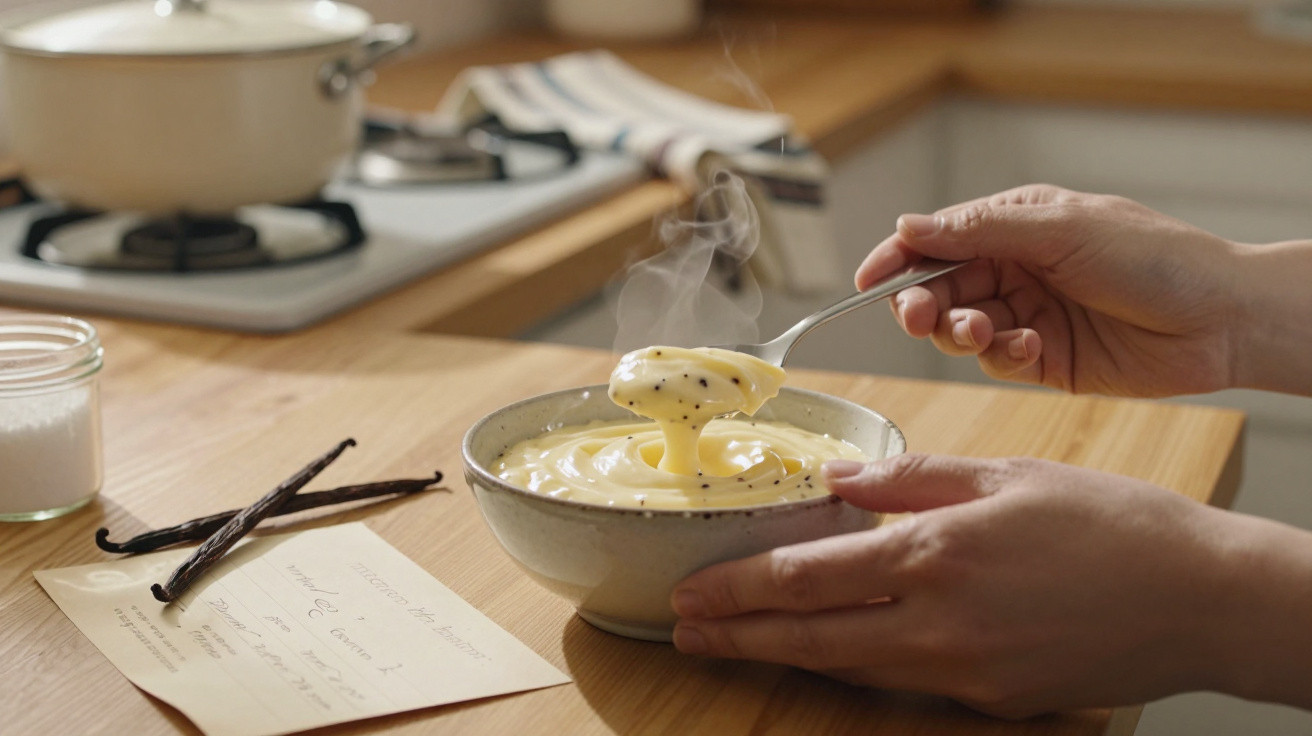
The saucepan was already murmuring on the hob when the first rush of vanilla filled the room. It was not the harsh, artificial scent that hangs around budget candles, but a mellow, almost buttery aroma that makes you pause without realising. A wooden spoon lay on the worktop, three unmatched bowls sat waiting like little promises, and the milk had only just begun to steam. Someone entered the kitchen and said, “Oh. That smells like my grandmother’s house.” Nobody disagreed.
Outside, the world may have been tallying steps and macros, but in that kitchen, time seemed to curve around a pan of pudding. There was a dusting of flour on a dark top, milk splashed across the hob, and a spoon scraped along the base of the pan in a quiet, familiar search for lumps. Then came one mouthful, and the room fell silent for half a second.
Something from long ago had returned to the table.
The quiet magic of a spoonful of real vanilla pudding
A particular kind of hush arrives when dessert is placed on the table and everyone forgets about their phones. Old-fashioned vanilla pudding can do that. There is no theatrical flair, no molten middle and no flaming liqueur: only a pale, wobbly cream in a chipped bowl, perhaps with a biscuit tucked alongside. As the first spoon breaks the surface, you can almost hear its soft give.
This is not the vanilla pudding that comes from a brightly coloured packet. It is the kind made slowly on the hob, watched and stirred until it thickens and the kitchen takes on the scent of Sunday afternoons from years gone by. It tastes like peace.
Ask people to name the desserts from their childhood, and vanilla pudding comes up more often than expected. Perhaps it was a grandmother who always added a pinch of cinnamon, or an uncle who mixed in crushed biscuits “so no one fights over the last one.” In an informal social-media survey, dozens of readers said vanilla pudding felt “safer” and “more real” than many elaborate restaurant desserts.
One woman recalled making it on stormy evenings, while the windows shook and the television picture fizzed. Standing on a chair and gripping the whisk too tightly, she watched her mother pour in the milk. Decades later, she still cooks it in the same scratched saucepan, although replacing it would be easy. This is the sort of dessert in question: sweet, certainly, but also tied to particular people and places.
There is a reason the recipe strikes such a chord. Vanilla pudding is easy enough for an exhausting Tuesday, but indulgent enough to feel slightly illicit. It occupies the space between comfort and nostalgia. Its ingredients are almost comically straightforward: milk, sugar, eggs or cornflour, butter, salt and genuine vanilla.
Yet the real transformation happens in the pan. Low heat encourages proteins to set, starch to expand and fat to smooth every edge. What emerges is neither quite custard nor quite cream, but something between the two, clinging to the spoon for a moment before sliding away. It tastes as though someone cared enough to remain in the kitchen a little longer.
The creamy hob method that tastes like the past
Begin with a heavy-based saucepan. It is the best defence against scorched edges and disappointing, grainy pudding. While everything is cold, whisk together the sugar, a pinch of salt and either cornflour or flour. Gradually stream in the milk, whisking throughout, until the mixture is loose and smooth, with no dry pockets of powder left at the bottom.
Place the pan over a medium-low heat and stay nearby. Stir in unhurried figure-of-eight motions, making sure to reach into the corners. Within a few minutes, it will move from thin and glossy to silky with a slight resistance, as though it is gently pushing against the spoon. That subtle shift signals that the pudding is beginning to take shape.
For a fuller, more custardy taste, use egg yolks and temper them as though you are carefully talking someone down from a ledge. Whisk a little of the hot milk mixture into the beaten yolks quickly, then return the warmed egg mixture to the saucepan. It may sound fiddly, but it prevents scrambled egg appearing in your dessert. We have all had that moment of thinking, “Maybe I overheated this,” only to suspect that we are not entirely wrong.
After that, allow it to thicken gradually. The pudding should cover the back of a spoon and leave a clean track when you run a finger through it. Remove it from the heat just before it appears “perfect”, as it will keep thickening during cooling. Warm is wonderful; hot can be risky.
This is where many people go wrong: either the flavour is hurried or the texture is overworked. Vanilla should be the final major addition, stirred in away from the heat to keep it fragrant and lively. Choose a quality extract or, for something more luxurious, scrape in the seeds of a vanilla pod, letting them dot the cream like miniature constellations.
Honestly, nobody makes it like this every day. However, when you do, the difference is clear. To prevent the dreaded skin from forming, press cling film or baking parchment directly onto the pudding before chilling. Alternatively, leave it uncovered if you secretly enjoy lifting off the skin and eating it as a small guilty pleasure.
“The first time I made real vanilla pudding,” says Elise, 38, “my kids actually went quiet at the table. That never happens. It tasted like something I should have been making all along.”
- Use whole milk to achieve that rich, traditional creaminess.
- Cook over medium-low heat to avoid lumps and scorched pieces.
- Stir continuously towards the end, when the mixture begins to thicken.
- Add real vanilla off the heat for the fullest flavour.
- Chill at least 2–3 hours for the classic texture that stands up on a spoon.
Why this old-fashioned vanilla pudding still feels surprisingly new
When homemade vanilla pudding is served to people raised on shop-bought mixes, something revealing often happens. First they seem surprised, then faintly irritated, as if somebody has exposed a trick that has been played for years. This version is more substantial yet softer, sweet without becoming sickly, and gently rounded in flavour rather than delivering a blunt hit of sugar. It is a quiet luxury concealed in plain sight.
You can embellish it with berries, a spoonful of jam or crushed biscuits, but it never loses its identity. Its modesty feels unexpectedly refreshing amid trending desserts and viral recipes. There is no glaze and no glitter, only a chilled bowl that tastes as if the day has been placed on pause.
| Key point | Detail | Value for the reader |
|---|---|---|
| Authentic hob method | Slow heating, steady stirring and correct thickening | Creates the classic creamy texture without lumps |
| Quality vanilla | Good extract or vanilla pod added after removing from the heat | Provides a deep, nostalgic flavour that feels “bakery-level” |
| Straightforward ingredients | Milk, sugar, eggs or cornflour, butter, salt | Produces a comforting dessert from cupboard staples on any evening |
FAQ:
- Question 1 Can I use plant-based milk for this vanilla pudding recipe? Yes, although a creamier choice such as oat or soya works best, and you should add a little extra cornflour for structure. The flavour will change slightly, but the comforting quality remains.
- Question 2 Why did my pudding turn out lumpy? High heat or unevenly incorporated cornflour is usually responsible. Whisk the dry ingredients into cold milk first, cook it gently and keep stirring along the bottom of the saucepan.
- Question 3 How long does homemade vanilla pudding keep in the fridge? It will keep well for roughly three days in an airtight container. Beyond that point, the texture may split and the flavour begins to fade.
- Question 4 Can I skip the eggs and just use cornflour? Absolutely. The result will be a lighter pudding with a cleaner flavour. Add a little extra butter at the end to restore some of that traditional richness.
- Question 5 How do I stop the pudding from forming a skin on top? Before chilling, lay cling film or baking parchment directly over the surface. If a skin forms anyway and you dislike it, briefly whisk the pudding before serving until smooth again.

















Comments
No comments yet. Be the first to comment!
Leave a Comment