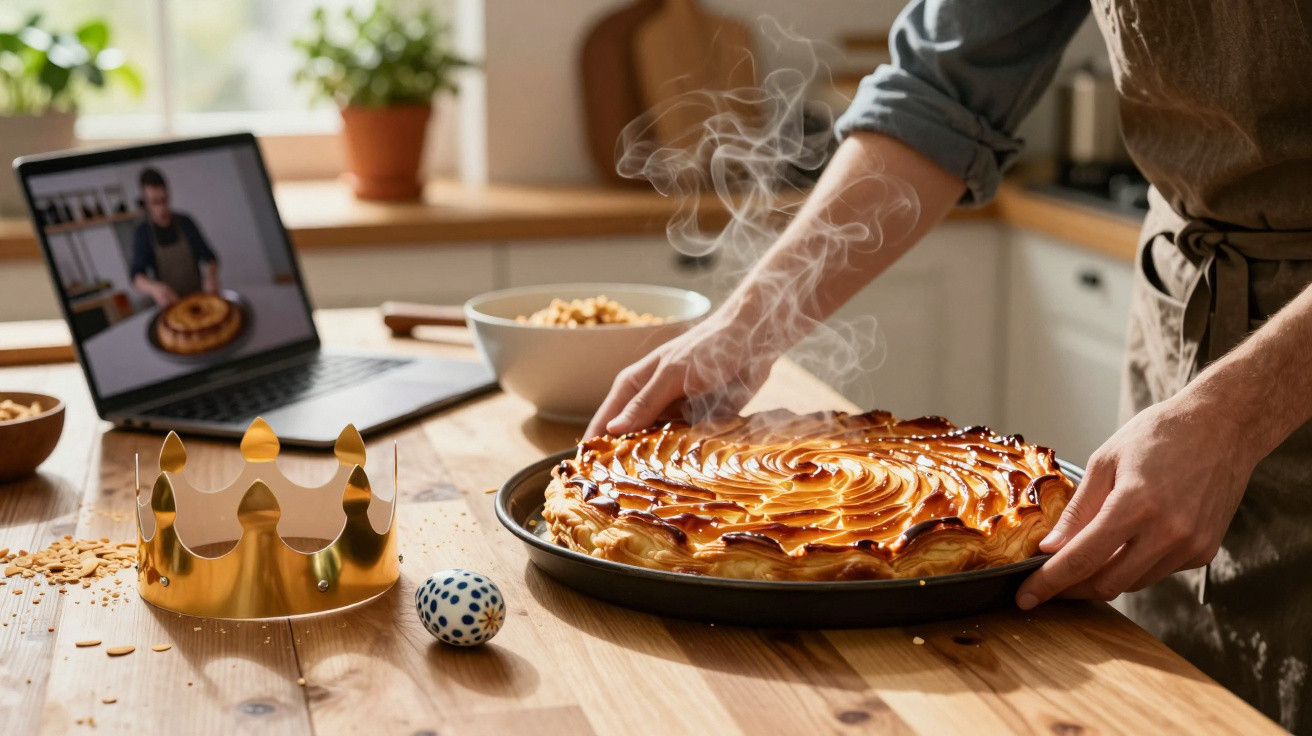
January arrives and the festive season recedes, but one final custom still gathers people around the table for an understated celebration.
Throughout France, that custom is the galette des rois: the crisp, flaky “kings’ cake” displayed in bakery windows. This year, increasing numbers of amateur bakers are doing more than purchasing one. Equipped with online lessons, expert advice and some confidence, they are making their own.
Why more people are making galette des rois at home
Buying a galette des rois was once straightforward: pick one up on the journey home, hope the pastry stayed crisp, then debate who had found the fève, the small charm concealed inside. That custom has shifted over recent years. Prices are higher, queues are longer, and many shoppers feel that bakery versions have become somewhat standardised.
Meanwhile, online baking culture has grown rapidly. Home cooks post their successes and failures with laminated pastry on social media, while video platforms are packed with detailed pastry demonstrations. In that environment, producing a golden, well-risen galette in a domestic oven no longer appears to be the preserve of professionals.
Making a galette des rois at home combines three strong appeals: saving money, gaining skills and creating a dessert tailored to your taste.
Rather than choosing between industrial frangipane and a limited-edition pistachio option, home bakers can control every detail: the sweetness, the filling and even the pattern cut into the surface. Online training platforms now maintain that, with suitable instruction, a homemade galette can resemble one from an upmarket pâtisserie.
What a chef-standard galette des rois involves
Its apparent simplicity conceals a technically demanding pastry. Professional bakers treat the galette seriously because it brings together several exacting stages: puff pastry, almond cream, assembly and carefully controlled baking.
The essential parts of a traditional galette
- Puff pastry (pâte feuilletée): repeated layers of dough and butter that are rolled and folded to create height.
- Frangipane: a rich mixture of ground almonds, eggs, butter and sugar, sometimes made lighter with pastry cream.
- Egg wash and scoring: a glossy coating and decorative cuts that also regulate the rise of the pastry.
- Fève and crown: the charm hidden in the cake and the paper crown worn by the person who discovers it.
For many home bakers, the words “laminated dough” alone can cause anxiety. The method calls for chilled butter, even rolling, resting periods and an understanding of the dough’s texture. This reputation has kept galette des rois firmly in the “bakery only” category for a long time.
The turning point comes when each step is broken down into clear, repeatable actions rather than mysterious chef tricks.
How online courses make the process less daunting
Services such as the French platform VoilaChef occupy this space. Rather than providing a brief written recipe, they present the galette as a structured learning programme. Learners can watch close-ups of butter blocks being folded, listen as chefs explain the need for resting the dough, and view several scoring designs.
For instance, selected parts of its chocolate frangipane galette course are available free of charge. Interested bakers can sample the teaching approach before making a commitment, helping them assess whether they can follow the process. Those who choose the full course are guided through every stage, from weighing the ingredients to achieving an evenly baked result.
VoilaChef’s chef-led learning approach
VoilaChef positions itself as an online culinary school for committed enthusiasts and professional cooks, rather than simply as a recipe website. Its platform brings together more than 130 courses from around 40 prominent chefs, including Meilleurs Ouvriers de France (MOF), world champions and pastry instructors from leading hotels.
This approach differs from short social-media tutorials. Lessons are arranged as compact modules, with several brief videos dedicated to a single recipe or skill. A standard galette course includes individual clips for preparing the dough, lamination, frangipane, assembly, decoration and baking, all with a defined purpose.
Almost 900 videos form a catalogue where recipes are only one part; the real focus is technique, repetition and understanding.
Subscribers can download comprehensive technical sheets, replay important movements in slow motion, and take part in monthly live sessions where chefs respond to questions. For the all-chocolate frangipane galette, MOF baker Cyrille Van Der Stuyft presents his approach with a professional bakery perspective while adapting the method for equipment found in home kitchens.
Equipment needed for a homemade galette des rois
Although the chefs’ credentials are impressive, the required equipment is relatively accessible. Most courses are designed for a properly equipped household kitchen rather than a commercial pastry laboratory.
| Tool | Why it matters for galette des rois |
|---|---|
| Digital scale | Precise quantities for dough hydration and the texture of the frangipane. |
| Rolling pin | Ensures an even thickness across both puff-pastry sheets. |
| Baking tray and baking paper | Provides a level, consistent baking surface and makes removal easier. |
| Sharp knife or scoring tool | Creates neat decorative cuts without pulling or tearing the dough. |
| Oven thermometer (optional) | Confirms that the oven actually reaches the intended temperature. |
Chefs on the platform regularly suggest practical alternatives. In an emergency, a wine bottle can stand in for a rolling pin, while an ordinary kitchen knife will score the surface as effectively as a professional lame if it is sharp and handled gently.
From traditional almond to chocolate, pistachio and apple
Although northern France’s traditional galette des rois contains frangipane, modern home bakers are exploring other options. Once the fundamental structure is understood-crisp puff pastry, a moist filling and a sealed edge-many variations become possible.
Favourite variations for home bakers
- Pure almond frangipane: the benchmark version, balancing ground almonds, butter, eggs and sugar.
- All-chocolate frangipane: cocoa and melted chocolate mixed into the almond base for a richer, brownie-like centre.
- Pistachio twist: some of the almonds are replaced with finely ground pistachios, frequently coloured green for visual effect.
- Apple filling: a more tart-like version, with sautéed apples or apple compote layered between the pastry.
The home setting encourages customisation: less sugar for adults, more chocolate for kids, even dairy‑free versions for guests with allergies.
Online courses generally begin with the traditional recipe before explaining how proportions and baking times should change when adding cocoa or fruit. This format helps bakers avoid familiar issues, including undercooked centres and filling that escapes through the sealed edges.
Beyond the recipe: customs, pitfalls and modest triumphs
For those outside France, the context is worth noting. Galette des rois is traditionally eaten for Epiphany, on or close to 6 January. A small charm or figurine, known as the fève, is concealed in the filling. The person who finds it in their portion becomes “king” or “queen” for the day and wears a paper crown. Many households continue the custom throughout January, using it as an excuse for several informal get-togethers.
Making a galette yourself introduces a few further considerations. Food safety matters: the fève needs to withstand baking heat and should be inserted into the filling before baking, never afterwards, to prevent contamination. Bakers must also monitor the oven temperature carefully. If it is too high, the surface will burn before the middle can rise; if it is too low, butter will leak out rather than lifting the pastry layers.
On the positive side, homemade galettes can be adapted to dietary requirements. Custard-based or fruit-only fillings can suit friends with nut allergies. People reducing saturated fat may opt for a smaller galette with thinner layers, or make it less often while choosing particularly good butter for improved flavour.
For anyone becoming more serious about pastry, this kind of project is a useful practical test. It combines theory-gluten development, steam expansion and frangipane emulsion-with manual abilities such as shaping and scoring. A successful bake gives clear evidence of progress: an even rise, defined layers and filling that remains in place.
The social element also deserves attention. A homemade galette often sparks discussions in ways that a shop-bought version does not. Guests may ask how the design was created, whether the recipe was difficult, or if the fève was positioned randomly. For many amateur bakers, that proud moment around the table encourages them to take on their next technical project, from croissants to entremets, often with further support from chef-led training platforms.

















Comments
No comments yet. Be the first to comment!
Leave a Comment