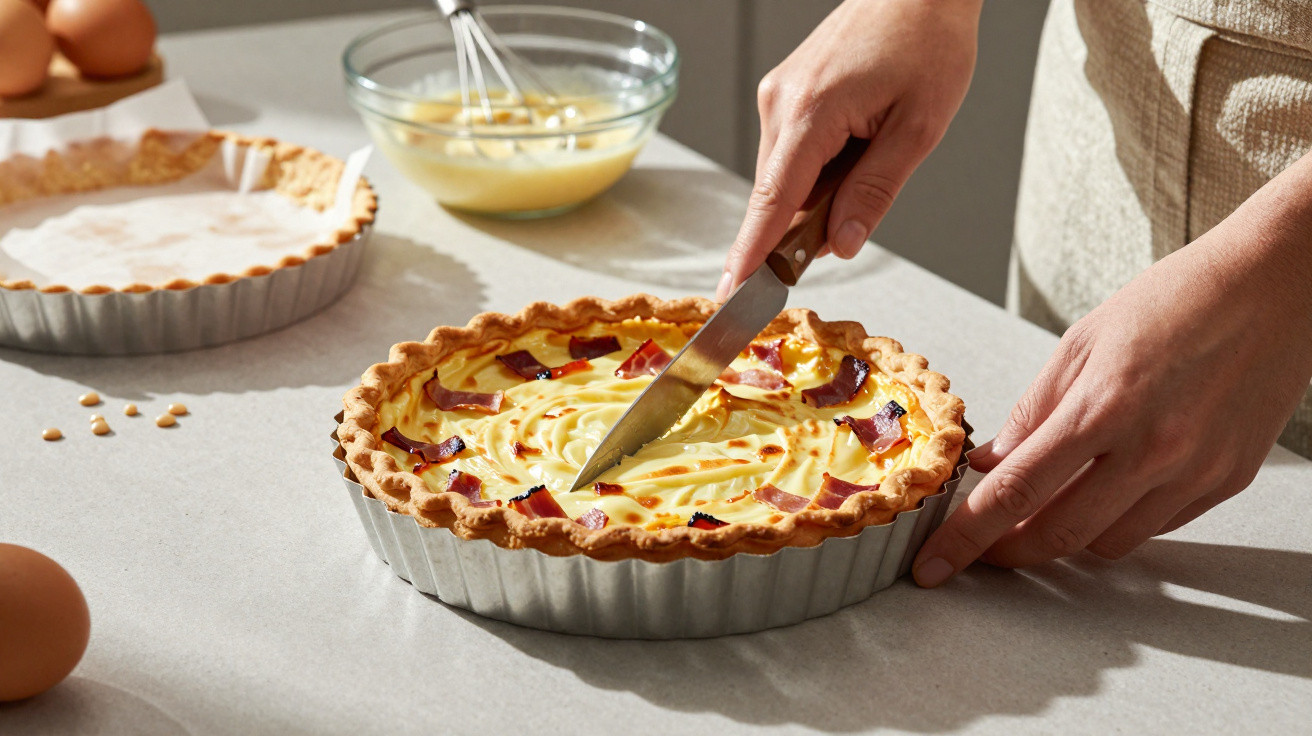
Quiche lorraine may seem like the sort of straightforward supper you can make without a second thought, but chefs discreetly take a different approach.
That golden wedge can look modest on the plate, yet it depends on a precise technique. Professional cooks understand that one minor practice is the difference between a soggy, unremarkable quiche and a crisp, restaurant-style bake that slices neatly and can be served with confidence.
The step chefs quietly avoid skipping with quiche lorraine
Many home cooks assemble a quiche as they would an ordinary tart: pastry goes into the tin, filling is poured in, then it is put in the oven with fingers crossed. It may emerge puffed and nicely coloured, appearing perfectly acceptable. Ten minutes later, however, the custard has cooled, the base has gone soft and the wedge slumps across the plate.
Chefs never rely on raw pastry to “sort itself out” under a heavy custard. They prepare the crust as a separate job.
Missing out the pre-cooking stage leaves a pale bottom, gummy layers and pastry that tastes insufficiently baked, even when the surface has browned. Bacon fat and cream sink directly into the dough, while moisture from the milk follows. Rather than a crisp pastry case, the result resembles bread pudding resting on a floppy round of pastry.
Professionals prevent this by seeing pastry as a structural element rather than merely a vessel. The filling can wait; the crust is dealt with first.
The chef-approved method for a crisp, sliceable quiche
In professional kitchens, a quiche tin seldom moves straight from raw pastry to its complete bake. The pastry base is always cooked on its own first, frequently with an additional protective coating. This makes a substantial difference to the finished wedge.
Think of the base as a waterproof floor: it needs to harden and seal before you pour the “cement” of egg and cream on top.
Blind baking, with an extra safeguard
Chefs generally line the tin with shortcrust pastry and give it a brief “blind bake” before any filling is added. In numerous French-style kitchens, they first apply an exceptionally thin layer of egg white to the pastry. It sets in the oven, creating a barrier between the custard and the crust.
In practice, the process is as follows:
- Preheat the oven to roughly 180 °C (350 °F).
- Roll out the pastry and place it in the tin, pressing it firmly into the corners.
- Paint the base with lightly whisked egg white, using just enough to leave a sheen rather than a pool.
- Cook the unfilled shell for about 5 minutes, until its surface is dry and a little firm.
- Let it cool briefly, add the filling and return it to the oven with the custard.
The science behind it is straightforward. Egg white quickly firms and contracts, pastry fats begin cooking, and the flour starches start to create a protective layer. When the liquid filling is added afterwards, it cannot seep into uncooked flour. It sits instead on a surface that is already able to maintain its form.
What it does for the finished quiche
This two-part process brings several subtle yet important benefits when serving:
| Without blind baking | With blind baking + egg white |
|---|---|
| The base remains pale and soft | The base becomes evenly golden and crisp |
| Custard penetrates the pastry | The crust and filling remain clearly distinct |
| Wedges droop or fall apart | Neat slices hold upright on the plate |
| The texture declines as it cools | The texture lasts for hours, including after reheating |
The approach is particularly useful when serving quiche at room temperature, putting it on a buffet or taking it to work the following day. A pastry case that retains its crisp edge still tastes freshly baked long afterwards.
How chefs actually make a classic quiche lorraine
As well as focusing on the pastry, professionals adhere to a closely defined filling. Traditional quiche lorraine is based on salted pork, eggs, cream and milk, finished with a little nutmeg. Cheese features in plenty of modern versions, although purists commonly leave it out.
A typical chef-style ingredient list includes:
- Shortcrust pastry (homemade or good-quality ready-rolled)
- Smoked bacon lardons
- Butter to finish the base
- Whole eggs
- Double cream and whole milk
- Salt, freshly ground black pepper and grated nutmeg
- Egg white to seal the pastry
The bacon is fried until its fat has rendered and its edges are golden, then placed on kitchen paper to drain. Because excess fat in the filling can damage the crust and make the custard heavy, chefs remove it before folding the lardons into the egg mixture.
The custard: not simply eggs and cream
Professionals handle the custard almost as though they are preparing a savoury crème anglaise. They whisk the eggs, cream and milk until smooth before adding the seasoning. Nutmeg should remain restrained, adding warmth rather than taking over the flavour.
A well-balanced quiche custard sets softly, with a gentle wobble, not a rubbery bounce.
The relationship between egg and liquid determines this texture. An excess of cream and milk can leave the middle unwilling to set, while too many eggs produce a firmer, nearly cakey consistency. Many chefs trial new proportions in small tins, making adjustments until a slice stays intact while remaining tender.
Baking like a professional: from oven to table
After the base has completed its short initial bake and the bacon-custard mixture is ready, assembly is swift. A few small pieces of butter are sometimes added to the hot pastry before the filling, contributing flavour and encouraging browning. The custard is then poured in, distributing the lardons evenly around the tin.
The quiche goes back into an oven at about 180 °C for approximately 40–45 minutes, according to its depth and the particular oven. Chefs do not depend on timing alone, instead checking for three indicators:
- The middle only just quivers when the tin is gently moved.
- The top is lightly risen and flecked with golden colour.
- The pastry edges have become darker in colour without reaching a brown-black shade.
In many restaurants, the quiche is allowed to cool a little before being served warm or at room temperature, giving the custard time to settle. Slicing it too soon can tear the wedges and cause the filling to run from the crust.
Why home cooks often overlook this step
Blind baking is an uncomplicated practice, but speed is the reason many home cooks leave it out. After work, a one-stage recipe is more tempting than one that takes extra time, even if it is only five minutes. Others are concerned about pastry shrinking or having to handle hot tins.
Chefs stress that spending those five minutes can rescue an entire dish from being merely average. It also makes quiche easier to plan ahead:
- The empty pastry shell can be baked earlier in the day.
- The sealed base can be chilled, then filled and baked later.
- You can make larger quantities for parties without worrying about soft pastry.
For people who entertain regularly, this one technique improves brunches, office potlucks and relaxed evening meals without requiring specialised equipment or expensive ingredients.
Beyond lorraine: using the same trick for other tarts
The technique chefs use for quiche lorraine extends well beyond this one dish. Every savoury tart with a wet filling benefits from a similar sealing and baking method. Spinach quiche, salmon and leek tart, and tomato and goat’s cheese galette all face the same issue: liquid saturating raw dough.
Once you start sealing pastry with a quick blind bake, supermarket-style soggy tart bases become hard to tolerate.
The same idea is useful in sweet baking, too. Fruit pies, custard tarts and lemon pies develop a crisper bite and more distinct layers when the base no longer absorbs juice or cream. In smaller home ovens, where the heat may be inconsistent, this added stage acts as a form of insurance.
For anyone interested in cooking techniques, quiche lorraine is more than an inexpensive, comforting evening meal. It becomes a useful lesson in the way fat, flour, egg and heat interact. Trying small adjustments-such as changing blind-baking times, adding extra yolks or raising the temperature slightly-quickly reveals how texture changes. Those lessons readily apply to other dishes, from uncomplicated weekday tarts to more delicate custard-based bakes.

















Comments
No comments yet. Be the first to comment!
Leave a Comment