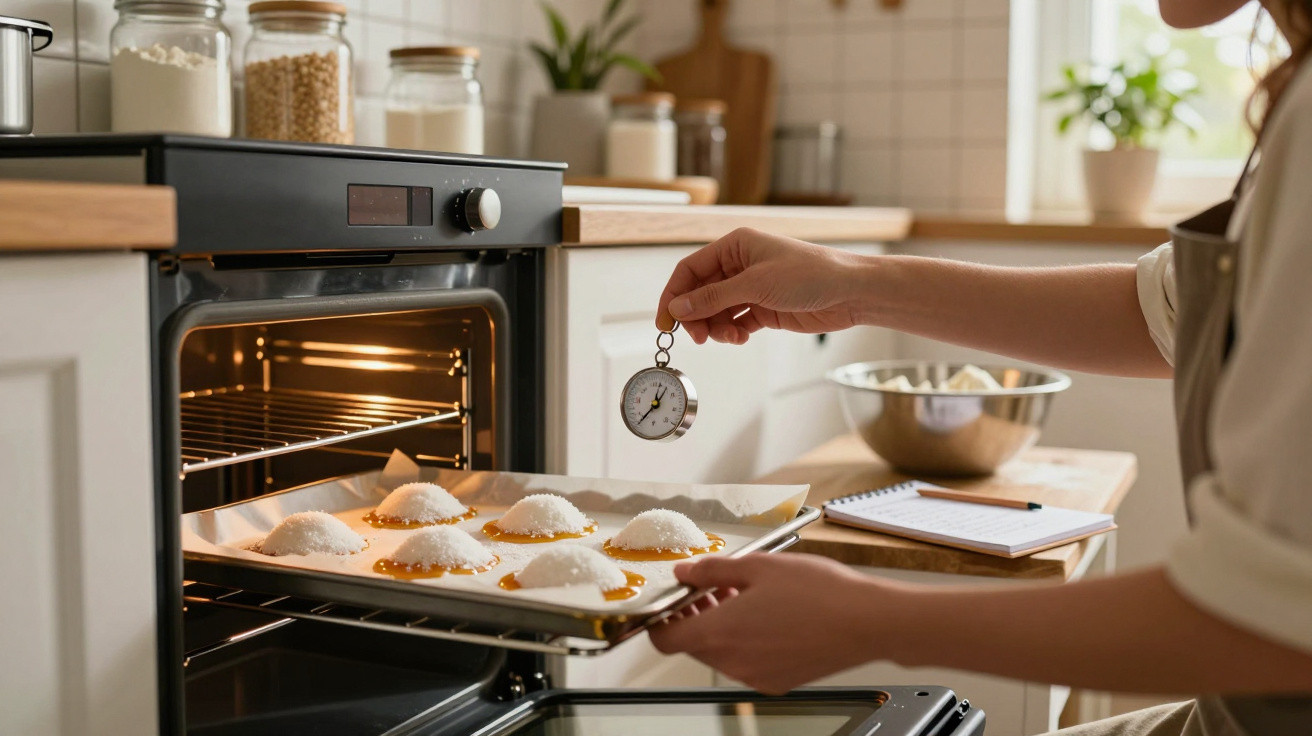
The baker crouched down, eased the oven door open and frowned.
The croissants appeared perfectly good to me, yet they were not what she was watching. Her attention was fixed on a little metal gauge attached to the oven shelf, as though she were checking a private detail amid the morning rush. She nudged the temperature control by a few clicks and said simply, “It’s running hot today.” Then she returned to shaping the dough as though nothing unusual had occurred.
That was when I had a mildly embarrassing realisation. At home, I treated my oven with the unquestioning faith you might give a loyal dog: set it to 180°C, leave it alone, then grumble when a cake collapses or a chicken turns dry. It had never occurred to me that the figure on its display might be untrue. In a professional kitchen, that sort of trust would be laughable.
The difference between the temperature your oven claims to be at and its real temperature is wider than most home cooks imagine.
The quiet habit that separates professionals from the rest of us
Visit a decent bakery before dawn and you will spot the same understated routine. Before the first tray goes into the oven, someone checks an independent thermometer or taps a softly beeping digital probe. There is no fuss and no speech about “precision” - only a fast, near-effortless calibration check before the dough is baked.
This is not an elaborate chef’s trick; it is essential for survival. When you are selling 200 loaves each morning, a 20°C difference can turn an ideal crust into a pale, gummy failure. Bakers cannot afford to wonder whether “200°C fan” really delivers 200°C. They require evidence, so they gather it with every preheat, gradually forming a mental picture of each oven’s behaviour on a hectic Tuesday or a wet Saturday.
At home, however, we seldom do this. We preheat, place our faith in the oven and hope.
Think of a small London bakery I visited last winter. Maya, the head baker, showed me a scuffed stainless-steel oven thermometer permanently clipped to the centre shelf. “This thing cost me eight quid,” she laughed, “and it saves me hundreds every month.” The oven’s digital display showed 220°C, while the small thermometer inside registered just below 200°C.
Without that measurement, every baguette would have entered the oven 20°C below the temperature required by the recipe. It may look like a minor numerical detail, but the practical result was loaves that were flatter, less richly coloured and chewier inside. Maya had discovered that this particular oven had to be set 15–20°C above the recipe’s instruction to produce the correct bake. The dial offered an estimate; the thermometer gave the truth.
Most domestic ovens shift over the years. Elements wear out, door seals become less tight and thermostats grow slightly sluggish. Research by a US consumer organisation found that home ovens were often inaccurate by 10–25°C, with bigger gaps sometimes appearing at higher temperatures. That can be the difference between golden and burnt roast vegetables, or between a light sponge and a dense let-down when you are making a birthday cake.
From a practical perspective, oven miscalibration is entirely understandable. An oven does not heat as uniformly as a laboratory instrument. Instead, it repeatedly switches on and off while chasing its set temperature. Some appliances rise above the target before falling below it, producing more of a thermal rollercoaster than a steady line. Your tray’s position within that cycle can matter more than the number shown on the control.
Professionals understand this, which is why they approach every oven as an individual with its own temperament. One may be “hot at the back, lazy on the left”. Another might run too hot for its first 15 minutes before settling at a lower level. Their calibration checks allow them to understand that character before risking dough that took 18 hours to prove.
At home, we tend to blame ourselves instead. We describe a recipe as “unreliable” or our own ability as “terrible”, even though the quietly erratic appliance in the kitchen may account for half the problem. Once you recognise it, it is impossible to ignore.
The straightforward oven calibration check bakers rely on
The process is almost frustratingly easy. Buy an inexpensive oven thermometer, either one that clips onto a shelf or stands upright. Position it in the middle of the centre shelf, ensuring it does not touch the oven walls. Choose a familiar baking temperature, such as 180°C, and preheat the oven. Then wait longer: allow a full 20–30 minutes rather than stopping when the indicator light goes out.
Check the thermometer through the door glass. A reading of 170°C means that your oven is 10°C too cool at that setting; a reading of 195°C means it is running hot. Make a note of it. Then test another useful temperature, such as 160°C for cakes and 220°C for pizza or bread. Within half an hour, you will have the beginnings of a calibration chart: “When I set 180°C, my oven is actually closer to 190°C.”
This is precisely what many bakers do, albeit with pricier equipment and more rigorous routines.
The step almost every home cook overlooks is checking again from time to time. Maya looks at her thermometer every morning, but that level of commitment is unnecessary at home. Repeating the test every few months - or when your baking starts behaving strangely - is already a major improvement. Let’s be honest: nobody really does it every day.
One frequent error is trusting the preheat beep completely. Usually, that noise means the air reached the target temperature briefly, not that the entire heavy metal oven cavity has stabilised evenly. Baking the moment it sounds is essentially temperature roulette. Another issue is filling the oven with trays and then being surprised when the thermometer reading plunges. Cold food and metal absorb heat, so the oven needs time to recover.
I have watched home cooks blame “bad yeast” or “cheap flour” for flat bread when the true culprit was a 30°C temperature fall as soon as the door opened. It is disheartening on a personal level: you follow each step carefully, make an effort, and the result still seems wrong. Professionally, that disappointment is exactly why bakers care so much about calibration. They would prefer to alter a dial rather than question their own hands.
We have all experienced that hopeful moment of opening the oven door, only to find that the middle of the cake has dropped like a deflated balloon.
“My oven lies to me. I just learned to speak its language,” a pastry chef told me, shrugging, as if that were the most normal sentence in the world.
To make that language simpler to understand at home, aim for small, repeatable adjustments instead of perfection. If you discover that your oven runs 15°C cool at around 180°C, raise recipes using that temperature by 10–15°C or cook them a little longer. Save notes on your phone: “Victoria sponge: 190°C in my oven, not 180°C, 5 min extra.” After several bakes, your kitchen starts to feel less like a place for guesswork and more like a compact, efficiently run bakery.
- Purchase a basic oven thermometer and keep it inside.
- Test it at 2–3 temperatures you use regularly.
- Record the difference at each temperature.
- Alter later recipes by adjusting temperature or cooking time.
- Check again every few months, or whenever results seem “off”.
Why this small oven calibration habit transforms your cooking
After carrying out a basic calibration check, the way you work in the kitchen subtly changes. You become less quick to blame recipes and begin to view them as guidance that must be adapted to your own oven. A roast chicken recipe specifying 200°C becomes, in your mind, “Right, 210°C in my kitchen.” When biscuits consistently brown too much at the back, you learn to rotate the tray halfway through because you now understand that your oven is hotter there.
This does not make cooking feel like a scientific experiment. If anything, it makes the process more relaxed. Once you understand the appliance, you can worry less about everything else. Rather than lingering anxiously by the door, you look in with interest. You gain a sense of how long the oven takes to recover after opening, how heavily you can load it before it struggles and where its hottest corners are.
Professional bakers would not consider working without that understanding. The thought of relying entirely on a factory setting would make them laugh. At home, even a casual version of their approach - one thermometer, a few tests and a handful of notes - puts you ahead of most neighbours. It is a small, barely noticeable practice that improves everything from frozen chips to a carefully layered lemon drizzle.
Once you tell somebody else about it, you will sound like someone sharing a secret: “You know your oven temperature is probably lying to you, right?”
| Key point | Detail | Benefit for the reader |
|---|---|---|
| Ovens often run hot or cold | Domestic ovens can be off by 10–25°C from the set temperature | Explains why recipes “fail” even when you follow them |
| Simple calibration check | Use a cheap oven thermometer, test a few key temperatures, note the gaps | Gives a quick, practical way to understand your own oven |
| Adjusting for your oven | Increase/decrease temps or times based on your findings, and keep notes | Improves baking reliability and builds confidence in the kitchen |

















Comments
No comments yet. Be the first to comment!
Leave a Comment