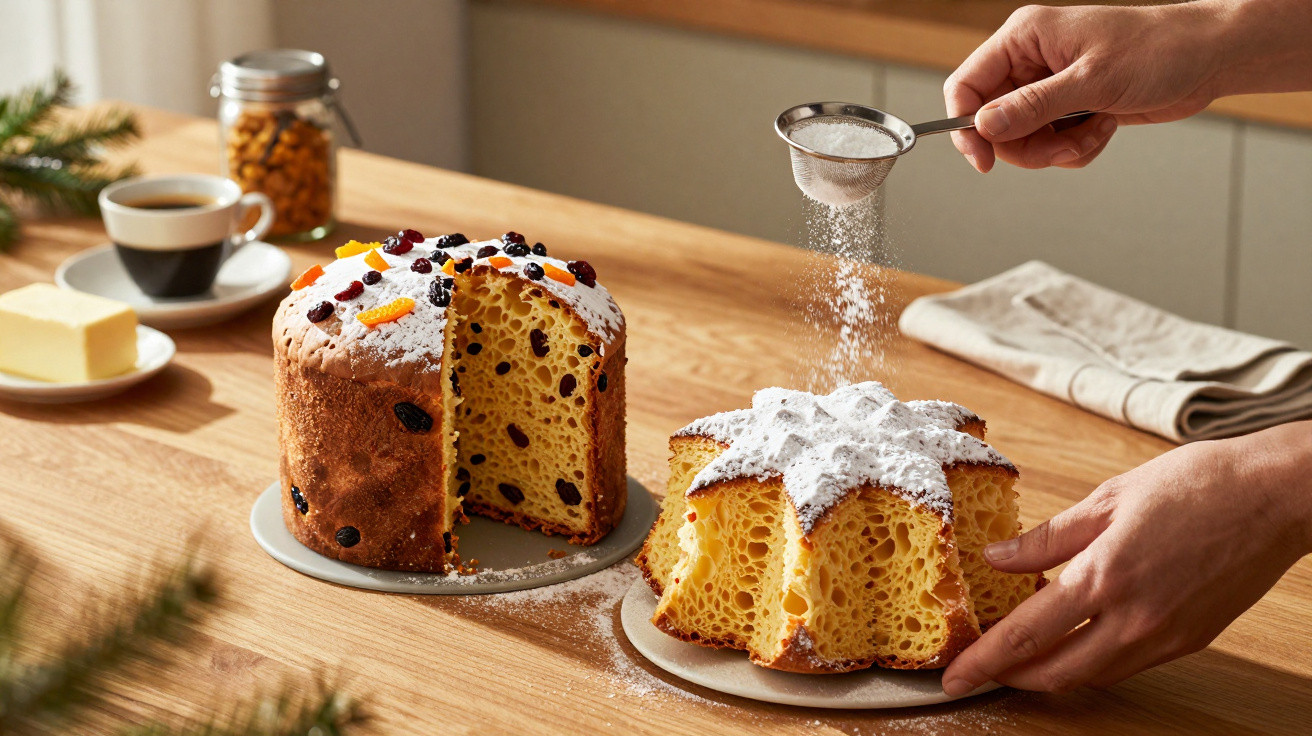
Across Europe and the US, two lofty Italian cakes are engaged in a quiet Christmas battle for space on festive dessert tables.
Both are impressive to look at, sold in crinkled cardboard boxes, and scented with butter and the festive season. But panettone and pandoro reveal markedly different stories about Italy, its regional identities, and the global spread of Christmas traditions.
The Christmas cake showdown on your table
Enter a supermarket anywhere from London to Los Angeles in December and you are likely to see an entire display of Italian festive cakes. To plenty of shoppers, they can seem much the same: tall, golden and somewhat bread-like. The packaging may read panettone or pandoro, yet that distinction is often all they know.
Italian households, however, seldom mix them up. Choosing one over the other is rooted in regional allegiance, preferred textures and memories of breakfast on 26 December.
Panettone and pandoro are not just cakes; they mark where, how and with whom people celebrate Christmas.
With appetite for “authentic” festive food increasing in the UK and US, the competition between these two staples has also become a subtle seasonal commercial story. Export volumes rise each year, extra brands appear on shop shelves, and pastry chefs from New York to Manchester adapt the recipes.
Panettone, the rich Milanese original
Originating in Milan, panettone comes with a rich layer of legend. Food historians place its earliest forms several centuries ago, when enriched breads gradually developed into the high, domed loaf familiar today.
From fairy tale to global product
A number of romantic legends seek to account for its name. In one well-known telling, a baker’s apprentice named Toni supposedly created an extravagant bread to win over his master’s daughter. “Pan de Toni” is said to have later evolved into panettone.
A different story centres on a baker who enriched an ordinary dough with butter, eggs and candied fruit in an effort to win somebody’s affection. While neither account can be fully verified, they illustrate the close association people make between this cake, emotion, drama and celebration.
Its modern evolution is clearer: it moved from being a local Christmas speciality to a mass-produced symbol, shipped worldwide and reinvented with chocolate chips, pistachio cream and even savoury fillings.
What panettone really is made of
Proper traditional panettone is more than sweetened bread. Bakers prepare a slowly fermented dough, frequently using a natural starter, and enrich it with:
- high-fat butter, providing softness and flavour
- egg yolks, adding richness and colour
- sugar, for sweetness and browning
- raisins, for aroma and chew
- candied orange and citron peel, bringing citrus notes and bitterness
The dough is kneaded and left to rise several times. These stages strengthen the gluten and create its recognisable honeycomb-like interior. Once baked in its distinctive paper mould, the loaf is cooled upside down so it does not collapse and retains its light crumb.
A well-made panettone feels incredibly light in the hand, yet tears into long, elastic strands like a delicate brioche.
Industrial products commonly shorten this process through additives or quicker fermentation. Artisan makers uphold the lengthy approach, citing improved digestibility and a deeper, more complex flavour.
Pandoro, Verona’s golden star
Pandoro hails from Verona, with a character that strongly differs from its Milanese relative. While panettone is packed with raisins and citrus, pandoro remains smooth and restrained.
A cake built around texture
Its name directly translates as “golden bread”, referring both to its colour and its richly made dough. The recipe contains generous quantities of butter, eggs, sugar and vanilla, while leaving out raisins and candied fruit altogether.
This creates an exceptionally soft, almost velvety crumb. Baked in a tall mould with eight points, it resembles a towering star. Before it reaches the table, it is generally covered liberally in icing sugar to evoke newly fallen snow.
Pandoro sits closer to cake than fruit bread when compared with panettone. That often makes it popular with younger diners and with anyone who does not enjoy candied peel.
Pandoro is the “blank canvas” of Italian Christmas baking: golden, buttery and easy to match with creams, chocolate or fruit.
Serving rituals and timing
Regional customs differ, although a broad pattern can be seen:
| Aspect | Panettone | Pandoro |
|---|---|---|
| Typical occasion | Christmas Day, St Stephen’s Day | New Year’s Eve, New Year’s Day |
| Cutting style | Vertical slices, like a tall loaf | Horizontal rings, forming a layered star |
| Common pairing | Espresso, sweet wine, mascarpone cream | Hot chocolate, zabaglione, whipped cream |
| Texture | Open crumb, irregular holes, chewy fruit | Fine crumb, soft, uniformly tender |
Such practices are not fixed rules, particularly beyond Italy. Still, they demonstrate how each cake has claimed a distinct place in the festive timetable.
How to tell them apart in a UK or US shop
When faced with a busy seasonal aisle, shoppers can use several quick visual signs to choose which cake to bring home.
- Shape: Panettone is generally a tall dome; pandoro has the faceted form of a star-shaped tower.
- Packaging: Panettone boxes commonly feature slices speckled with raisins and orange peel, whereas pandoro packs emphasise golden crumb and a snowy layer of sugar.
- Weight: At an equivalent size, conventional panettone often seems a little lighter, thanks to its more aerated structure.
- Ingredient list: Raisins and candied fruit point to panettone; vanilla with no fruit points to pandoro.
The labels have become less straightforward with chocolate editions, vegan recipes and gluten-free alternatives. Certain makers even market a pandoro-shaped “chocolate pandoro” as panettone, or do the reverse, adding further confusion.
Why these cakes are everywhere this year
A number of developments are taking panettone and pandoro beyond their established markets. Import figures over the past decade indicate robust export growth to northern Europe, North America and Asia. Meanwhile, craft bakeries outside Italy are producing “sourdough panettone” and “modern pandoro”.
The appeal for retailers is clear: these cakes keep well, have a festive appearance, and convey a sense of European heritage that suits Christmas promotion perfectly. Consumers, meanwhile, get an option more exciting than an ordinary fruitcake, with a lighter texture suited to breakfast as well as post-dinner eating.
In many households, leftover panettone or pandoro quietly becomes the base for French toast, trifles or bread-and-butter puddings in January.
Some Italian producers are concerned about this dilution. In their view, speeding up fermentation or filling products excessively damages the standing of both cakes. Protected geographical indications and quality seals are intended to give purchasers confidence, although only a minority of exported products display them.
Choosing based on taste, not just tradition
Outside Italy, family background is seldom the deciding factor. Flavour preferences and intended serving occasions matter more, and a few practical pointers are useful.
- Choose panettone if you like dried fruit, the slight bitterness of candied peel and a more layered flavour profile.
- Choose pandoro if vanilla, a purer buttery flavour and a texture nearer to sponge or brioche are more appealing.
- Offer panettone with coffee or dessert wine after a rich meal, as its fruit and acidity make an effective final course.
- Serve pandoro with hot drinks at afternoon get-togethers, or use it for a layered dessert with berries and cream.
Allergies and dietary requirements matter too. Traditional versions of both cakes contain substantial amounts of eggs, butter and gluten, though a growing number of makers sell plant-based and gluten-free choices. Quality differs greatly between these alternatives, so it is generally worthwhile to check ingredient lists and reviews.
From festive treat to culinary project
For enthusiastic home bakers, both panettone and pandoro offer demanding winter baking projects. Each calls for strong flour, prolonged fermentation and precise timing, but panettone is usually considered the harder challenge because of its height and its tendency to collapse.
An initial attempt is unlikely to equal bakery-quality results, but making them develops valuable abilities: handling sourdough, regulating dough temperature and learning how gluten develops. Many bakers begin with a simpler recipe before progressing to the multi-day processes used by professionals.
Those who would rather eat than knead can approach them differently, by sampling multiple brands side by side. Setting an industrial panettone against an artisan version shows how fermentation length affects aroma, how genuine butter registers on the palate, and how the quality of fruit alters the relationship between sweetness and acidity.
They may appear to be minor distinctions in a packed shop display, yet they define the whole experience at the table: from the first slice shared on Christmas Eve to the final toasted wedge in early January.

















Comments
No comments yet. Be the first to comment!
Leave a Comment