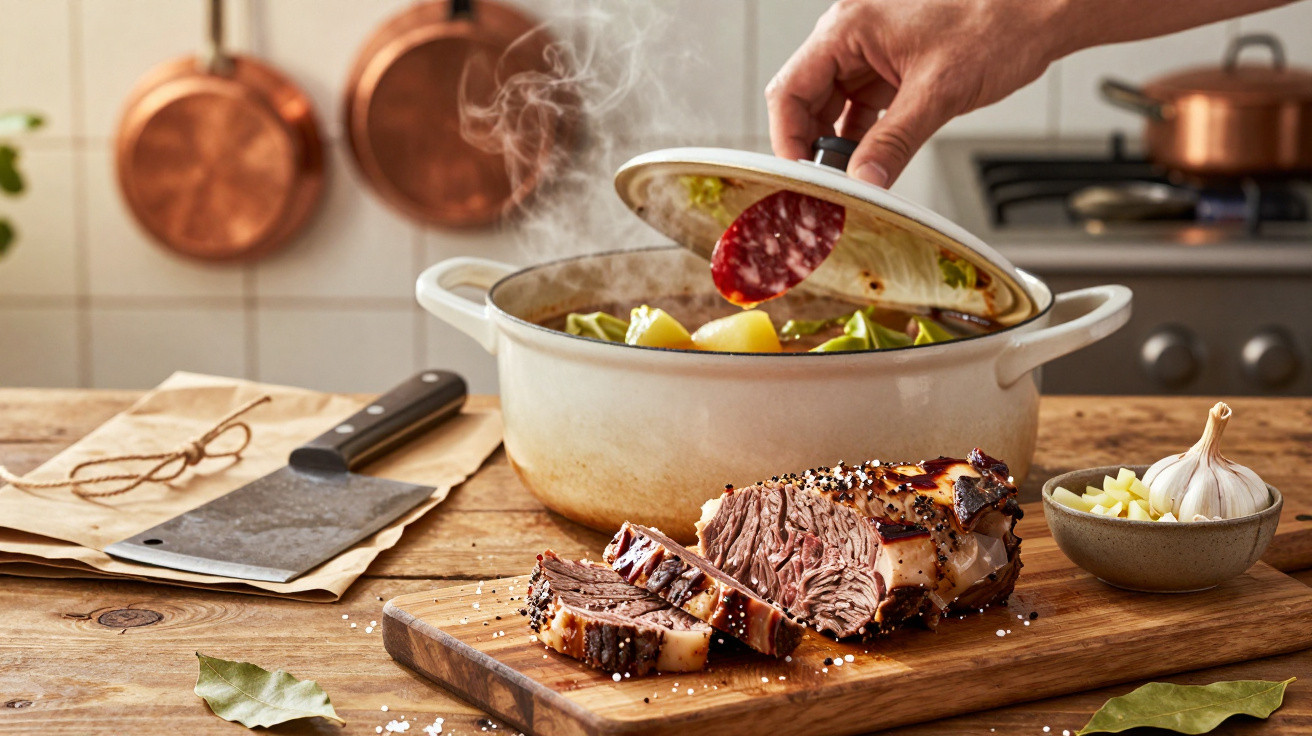
On a Saturday morning at the butcher’s counter, the same cuts invariably disappear first: bright-red blade steak, beef cheek made famous online, and thick slices of shin with their central bone. Alongside them, a more modest cut waits almost unnoticed. It lacks the photogenic fullness of premium cuts, and its name is hardly glamorous: shoulder clod. Yet regular customers often ask quietly for it when planning their Sunday boiled beef dinner. At under €10 per kilo in some butcher’s shops and market stalls, it produces a full-bodied broth, yielding meat and the comforting childhood flavour that hurried meals never quite recreate. You simply need to know what to ask for.
Shoulder clod: the understated cut that transforms boiled beef
Shoulder clod comes from the beast’s shoulder, close to the neck and blade. There are two varieties: a slow-cooking shoulder clod with more gelatine, and a steak shoulder clod that is slightly more tender and suited to quick cooking. For boiled beef, it is the former that you need. Its initial appearance is not especially impressive, with visible fibres and small sinews running through it. After three hours in a gently simmering broth, however, these gradually break down, leaving meat with a soft bite that never turns dry. It is the sort of cut that seems unremarkable at first, then becomes everyone’s favourite at the table.
At independent butchers, slow-cooking shoulder clod commonly costs between €8 and €10 per kilo, depending on the region, the meat’s origin and the time of year. At that price, it remains much more affordable than beef cheek or blade, which are often priced above €13 or €15. One market butcher explains that her most loyal customers sometimes ask for “the cut that makes the broth”, without even naming it. They know exactly what they want: enough meat to feed six people without sending the shopping bill soaring. A kilo of shoulder clod, a few vegetables and a marrow bone are enough to make the meal feel altogether more special.
Butchers sometimes keep this cut for their own cooking, or recommend it to customers who understand the value of waiting. It is not scarce; it simply needs old-fashioned, slow cooking, far removed from fast-food habits. Honestly, nobody cooks that way every day. Shoulder clod cannot offer the instant drama of a grilled rib-eye, but it has a genuine strength: it enriches stock without making it heavy. Its connective tissue naturally releases gelatine, creating that faintly silky feel on the lips and helping a soup set in the fridge the next day.
How to order and cook shoulder clod properly
At the counter, the easiest request is: “I’d like slow-cooking shoulder clod, with a little fat and sinew.” This avoids confusion with steak shoulder clod, which will not deliver the same results after several hours on the hob. Allow roughly 180 to 220 grams of raw meat per adult when boiled beef is the main course. For four people, 800 grams to one kilo is more than enough, particularly with carrots, leeks, turnips and potatoes. Ask for one whole piece or two large pieces, as they will stay juicier than meat cut into very small chunks.
The most common mistake is to boil the pot hard in an attempt to speed things up. The meat tightens, the stock becomes cloudy, and the vegetables break down into an unattractive mush. Instead, put the shoulder clod into a large pan of cold water, bring it slowly up to temperature, skim it at the start, then keep it at the gentlest simmer. Leave the lid slightly ajar. After two and a half to three hours, a fork should slide in without resistance. There is no need to add every vegetable at once: leeks and carrots can cook for longer, while potatoes need far less time.
A good boiled beef dinner does not depend on a single cut, even though shoulder clod can easily take the leading role. Butchers often like to pair it with a small amount of beef ribs or shin, especially for a more robust stock.
“Shoulder clod gives the meat, shin gives the richness, and the marrow bone gives the memory,” says an artisan butcher accustomed to weekend orders.
When placing your order, these straightforward pointers will help:
- Slow-cooking shoulder clod: economical, flavourful and ideal for long cooking.
- Shin: brings gelatine and makes the broth richer.
- Beef ribs: add flavour, but contain more fat.
- Marrow bones: use sparingly, for those who enjoy them spread over well-toasted bread.
The renewed pleasure of cooking an overlooked cut
The growing appeal of shoulder clod also says something about how we cook today. For years, many households favoured lean, quick-cooking cuts that could be ready in ten minutes. Prices then rose, tastes shifted, and slow-simmered meals regained their place, especially on Sundays or when the first cold weather arrives. Shoulder clod meets that desire without pretending to be a luxury product. It does require time, certainly, but that time largely takes care of itself. A pan on the hob, the scent of leeks through the home and bread waiting on the table: very little more is needed to slow the pace for a while.
There is also quiet satisfaction in moving beyond the usual automatic choices. Rather than ordering blade simply because everyone is talking about it, asking for shoulder clod starts a conversation with the butcher. Depending on the delivery, they may suggest a more marbled piece, some neck, or a combination suited to the number of guests. Prices naturally vary, and the €10-per-kilo mark is not guaranteed everywhere. Still, the habit is worthwhile: check the label, ask the question and compare prices without embarrassment. Good family food should not be the preserve of large budgets.
The following day, shoulder clod offers another advantage: it makes excellent use of leftovers. Shredded meat can be added to a potato salad, a cottage pie or pasta with a ladleful of reduced stock. Once strained and chilled, the broth becomes a valuable base for risotto or soup. This is the kind of cooking people often remember because it does not try to impress. It works with what is available, wastes almost nothing and brings people together without fuss. Perhaps your next boiled beef dinner should begin with one simple question for the butcher: “Do you have shoulder clod?”
| Key point | Detail | Benefit for the reader |
|---|---|---|
| The cut to request | Slow-cooking shoulder clod, from the shoulder | A flavoursome alternative to better-known cuts |
| The right price | Often between €8 and €10 per kilo, depending on the butcher | A generous meal without blowing the budget |
| Ideal cooking | Two and a half to three hours at a gentle simmer | Tender meat and naturally rich broth |

















Comments
No comments yet. Be the first to comment!
Leave a Comment