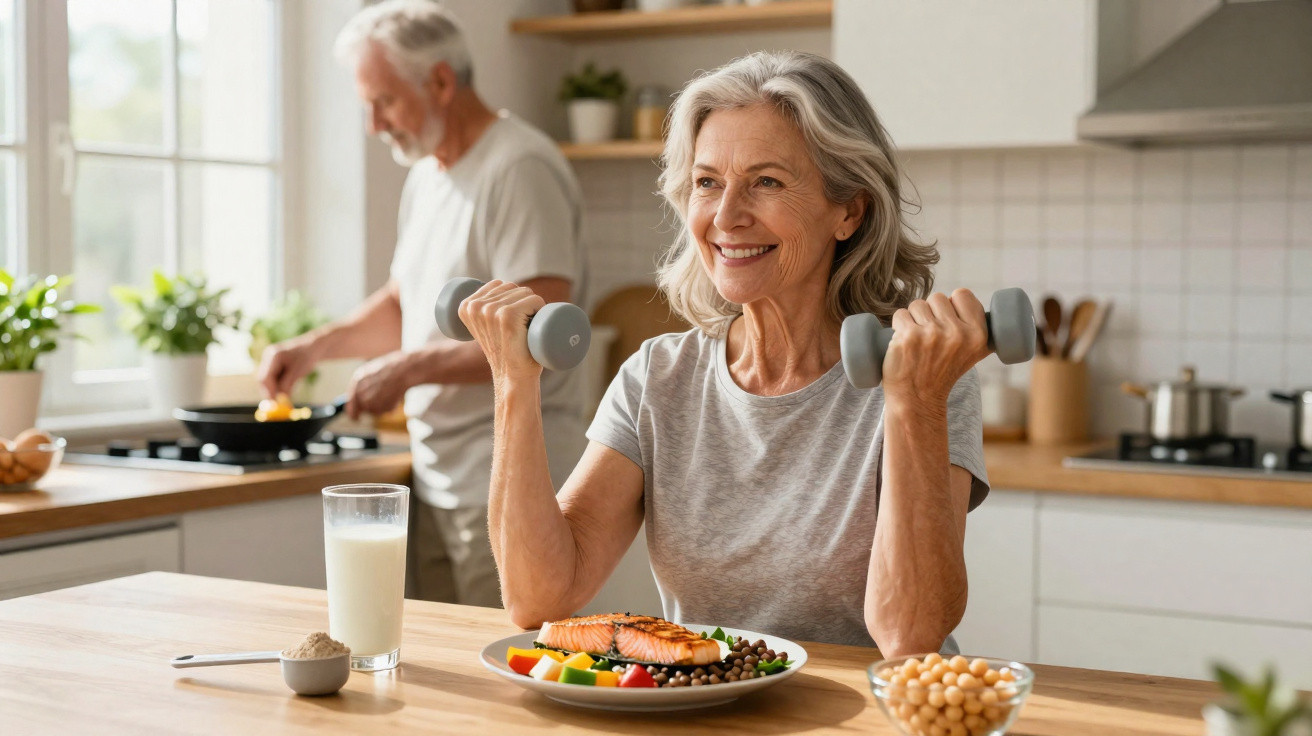
Have you found that routine activities can gradually demand more effort as you get older? Twisting open a stubborn jar, lifting bags of shopping, going up stairs or simply rising from a chair can become more difficult than they once were.
Although many people regard these shifts as an unavoidable feature of ageing, emerging research indicates that one straightforward factor could matter more than previously thought: protein.
A major study of almost 38,000 older people in 27 European nations identified a clear association between protein consumption and remaining physically active and independent.
Its results indicate that adequate protein could help people retain muscle power and physical capability as they grow older.
“Functional decline and sarcopenia are major aging-related concerns. While protein intake is known to influence muscle health, its longitudinal impact on strength and physical function across age and gender remains underexplored,” the authors write.
Muscle loss can undermine independence
With age, muscle is lost much like money disappearing from a wallet: initially little by little, then more quickly than anticipated.
Clinicians refer to this gradual decline as sarcopenia, but its everyday consequences are far from trivial. It is linked with more falls and longer periods in hospital.
It can also raise the likelihood of entering long-term care, something few people expect or plan for.
Grip strength, assessed by squeezing a small instrument, is now widely regarded as one of the most reliable straightforward measures of general health among older people. It may forecast outcomes ranging from walking pace to long-term survival.
“Functional decline is multifactorial, involving musculoskeletal deterioration, neurological changes, and nutritional deficiencies,” the authors note.
Within this wider context, protein supplies the material the body needs every day to repair muscle that ageing continually breaks down.
Examining protein intake patterns
The study used a long-term survey that follows many thousands of Europeans aged 50 and above.
The researchers assessed information gathered in 2019 and 2020, then compared it with follow-up results collected two years afterwards. Their analysis centred on three basic questions.
In a normal week, how frequently do you consume dairy products? How often do you have eggs or beans? And how often do you eat meat, fish or chicken?
Researchers converted the responses into one score between 0 and 100, classifying the lowest 10 per cent of participants as low-protein consumers.
Many Europeans fell short on protein
Dairy products dominated European diets. Roughly 60 per cent of participants consumed milk, cheese or yoghurt every day.
Around 30 per cent ate meat, fish or chicken daily. Eggs and beans, which are more affordable yet valuable protein sources, were eaten each day by only about 10 per cent.
Educational attainment also influenced dietary habits. A greater number of years in education was associated with more frequent consumption of beans, eggs and lean meat.
Low protein intake reduced strength
This is where the findings became striking. Compared with men whose diets were better supplied with protein, men in the lowest-protein category were 35 to 39 per cent more likely to have weak grip strength.
Among older women, the risk increased by 21 per cent. Somewhat unexpectedly, the same individual measure showed no definite association for younger women.
Dr Rizwan Qaisar, a muscle scientist at the University of Sharjah, led the research.
“The findings showed that individuals with consistently low protein intake were more likely to report problems with walking short distances, climbing stairs, reaching overhead, or managing routine tasks such as shopping,” said Dr. Qaisar.
Everyday movement became more difficult
In all groups examined, low protein consumption was associated with greater difficulty walking 100 metres - roughly the distance between a car park and a pharmacy counter, or from a bus stop to a clinic entrance.
Younger men with low protein intake were 53 per cent more likely to report difficulty, while the figure for younger women was 51 per cent.
The increase was less pronounced among older adults, but it remained meaningful. The implication is modest yet important: a daily walk that many people scarcely notice was gradually becoming more challenging for people who lacked protein.
“Simple movements such as walking, standing up, or carrying groceries require muscle strength, balance, and coordination,” noted Dr. Qaisar.
“When protein intake is low over long periods, the body may struggle to maintain these systems, increasing the risk of functional decline and loss of independence.”
Different effects for women and men
The findings suggested that insufficient protein created distinct difficulties for men and women.
Women in the low-protein group had the greatest problems with bending, kneeling and reaching above their heads - movements involved in dressing, emptying a dishwasher or taking a glass from a high cupboard.
For men aged 50 to 65 who had low protein intake, the odds of difficulty pushing or pulling large objects were 44 per cent higher. For men aged 66 and over, the odds were 21 per cent higher.
The researchers believe differences in muscle mass may explain these patterns.
Because men begin with more muscle, any reduction in strength may appear sooner in a test. Women have less muscle in reserve, so they may reach their limits sooner during activities requiring several muscle groups to work at once.
Younger women experienced particular difficulties
One finding was sufficiently pronounced that the research team checked it again. Women aged 50 to 65 in the lowest-protein category were more than twice as likely to experience difficulty using the toilet.
That same group was also 65 per cent more likely to have trouble doing the food shopping.
These are not minor adjustments to everyday life; they are the kinds of tasks that frequently determine whether an older person can continue living independently.
Older people require more protein
The biology underlying these results challenges a widespread assumption. Older bodies require more protein than younger bodies, rather than less.
Present recommendations advise at least 0.8 grams of protein per kilogram of body weight daily for adults below 65, increasing to roughly 1 gram per kilogram after the age of 65.
There is a term for the reason: anabolic resistance. Older muscle is less responsive to the amino acids entering the bloodstream after eating.
To activate the muscle-building signals that younger bodies produce more readily, an older person needs a stronger dietary signal, particularly from leucine. This essential amino acid is found in animal protein and some beans.
Plant foods and exercise also help
The results do not exclude plant-based diets. Beans, lentils, grains, dairy foods and eggs, combined throughout the day, can provide every amino acid the body requires.
Mediterranean and Nordic eating patterns have demonstrated this for many decades. Combining protein with physical activity is equally important.
Resistance training, including gentle options such as bodyweight squats or basic resistance bands, greatly improves how effectively dietary protein supports muscle building.
The evidence indicates that protein and exercise should go hand in hand.
Making protein choices at mealtimes
The study’s practical guidance is simple enough to put into practice this week. Rather than consuming most protein at dinner, distribute it across the day.
Base breakfast around a protein-rich choice, as this is the meal at which most older adults consume too little.
Combine animal and plant protein sources to support both quality and variety. Pay attention to portions, because appetite commonly declines with age even though the body’s requirements may not.
For women in their fifties and early sixties, the figures deliver a particularly direct message: it is not too soon in life to give protein the attention it deserves.
















Comments
No comments yet. Be the first to comment!
Leave a Comment