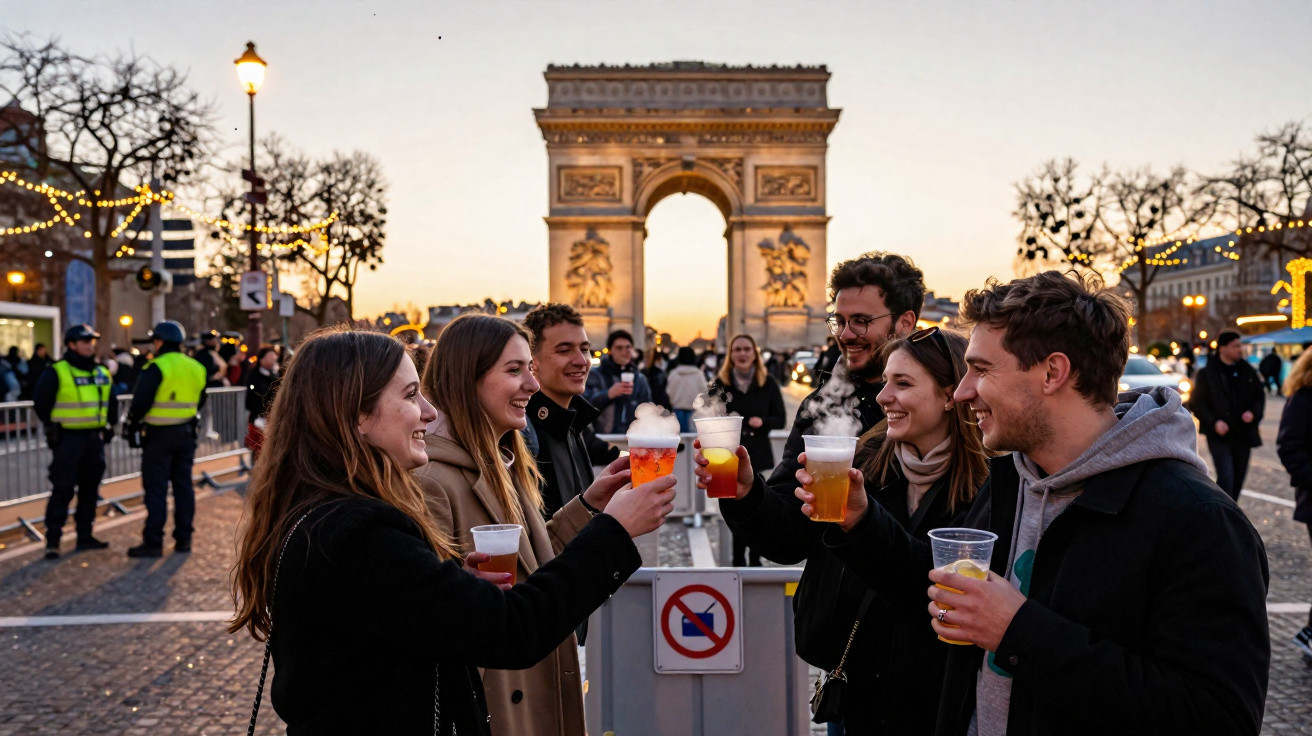
As 2026 begins, Paris’s main tourist district will be filled with celebrations, lights and crowds, yet the atmosphere around New Year toasts will change significantly.
The French capital’s New Year celebrations will still feature fireworks, projections and thousands of people on the streets. However, the customary glass of champagne on the pavement will disappear from one of the city’s best-known areas.
New Year 2026 alcohol ban: what changes in Paris
From 16:00 on 31 December 2025 until 04:00 on 1 January 2026, buying or drinking alcohol in public spaces will be banned within a defined perimeter around the Champs-Élysées area. The rule applies equally to residents and visitors.
The arrangement was introduced through a new Paris Police Prefecture order, Order No. 2025‑01692, created specifically for New Year’s Eve. Its purpose is to reduce risks in an area where crowd density rises sharply between 22:00 and 01:00.
Any alcoholic drink bought to take away or consumed in the street, on pavements, in squares or on central reservations within the defined perimeter is prohibited.
The restriction covers convenience shops, mini-markets, late-night grocers, wine shops, street vendors and any other retailer selling alcohol for consumption away from its premises. Businesses that continue to sell takeaway alcohol during the restricted hours may face enforcement action.
Which parts of Paris are covered by the ban
The 8th arrondissement is the principal focus of the measure, as it contains most of the Champs-Élysées avenue and the surrounding area of Place de la Concorde. The order extends beyond this district, however, also covering parts of the 16th and 17th arrondissements.
In practical terms, the covered zone includes:
- Champs-Élysées avenue, from Place Charles de Gaulle to Place de la Concorde;
- Nearby streets used by the public as access routes and meeting points;
- Side areas into which crowds usually spread after the show.
The boundary has a clear purpose: to prevent alcohol-consumption “islands” immediately beside the central zone, which could draw crowds into narrower streets that are harder to manage.
Even if you are not standing directly on the Champs-Élysées, you may still be inside the restricted zone. Residents and tourists are advised to check the official perimeter map before planning their evening itinerary.
What remains allowed within the zone
The ban concerns public spaces and takeaway sales, while licensed venues retain limited scope to operate:
- Bars, restaurants and clubs may sell and serve alcohol inside their premises;
- Drinking remains permitted indoors, provided normal opening-hours and safety rules are followed;
- Hotels may serve drinks to guests in internal bars or in rooms.
Anyone wishing to toast near the avenue should therefore book a table or arrange their evening in an indoor venue. Opening a bottle of champagne on the pavement, central reservation or public steps is a direct breach of the rule.
Timings, drink types and how the rule applies
The restrictions cover the busiest part of the celebration:
| Date | Time | Rule |
|---|---|---|
| 31/12/2025 | 16:00 to 23:59 | Takeaway alcohol sales and public drinking are banned within the zone |
| 01/01/2026 | 00:00 to 04:00 | The same restrictions remain in force overnight |
The measure applies to every category of alcoholic drink:
- Beer, including bottled beer and cans;
- Wine and sparkling wine, including champagne;
- Spirits and ready-made cocktails.
There is no distinction based on low or high alcohol content. If it contains alcohol, it cannot be bought to take away or drunk in the street within the specified perimeter and hours.
Fines and risks for anyone who chooses to toast anyway
Disregarding the rule can be costly. Drinking alcohol in a public space subject to a specific ban for a high-risk event constitutes a fourth-class offence under Article R.644‑5 of the French Penal Code.
The standard fine is 135 euros, which can increase to as much as 750 euros in the event of an uplift.
In addition to issuing a fine, security officers may:
- Seize bottles and cans;
- Instruct the person to leave the perimeter;
- Take an offender to a sobering-up cell where there is obvious intoxication.
For visitors travelling in groups or on a limited budget, this kind of offence could spoil the night and put pressure on the overall travel budget. The risk is greater for those carrying glass bottles, which are also prohibited in the area during the celebration period.
Heightened security and the effect on the celebrations
The security operation prepared by the French government for this New Year period is extensive. Around 90,000 police officers and gendarmes will be deployed nationwide, with approximately 10,000 in Paris and its surrounding area.
Around the Champs-Élysées, these personnel will be joined by the Paris Fire Brigade and soldiers from Operation Sentinelle. Expected measures include:
- Checkpoints involving searches of bags and rucksacks;
- Removal of street furniture from broad pavements and terraces;
- A ban on glass bottles and items considered dangerous.
The traditional end-of-year programme has been adjusted: the planned concert on the avenue has been cancelled, but the projection show on the Arc de Triomphe and the fireworks display remain on the programme. The intention is to retain the festive character while reducing alcohol consumption in a tightly packed crowd environment.
How to adjust your New Year plans in Paris
Anyone intending to be in Paris on this date will need to factor the new rules into their plans. The following scenarios illustrate the options:
- A toast at the hotel: the least complicated choice. Buy sparkling wine before 16:00, leave it in your room and raise a glass after returning from the street spectacle;
- Dinner with a New Year’s Eve menu: many restaurants provide packages that include drinks. Watch the show sober, then return for a toast at the table during service hours;
- A club or bar party: an option for those who prefer music and a dancefloor. Alcohol may be consumed inside the venue, in accordance with the law.
Arriving with a bottle of champagne to open in the middle of the avenue, in front of the Arc de Triomphe, is therefore clearly among the risky behaviours. Even plastic cups may lead to an issue if officers identify alcoholic drinks.
Why Paris is restricting alcohol
Measures of this kind are becoming more common at major European events. The rationale combines public safety and public health: less alcohol generally means fewer fights, fewer falls, fewer disorientated people attempting to cross busy routes, and fewer call-outs for emergency services.
Crowd management is another consideration. In extremely congested areas, small incidents can trigger sudden crowd movement, chain pushing and dangerous situations. Limiting alcohol consumption is intended to reduce this domino effect.
By restricting drinking in the street, authorities are seeking to turn the Champs-Élysées into a vast spectacle venue rather than a huge open-air “open bar”.
Key terms and scenarios worth noting
Two expressions appear regularly in these orders and are worth understanding. “Public highway” includes pavements, squares, public-building steps, central reservations and even freely accessible open areas, whether or not they are enclosed. “Takeaway sales” covers any sale in packaging intended for consumption away from the venue, including bottles, cans, growlers and bottled cocktails.
Consider, for instance, a group that decides to buy beer at a shop within the perimeter at 21:00 to drink in a nearby holiday flat. The sale itself would breach the order, even if the alcohol were consumed on private premises. During this period, the purchase should be made outside the restricted zone or before 16:00.
Travellers with children or older people may even benefit from the new rule. Fewer intoxicated people lowers the likelihood of pushing, abuse and disturbances in the street, which often concern families at large-scale public events.

















Comments
No comments yet. Be the first to comment!
Leave a Comment