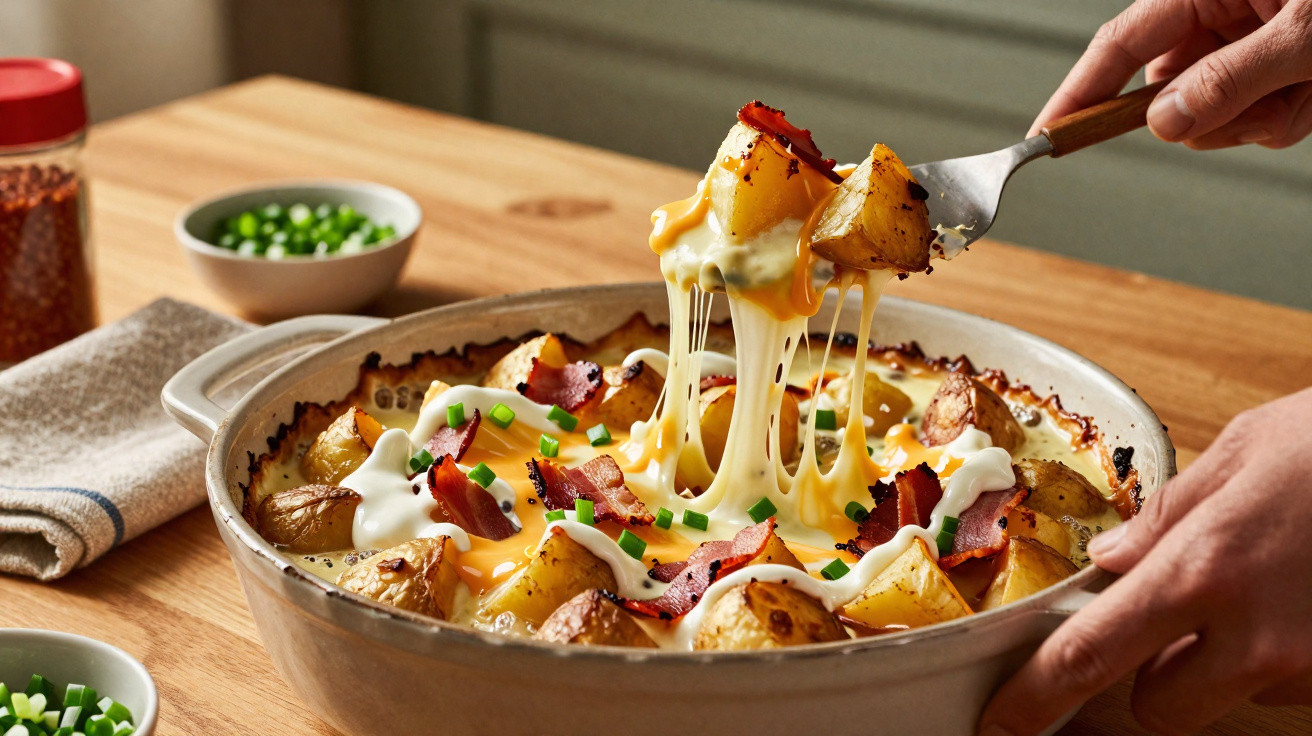
The pan emerged from the oven sizzling, with its corners bubbling like lava. From the next room, someone shouted, “What smells so good?”, and moments later the kitchen was full of people clutching forks as though they had been called there. There were no steaks on the table. No salad either. Just a dented metal pan holding potatoes, cream, cheese and tiny bacon pieces, delivering all the indulgence of a steakhouse side dish.
Everybody took “just a spoonful to taste”, before the conversation began to fade.
Mississippi Mud Potatoes have that effect on a room.
What are Mississippi Mud Potatoes exactly?
Imagine everything satisfying about a loaded baked potato, remove the fiddly parts and put it all into one oven dish. That is Mississippi Mud Potatoes. Chunkily cut potatoes are combined with sour cream or mayonnaise, grated cheese, bacon and green onions, then baked until browned on top and almost custard-soft within.
The word “mud” is appropriate: rather than looking neat or carefully layered, the mixture is dense and untidy, as if it had been scooped from a riverbank. The taste, however, is far from muddy. Every mouthful delivers the salty, smoky, creamy and gently tangy balance that makes a loaded baked potato so appealing.
These potatoes were not born in polished suburban kitchens. They came from church potlucks, tailgate tables and the aluminium trays at family gatherings that mysteriously remain hot for hours.
Ask people across Mississippi and you will hear at least half a dozen claims to the “original” recipe. One aunt may insist on cubes of Velveeta, while another will accept only mature cheddar. Some cooks mix the ingredients while the potatoes are raw; others parboil them first “because that’s how Grandma did it.” What links every version is abundance: Mississippi Mud Potatoes are designed to serve more people than expected, and somehow they always manage it.
Their appeal is partly psychological. A loaded baked potato feels like a side dish, whereas a pan of Mississippi Mud Potatoes feels like an occasion.
There is no need to wrap individual potatoes, prick their skins or watch the clock. Simply tip the chunks into a dish, mix through the “mud” and put it in the oven. What emerges is easy to spoon, easy to share and unexpectedly unpretentious. Here is one plain truth: nobody wants to monitor eight foil-wrapped potatoes on a Tuesday evening.
Mississippi Mud Potatoes borrow steakhouse comfort, then discreetly change the rules.
How to make Mississippi Mud Potatoes that genuinely rival a loaded baked potato
Begin with the potatoes. Russets provide the familiar fluffy middle, while Yukon Golds offer a buttery texture and keep their form well. Cut them into substantial cubes, around the size of a large dice: smaller pieces become mushy, while larger ones can remain hard in the centre. In a large bowl, coat them with oil, salt and pepper until each piece shines.
Next comes the “mud”. Mix in sour cream or mayonnaise, grated cheese, crisp bacon or smoked sausage, plus a generous handful of chopped green onions. Transfer the whole mixture to a greased baking dish, then cook it until the edges are dark, bubbling and sizzling, with golden freckles across the surface.
This is where cooks tend to make things too complicated. They start worrying about flawless proportions, precise cooking times and the “correct” cheese. There is no need.
The potatoes themselves will show you when they are ready: a fork should pass through without any resistance, and the top should look as if it has spent a week on the beach. Should the middle remain firm, loosely cover the dish with foil and leave it cooking a little longer. For a more dramatic finish, remove the foil near the end and place it under the grill for a minute or two to crisp the top.
We all know that moment when dinner guests text to say they are “10 minutes away” and the potatoes are still pale. Take a breath and allow the oven to do its work.
Once you start experimenting with the basic formula, this dish turns into a blank canvas. Replace bacon with chorizo, add roasted jalapeños, include caramelised onions or stir through a spoonful of ranch seasoning. You can make it lighter with Greek yoghurt, or make it richer with extra butter and double cream.
One home cook I spoke to described it this way:
“It’s the one dish I know will disappear even if the rest of the meal is a little… experimental.”
To keep the approach simple, consider the dish in straightforward layers:
- Base: potatoes, oil, salt, pepper
- Body: sour cream or mayo, plus cheese
- Personality: bacon, sausage, green onions, spices
- Finish: extra cheese on top, a final scattering of green onions
Once those layers make sense, you can improvise with confidence.
Why this one-pan “mud” outdoes a classic loaded baked potato
A subtle change is taking place in home kitchens: people are moving away from food arranged for a “perfect plate” and towards dishes shared straight from the pan. Mississippi Mud Potatoes belong to that shift. They need neither a steak alongside them nor a white plate beneath them. They work just as well with grilled chicken as with a mound of barbecue ribs or a simple green salad.
You serve yourself a spoonful, pass around the pan and take a little more than intended. It feels relaxed and faintly rebellious, like disregarding the menu and choosing what you wanted in the first place.
Once everyone is at the table, the contrast with a loaded baked potato is clear. Nobody quietly works out who will get the potato with the fluffiest middle. Nobody scrapes the final streaks of sour cream from a skin that has already gone cold. Instead, the warmth gathers in the centre of the dish, so you can scoop into its hot middle even 20 minutes after it leaves the oven.
Children who are suspicious of whole baked potatoes will eat Mississippi Mud Potatoes as readily as macaroni cheese. Adults return for second helpings, sometimes third, before murmuring something about “I’ll skip dessert.” There are rarely any leftovers from the pan.
In practical terms, the dish also answers the timing puzzle that ruins many meals. Baked potatoes take up valuable oven space and require accuracy; they need a full hour, sometimes longer, and they do not respond well to being hurried.
Mississippi Mud Potatoes are more accommodating. The potato pieces can be parboiled earlier in the day, assembled in the dish and refrigerated. When the time comes, let the dish return to room temperature as the oven heats, then bake it until bubbling. If the main dish is running late, reduce the oven temperature and allow the potatoes to sit there, softening gently without falling apart.
Let us be honest: on most weeknights, “close enough” beats “technically perfect”. This dish embraces that truth while still tasting as though you made a real effort.
| Key point | Detail | Value for the reader |
|---|---|---|
| One-pan simplicity | Potatoes and toppings cook together in one dish | Less washing up, simpler timing and more energy for enjoying the meal |
| Customisable “mud” base | A flexible combination of potatoes, dairy, cheese and additions such as bacon or sausage | Suits fussy eaters, limited cupboards and a range of occasions |
| Party-friendly comfort food | Serves a crowd, stays warm and encourages seconds directly from the pan | Ideal for potlucks, match days and relaxed entertaining |
FAQ:
- Question 1 Can I prepare Mississippi Mud Potatoes in advance?
- Question 2 Which potatoes are most suitable for this recipe?
- Question 3 What can I do to stop the potatoes drying out?
- Question 4 Can I make a lighter version while keeping the flavour?
- Question 5 Do Mississippi Mud Potatoes reheat well the following day?

















Comments
No comments yet. Be the first to comment!
Leave a Comment