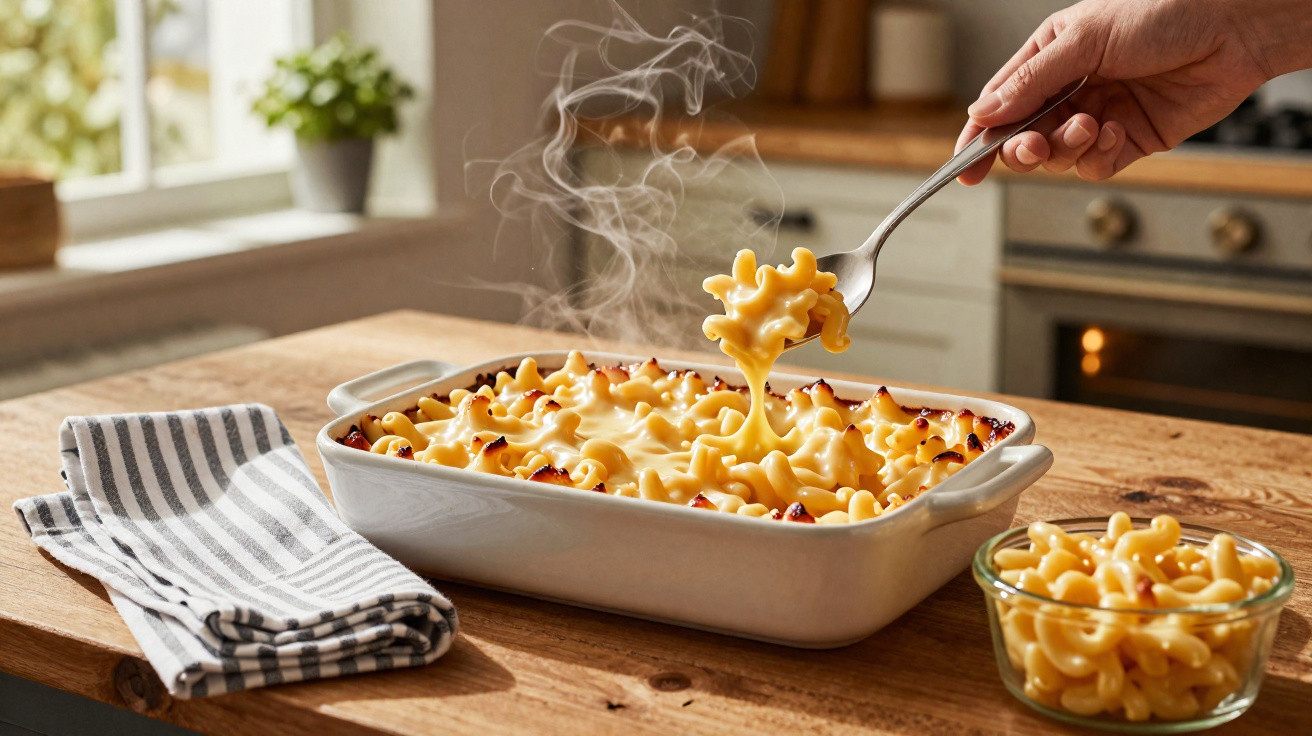
The first spoonful made me stop talking.
Steam rose from the dish, whose surface was shiny and gently undulating; beneath its delicate crust was a filling that managed to be set and melting at once. For years, I had been trying to achieve precisely that texture: the point at which comfort food is neither mushy nor resistant to a fork.
In theory, it was only a straightforward baked mac and cheese. In reality, it had become my white whale. I had tested every online shortcut, every family “secret” and every viral promise involving three cheeses.
This time, however, it all came together. As my fork slipped in as smoothly as it would in a slow-motion recipe clip, I knew I had finally solved it. What was surprising was the thing that truly changed the result.
The evening the pasta finally cooperated
It was already a slightly disastrous weekday evening. Emails had run beyond 6 p.m., the kitchen was still untidy from lunch, and ordering a takeaway was tempting. Instead, I opened the cupboard and faced the familiar box of elbow macaroni that had let me down so often: it was either limp and disappointing or chalky and insufficiently cooked.
For some reason, I chose to make one final, deliberate attempt. Out came the heavy oven dish, proper butter, a block of mature Cheddar and the bag of excellent cheese I always “save for a special occasion”. This counted as the occasion.
The brief was uncomplicated: a creamy centre, a golden topping and enough structure for each serving to hold together. No more gritty sauce. No more watery puddles around the edges. Only honest, old-fashioned comfort food.
I remembered the mac and cheese from my childhood: served in a chipped white dish, bubbling at the edges and lightly browned on top. My grandmother never weighed or measured anything, but her version was reliably the same-tender without becoming sludge, cheesy without turning oily, and firm enough to serve in neat spoonfuls.
My own attempts had been far less dependable. At times, the sauce separated into pools of grease. At others, the pasta absorbed every drop and became a dense slab by the following day. Once, it was so liquid that I called it “mac and cheese soup” and hoped no one would notice. They did.
That is the hidden struggle behind comfort-food recipes. We are trying to recreate a feeling, rather than merely a flavour, and texture is the route back to it.
Texture is often what determines whether home cooking succeeds or fails. You can make substitutions, change the cheeses or use ordinary supermarket milk rather than expensive cream. Yet if the pasta is soft and mushy, or the sauce is lumpy, the entire dish feels like a compromise.
What eventually worked was considering texture a recipe in its own right-not an accident or a by-product. I stopped fixating on the number of cheeses and concentrated on three essentials: the pasta cooking time, the thickness of the sauce before baking and the oven’s actual temperature.
Once those three controls become clear, the approach changes. You stop appealing to the cheese gods and begin cooking with a sense of what the outcome will be. That night, I realised my grandmother had not been magical; she had simply been consistent about the details nobody discusses.
The small changes that transformed baked mac and cheese
The first major adjustment was almost embarrassingly obvious: I deliberately undercooked the pasta. Not merely al dente in the restaurant sense, but firmer still. I removed the macaroni a full 2 minutes before the packet instructed, drained it and left it in the colander while making the sauce. It seemed wrong, and it looked nearly too firm.
Next, I made a sauce that was thicker than I believed it “should” be. Butter and flour went into the pan, whisked together, and I cooked the roux until the raw flour smell had disappeared. I then added warmed milk gradually, until the mixture was silky but still coated the spoon heavily. Once the grated cheese was stirred in, the sauce did not run like a river; it moved like lava.
That was when I understood that the oven does more than warm everything through: it completes both the pasta and the sauce. The hob is only the halfway point.
The second change was to stop making the recipe unnecessarily complicated. I had tried every supposed trick-cream cheese, soured cream, an extra egg, three kinds of mustard and four cheeses for a “restaurant-style” result. It was often rich, certainly, but it could also become oddly heavy or greasy.
This time, I kept the combination straightforward: mature Cheddar for sharpness, a little Gruyère for stretch and a small handful of Parmesan for depth. I added salt, a touch of smoked paprika and a little mustard powder. The sauce clung to the pasta rather than drowning it.
Once it entered the oven, I ignored my normal urge to pile cheese on top. I used only a thin, level layer, with a scattering of breadcrumbs for crunch. Honestly, nobody makes this every single day, so when you do, the topping should crackle rather than chew like a rubbery lid.
The final factors were temperature and patience. My oven runs hot-a fact I had long known but seldom allowed for beyond rough adjustments. This time, I chose a slightly lower setting than recipes recommended and baked it for longer. The dish sat uncovered on the middle shelf until its edges were bubbling and its top was unevenly golden rather than dark brown.
When the timer sounded, I did the most difficult thing: I did not serve it. It rested on the worktop for a full 15 minutes while I listened to it settle. The sauce became thicker, the starches relaxed and the layers came together. That resting period is when the texture truly finishes developing.
The first spoonful after that wait was ridiculously satisfying, because it tasted exactly like what I’d been chasing for years.
- Take the pasta out early - remove it 2 minutes before the packet time, allowing the oven to complete the cooking.
- Make the sauce thick - it should resemble lava rather than soup, so it remains creamy instead of splitting.
- Use lower heat and a longer bake - gentler cooking followed by resting produces clean portions and a soft, custardy centre.
What changes when you get it right
There is a particular confidence in finally mastering a texture you assumed was reserved for “real cooks”. The next time mac and cheese was suggested for a family meal, I did not pause; I simply said, “I’ll bring mine.” It may sound insignificant, but anyone who has arrived with a dish they were uncertain about will recognise that knot in the stomach.
Food memories are held in small details: how the first spoonful stays intact, the gentle crack of the crust under a fork and the creamy centre that does not run across the plate. When the texture is right, people say, “This tastes like the one my mom used to make,” even when your recipe bears no resemblance to theirs. Suddenly, you are doing more than making dinner-you are preserving a thread of memory.
| Key point | Detail | Value for the reader |
|---|---|---|
| Undercook the pasta | Remove it 2 minutes before the packet time so it can finish cooking in the oven | Stops mac and cheese becoming mushy and collapsed |
| Thick stovetop sauce | Cook the roux thoroughly and aim for a lava-like cheese sauce | Produces a creamy, cohesive texture that can be served in clean portions |
| Gentle bake + resting time | Bake at slightly lower heat, then leave it to rest for 10–15 minutes | Makes a set, spoonable dish with a crisp top and soft centre |

















Comments
No comments yet. Be the first to comment!
Leave a Comment