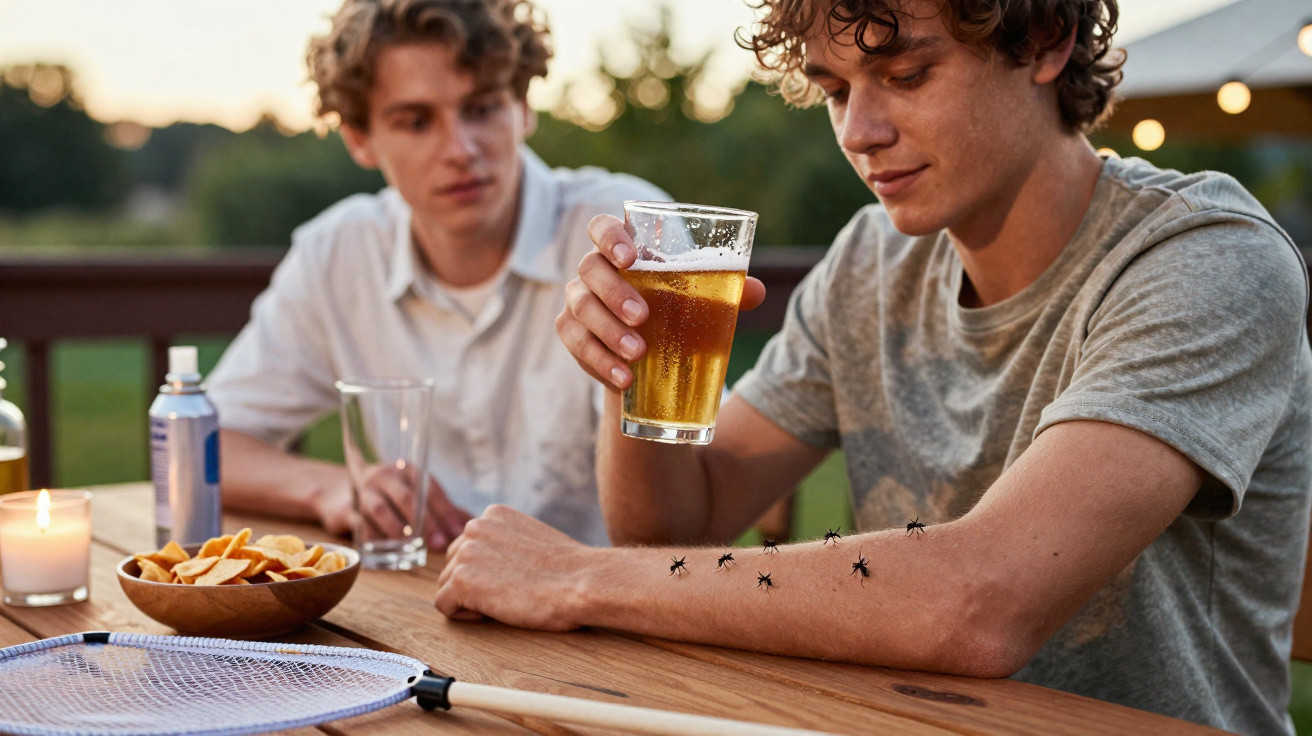
Some people escape without a care, while others seem to be devoured mercilessly.
Fresh research from the Netherlands indicates that a fondness for beer may tilt the odds in mosquitoes’ favour, particularly on warm summer evenings when you are already more exposed.
When happy hour becomes mosquito hour
Researchers at Radboud University in Nijmegen wanted to investigate a straightforward question: why do mosquitoes appear to favour certain people over others at large outdoor gatherings? Rather than conducting a controlled laboratory trial, they examined genuine behaviour at a busy Dutch music festival.
The team created a makeshift laboratory in repurposed shipping containers at the Lowlands music festival. Almost 500 volunteers took part, completing questions about their hygiene, food, alcohol consumption and sleep patterns during the event.
Next came the less pleasant stage. Every participant put an arm into a purpose-built enclosure containing female Anopheles mosquitoes, species known to search for human blood. Cameras recorded the number of mosquitoes that approached the uncovered skin and compared this with the number drawn to a sugar feeder on the cage’s opposite side.
Festivalgoers who had drunk beer in the previous 12 hours were, on average, 35% more attractive to mosquitoes than non-drinkers.
The findings were striking: participants who had drunk beer were 1.35 times more likely to attract mosquitoes than those who had not. This does not mean that every beer drinker was covered in bites, but it did mean their likelihood rose noticeably.
Why beer appears to attract mosquitoes
Published in August 2025 on the bioRxiv preprint server, the study identifies beer as a potentially distinctive alcoholic drink. In this research, other drinks, including wine, did not show the same pronounced association with mosquito attraction.
What could make beer different? One possibility is that it changes the chemistry of the skin’s surface. Previous research has indicated that alcohol consumption may alter body temperature, skin odours and the carbon dioxide we exhale, which is a gas mosquitoes use to find people.
Beer appears to tweak your body’s scent and heat signals in a way that gives mosquitoes a clearer target.
Nigel Beebe, a mosquito specialist and associate professor at the University of Queensland, has proposed that drinking alcohol could produce a stronger “thermal signature” by widening blood vessels near the skin. This additional warmth, alongside subtle shifts in skin chemicals, may make you easier to locate than someone standing beside you.
Beer contains sugars and fermentation by-products as well, which may affect how the body uses energy and what it emits in sweat. The Dutch research suggests that beer may make a person’s blood and skin-scent profile somewhat more appealing to mosquitoes, effectively acting as a mild and unintentional attractant.
More than beer: lifestyle signals mosquitoes follow
The experiment considered more than drinks. The researchers also assessed festival behaviours, including sun cream use, sleeping arrangements and general hygiene. Together, the results began to form a picture of a typical “mosquito magnet”.
Mosquitoes tended to favor participants who skipped sunscreen, drank beer, and shared a bed or tent during the festival.
According to the Radboud researchers, these habits appeared to influence how appealing someone became to the insects. The study did not suggest that mosquitoes deliberately seek out “hedonists”, but its data did reveal a pattern: relaxed and sociable behaviour frequently coincided with conditions that mosquitoes favour.
Habits that can alter your risk
This study, alongside other mosquito research, highlights a combination of biological and behavioural influences on who receives more bites:
- Drinking beer during the previous 12 hours
- Failing to apply or reapply sun cream or repellent
- Sharing a bed or tent, which gathers breath and body heat
- High levels of physical activity, producing more sweat and CO2
- Differences in body odour connected with skin bacteria
People often put bites down to “sweet blood”, but researchers focus more on volatile chemicals released by the skin, breathing patterns and the microclimate surrounding the body.
What this could mean for summer nights
Although the Dutch trial examined Anopheles mosquitoes, its implications extend beyond one genus. Many mosquito species respond to comparable signals, following CO2 plumes, skin odours, body heat and moisture. If beer alters any of these cues, it could raise the chances of being targeted, especially where mosquito numbers are already high.
Festivals, barbecues and outdoor bars provide almost ideal circumstances: hot weather, dense crowds, drinks left open and lengthy evenings in light clothing. Nearby water, tents and grass can further add to the risk, as they may offer mosquitoes breeding locations or places to rest.
| Factor | Effect on mosquitoes | What you can do |
|---|---|---|
| Beer consumption | Up to 35% higher attraction observed | Limit rounds, especially late at night |
| No sun cream or repellent | Easier access to skin and scent signals | Use broad-spectrum sun cream and repellent separately |
| Shared tent or bed | More CO2 and body heat in a small space | Ventilate spaces, use nets where possible |
| High activity | More sweat and heat, stronger odour patterns | Change clothes, wash off sweat regularly |
Health risks beyond the itch
Across much of Europe and North America, mosquito bites generally cause itching and disturbed sleep. Elsewhere, however, their consequences can be far more serious. Anopheles mosquitoes can spread malaria, while other genera, including Aedes and Culex, transmit dengue, Zika, chikungunya, West Nile virus and other diseases.
When alcohol, including beer, lowers awareness and slows reaction times, you may fail to notice bites as they occur. Mosquitoes may then feed for longer, creating more opportunities to pass on infections in areas where such diseases are present.
Beer-driven attraction to mosquitoes doesn’t only affect comfort; in some countries, it can shift your real risk profile for mosquito-borne disease.
This is relevant for aid workers, soldiers and travellers attending festivals or events in tropical areas. In regions where malaria or dengue is endemic, a few drinks, no repellent and a damaged mosquito net can quickly combine into a significant problem.
Can you drink beer and avoid the bites?
The research does not advise people to remove beer from their lives altogether. Instead, it provides a clearer picture of what can happen when alcohol is combined with mosquito-heavy environments. Modest changes can reduce the impact without putting an end to social plans.
Practical measures for beer lovers
If you know mosquitoes are drawn to you, regard beer as one influence among several rather than an irrelevant background detail. Useful approaches include:
- Spreading drinks over the evening rather than drinking rapid rounds
- Avoiding heavy beer consumption shortly before sleeping outdoors
- Applying a dedicated mosquito repellent and reapplying it during long evenings
- Wearing pale, long-sleeved clothing during peak mosquito periods, commonly at dusk and in the early evening
- Ensuring tents, windows and nets are properly closed after dark
These measures will not remove the 35% increase reported by the study, but they may help offset it. Beer can be viewed as one control being turned up, while repellent, clothing and sleeping conditions are controls that can be turned down to compensate.
Why certain people still receive more mosquito bites
Scientists already knew, before the Dutch festival study, that mosquitoes do not treat all humans alike. Genetics, skin bacteria, hormones and pregnancy can each contribute. Some people release higher levels of the compounds mosquitoes rely on to locate a host, whereas others have skin microbiomes that create fewer appealing smells.
Beer appears to add another factor to these underlying differences. If you are already high on the “mosquito favourite” scale, alcohol - particularly beer - could make that difference more obvious at crowded summer events.
For anyone who repeatedly finishes an evening with red welts while friends remain untouched, this research supplies one part of the explanation. Drink choice, sun cream habits and sleeping arrangements all interact with biology to influence how many bites you have when the music ends.

















Comments
No comments yet. Be the first to comment!
Leave a Comment