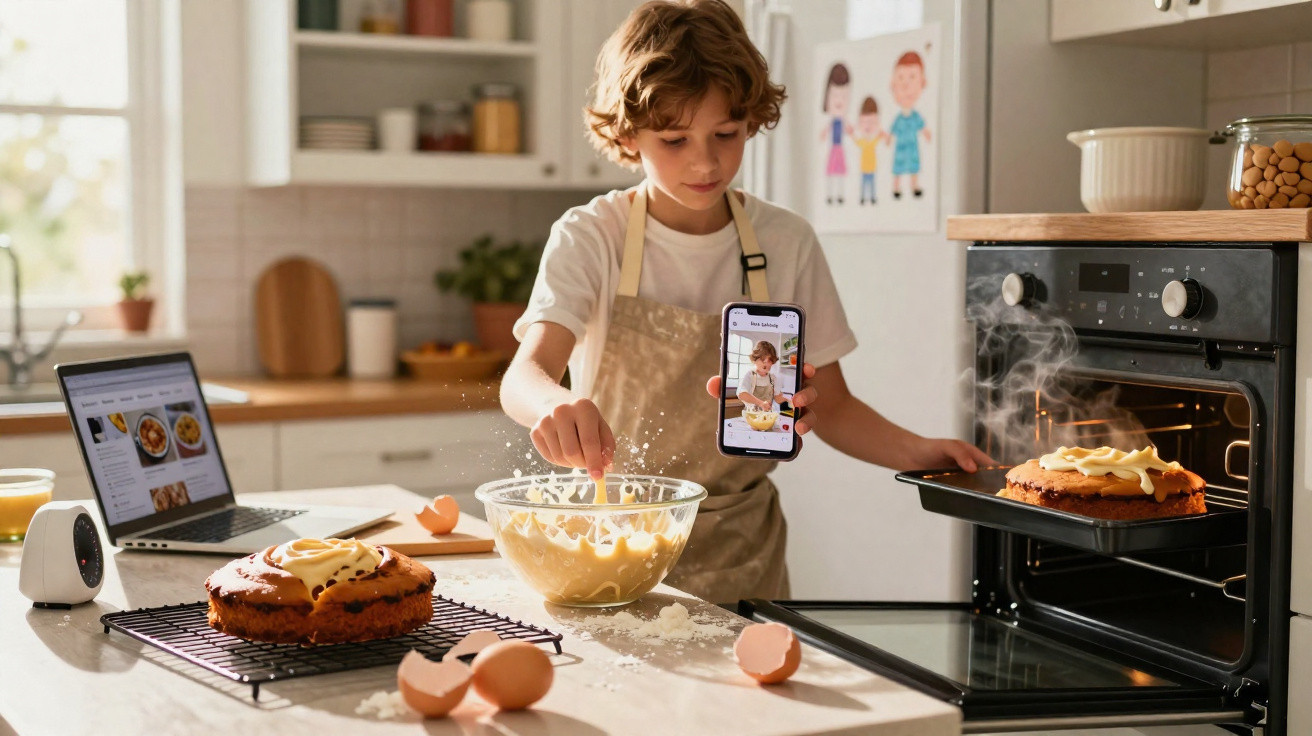
On TikTok, Instagram and YouTube, creators turn gloopy mixtures into immaculate cakes within seconds. There is no mess and no failed attempt – only close-ups and rapid edits. This apparent perfection is precisely what makes experts suspicious: some of these clips do not show real baking, but staged fake recipes that would not work in any kitchen and, in the worst cases, may be dangerous.
What lies behind the ‘Fake Baking’ trend
Australian food expert and YouTuber Ann Reardon has coined a name for the phenomenon: ‘Fake Baking’. For years, she has examined viral recipes and recreated the supposed ‘hacks’ step by step. Her conclusion is that a substantial proportion of this content is simply staged.
Fake Baking is the fake news of the cooking world: it looks real, but it is often deliberately manipulated.
Typical features of Fake Baking videos include:
- Preparation appears to take far less time than it would in real life.
- Crucial stages are removed entirely through editing.
- Details such as quantities, timings and temperatures are omitted.
- A failed dessert ‘magically’ becomes a flawless finished result.
Anyone who sees only the completed cake can quickly assume that they simply ‘have no talent’ when it does not work at home. Many do not realise they have fallen for an elaborately arranged trick video.
Why Fake Baking is so successful
There is a clear business model behind the trend. High-reach channels on YouTube, Facebook, Instagram and TikTok earn money from advertising revenue and partnerships. The more spectacular and absurd the clips are, the more views they attract – and the higher the income.
Large craft and life-hack channels churn out new videos at a relentless pace. The recipes do not have to work. They only need to look good in the preview, stop people while they are scrolling and prompt a response such as, ‘Wow, I’m going to try that!’
This creates a kind of arms race for ever more extreme images: stickier rivers of caramel, taller cakes and more ridiculous three-ingredient ‘hacks’. Whether the content is true barely matters as long as viewing time is high.
When fake recipes become dangerous
The issue goes beyond frustration in the home kitchen. Some Fake Baking trends take things much too far. Ann Reardon and other critics repeatedly come across clips involving chemicals or risky combinations of appliances.
Particularly worrying examples include:
- Strawberries dipped in bleach to make them ‘brilliantly bright’.
- Cooking or baking ideas involving cleaning products, glue or other household chemicals.
- Liquid, extremely hot caramel poured over a running hand mixer to spin it into a ‘sugar nest’.
- Recipes deliberately showing heavy smoke or ‘small explosions’ in the kitchen.
Such ideas may look impressive in glossy footage. In a real kitchen, however, they can lead to serious chemical burns, burns or poisoning. The light-hearted, harmless tone often used in these videos makes them especially deceptive – particularly for children and teenagers, who may struggle to judge the risks involved.
When cleaning products, exposed cables or burning liquids appear in ‘recipes’, baking fun ends and real danger begins.
Typical warning signs in Fake Baking videos
People who regularly watch baking content can avoid plenty of trouble with a few simple checks. Experts repeatedly point to similar warning signs that should raise doubts.
Signs that suggest a trick video
- No precise details: There are no quantities in grams, oven temperatures or baking times.
- Frantic editing: A sharp cut appears, particularly at delicate moments such as baking, cooling or turning a cake out of its tin.
- ‘Miracles’ in seconds: A cold mixture supposedly turns into a perfectly risen cake without any waiting time.
- Unrealistic textures: Mixtures hold their perfectly smooth shape in the oven, creams never run and nothing crumbles.
- Suspicious materials: Cleaning products, glue, aerosol cans or unusual electrical tricks suddenly take centre stage.
Another useful test is to ask whether the clip shows failed attempts, careful technique or minor mishaps. Anyone who genuinely bakes knows all of these. Anyone merely staging a result consistently edits out anything inconvenient.
How to check whether an online recipe idea is trustworthy
A healthy degree of scepticism offers protection without spoiling the enjoyment of baking. A few habits are usually enough to dismiss risky ideas quickly.
A step-by-step check for social-media recipes
- Look at the recipe source: Is it a recognised food blog, publisher or reputable cooking channel – or an anonymous compilation account for ‘life hacks’?
- Read the comments: Specifically look for feedback from people who have genuinely baked it themselves. Brief comments such as ‘Delicious!’ reveal very little.
- Cross-check the recipe: Search for the name or key ingredients on established recipe websites or in a good baking book. Do you find similar methods there, or does the social-media hack appear completely disconnected from them?
- Use common sense: Anything that looks too much like magic is usually not a sound kitchen technique.
| Feature | Reputable recipe | Possible Fake Baking clip |
|---|---|---|
| Information | Exact quantities, timings and temperatures | Vague claims such as ‘some flour’ or ‘bake briefly’ |
| Video structure | Logical sequence with very few jumps | Abrupt cuts at critical stages |
| Finished result | Plausible and slightly imperfect | Extremely smooth, with no cracks, and artificial-looking |
| Materials | Normal kitchen utensils | Cleaning products, craft glue or risky electrical tricks |
When children copy Fake Baking
Many Fake Baking videos appeal directly to young viewers, using bright colours, slime-like visuals and cute music. That is exactly what can make them problematic in family life. Parents have told Ann Reardon about children recreating risky recipes, getting into trouble as a result and then no longer wanting to cook at all.
An open conversation is more helpful than a blanket ban. Useful approaches include:
- watching videos together and discussing obvious tricks;
- choosing and baking safe recipes together;
- making it clear that even professionals need many attempts before something succeeds.
Anyone who actively tests real recipes with children takes away Fake Baking’s forbidden appeal and strengthens their sense of safety in the kitchen.
Why real cooking looks different from a clip
A misconception further fuels Fake Baking: many users now expect cooking and baking to be as quick and clean as they appear on video. In reality, a good yeast dough needs time, a sponge cake can collapse and chocolate is prone to becoming lumpy. All of this is part of the process.
Professional food photography uses tricks, but in reputable recipes these serve appearance alone – not to override the laws of science. Cream, for example, can be made more stable with gelatine, while ice cream is sometimes replaced with purée or purée foam for photographs. None of this is comparable to pouring bleach over fruit or tipping hot sugar mixture into running appliances.
Once people understand how much manual work, planning and failure can lie behind a genuinely beautiful cake, it becomes much easier to spot exaggerated online tricks.
Practical tips for safe baking fun despite social media
Online recipes can be inspiring, and many home bakers began that way in the first place. The key is choosing carefully.
- Use established sources for core recipes such as sponge, shortcrust pastry and yeast dough.
- Use social media primarily for decoration ideas and presentation tips, rather than as the basis for an entire recipe.
- Question exceptionally short preparation times: where dough needs to prove in real life, no ‘30-second hack’ can work miracles.
- Notice whether a channel works transparently: does it show mistakes and answer questions?
Fake Baking demonstrates how far parts of the platform economy will now go to generate attention. As long as clicks matter more than reliable recipes, critical users remain essential. Those who refuse to be dazzled can enjoy the best parts of the online food world – and simply scroll past the risky rest.

















Comments
No comments yet. Be the first to comment!
Leave a Comment