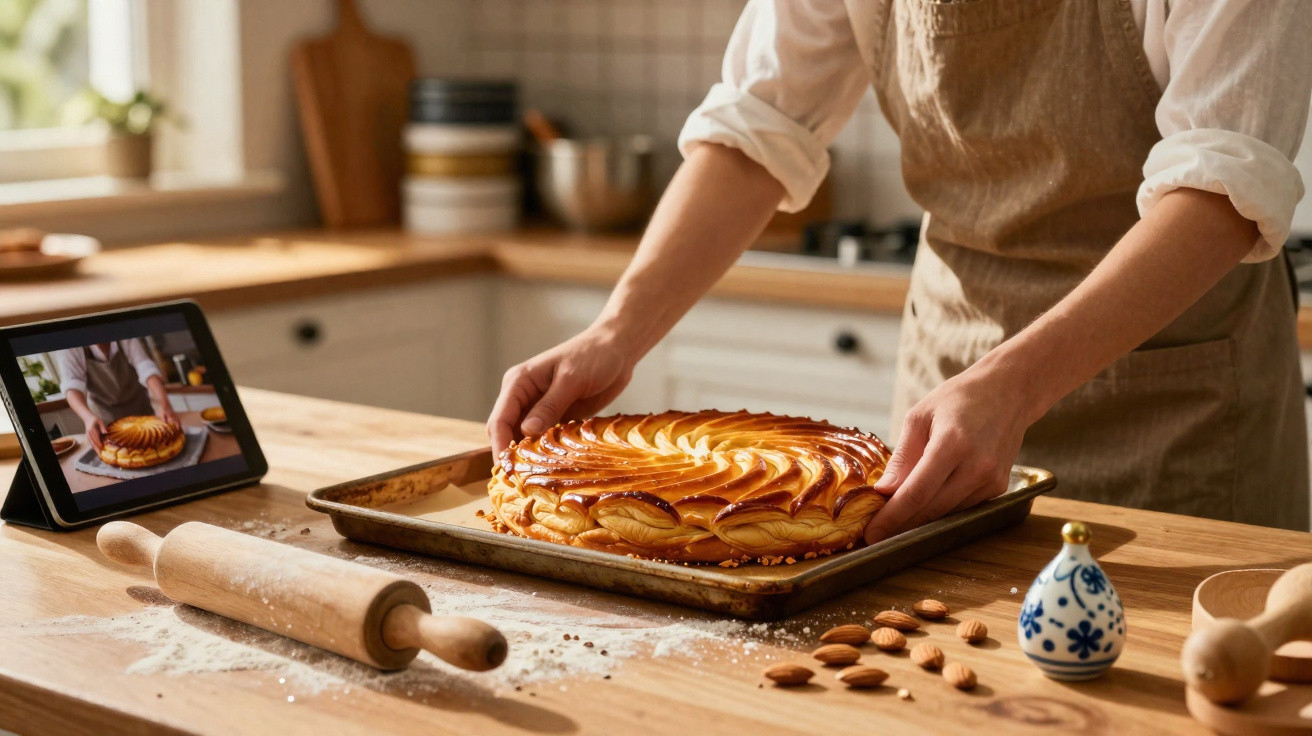
Anyone who does not want the standard Galette des Rois from the supermarket at the start of the year can create one at home with a few professional techniques.
Every year, it is the same: gleaming golden Galettes des Rois fill the bakery displays, the queue is long, and you still end up choosing “just any one”. Yet this traditional pastry can easily be made at home, with crisp puff pastry, a creamy filling and a hidden bean. Online courses led by professionals make the process surprisingly straightforward.
Why making your own Galette des Rois is more enjoyable than buying one from a bakery
The Three Kings’ Day custom surrounding the Galette des Rois has now become familiar in Germany, too. Families gather, divide the pastry and search for the bean; whoever finds it is king or queen for the day. What shop-bought versions usually lack, however, is a personal touch.
In shops, the choices tend to be limited to the standard options: traditional almond cream, perhaps chocolate, and occasionally apple. The size, sweetness and pastry thickness are all decided for you. When you bake it yourself, every detail is your choice:
- How large the Galette des Rois should be – for one person or a large family
- How bold or subtle the almond or chocolate cream should taste
- How thin and crisp the puff pastry should be
- Whether to choose a modern version with pistachio, citrus or caramel
A homemade Galette des Rois does not feel like a bought product, but like a small shared project at the start of the year – and that often makes it taste twice as good.
For many home bakers, puff pastry is the main obstacle. Laminating, chilling and turning it sounds complicated and suited to a professional kitchen. This is precisely where digital baking schools help, breaking the method into clear, manageable stages.
How online courses remove the fear of puff pastry and almond cream
Countless Three Kings’ Day pastry recipes circulate online. Most offer one photograph and a few brief lines, leaving people frustrated when the first problem arises. Platforms such as VoilaChef take a different approach, treating baking more like a structured workshop.
Step-by-step guidance instead of a recipe sheet
The courses are divided into short videos, each covering a specific stage: preparing the dough, incorporating the butter, mixing the filling, shaping the Galette des Rois, scoring it and baking it. This makes them easy to pause, replay and follow at your own speed.
Anyone planning an almond Galette des Rois can, for example, access individual sequences beforehand. You can see the required consistency of the cream or how thinly the pastry should be rolled before committing to the full course.
Instructions that make every movement visible take away the intimidation of elaborate doughs – and turn “I could never do that” into “actually, that looks achievable”.
The equipment you actually need
A good Galette des Rois does not require a professional kitchen. The usual essentials are:
- A rolling pin
- A sharp knife or pizza cutter
- Baking parchment and a baking tray
- A bowl and a whisk or hand mixer
- Ideally, an oven thermometer to ensure the temperature is correct
Anyone intending to make puff pastry entirely from scratch will benefit from a cool worktop and some space. However, many courses also show versions made with high-quality ready-made puff pastry, which is ideal when time is short or speed matters.
What makes a good Galette des Rois
Whether traditional or contemporary, several factors determine whether the result is a success or a disappointment.
| Feature | What indicates quality |
|---|---|
| Puff pastry | Clearly defined layers, crisp rather than greasy |
| Filling | Creamy, flavourful, not dry and evenly distributed |
| Baking colour | Golden brown, with no blackened edges or pale centre |
| Shape | A round, even outline with no filling leaking out |
| Appearance | A delicate pattern on the surface and a smooth sheen from egg yolk |
These are exactly the areas addressed in professionally run video courses: what should you do if the pastry shrinks? Why does the almond cream leak out? Why does the base turn soggy? Once such questions have been properly answered, the knowledge helps with every future baking project.
VoilaChef: a digital baking school for ambitious home bakers
VoilaChef deliberately presents itself not as a simple recipe collection, but as an online school focused on patisserie and baking. It is aimed at people who already have some experience and want to improve their technical skills.
More than 130 courses, taught by over 40 leading professionals – including award-winning bakers, pastry chefs from luxury hotels and respected instructors – form the foundation of the offering. Around 900 videos cover not only finished recipes, but above all the fundamental techniques involved.
Anyone who understands why a dough behaves as it does is no longer tied to a rigid recipe, but can make adjustments with confidence – that is exactly what the courses aim to teach.
Alongside the videos, there are downloadable technical fact sheets, an extensive directory explaining core techniques such as folding, laminating and piping, and regular live sessions with the professionals. Participants can ask questions, show examples of mistakes and receive direct feedback.
Example course: chocolate almond Galette des Rois by a master baker
One highlight for Three Kings’ Day pastries is a course for a completely chocolate-based variation, taught by a baker who holds the title Meilleur Ouvrier de France – one of France’s highest craft honours. The focus is on combining intense cocoa in the filling with perfectly risen puff pastry.
The course explains how the quantity of chocolate affects the texture, how to prevent the filling from splitting during baking, and which oven temperature is needed to make the layers rise well without burning. Ambitious home bakers who have already made several classic Galettes des Rois will find fresh inspiration here.
Tradition, play and a little oven physics
The Galette des Rois is more than simply a sweet pastry. Originally, the hidden bean symbolised good fortune and temporary power. Today, it mainly creates laughter: who bites into it, who secretly moves it, and who has to wear the paper crown? All of this is part of the ritual’s appeal.
From a technical perspective, the pastry is a small lesson in kitchen physics. Air trapped between the dough layers expands in the oven, fat keeps the layers apart, and water evaporates – creating the characteristic flaky structure. Once you understand these processes, it becomes clear why a tray that is too warm, too much pressure while rolling, or an overloaded topping can ruin that structure.
How the skills learned improve other baking projects
Anyone who seriously tackles a Galette des Rois soon notices how much of the knowledge transfers to other classics. Tarts develop a more even edge, croissants rise better, and quiches stay crisp. Many techniques reappear in slightly altered forms.
Planning changes as well. Instead of baking something on impulse, ambitious home bakers organise the process: dough the day before, time set aside for cool resting periods, and filling prepared in good time. This reduces stress, especially when guests are coming and the Galette des Rois is intended to be the evening’s quiet star.
Anyone attempting their first homemade Galette des Rois should therefore think beyond a single festive pastry. It is a small training ground for many more enjoyable moments at the oven – and for the pleasure of being able to say on Three Kings’ Day: “This magnificent creation came from my own oven.”

















Comments
No comments yet. Be the first to comment!
Leave a Comment