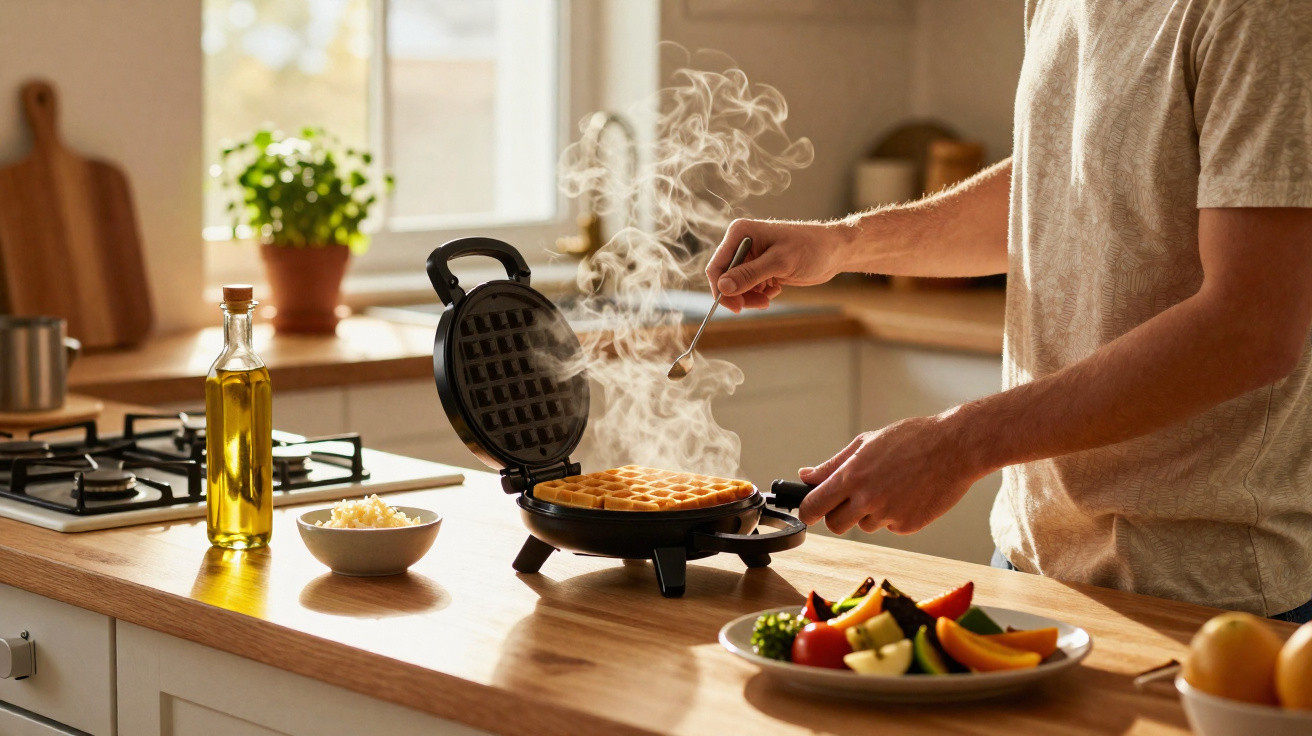
While many people still absent-mindedly preheat the oven, another appliance has long been quietly affecting the electricity bill: the waffle maker. This unassuming helper for Sunday waffles becomes a compact countertop oven, cooking savoury dishes in minutes – using far less energy than a full-sized oven.
Why the waffle maker is suddenly an energy-saving star
The principle is straightforward: an oven mainly heats air, while a waffle maker heats the food directly. An oven first needs ten to fifteen minutes to reach temperature, warming a large cooking chamber that is usually only half full. A waffle maker, by contrast, gets to work as soon as its plates are hot – and these sit only a few centimetres away from the food.
“When cooking for only one or two people, an oven often mainly heats air – a waffle maker directs the energy at the food.”
There is another advantage: in a waffle maker, heat reaches the batter or mixture from above and below at the same time. This double contact heat significantly reduces cooking time and creates crisp surfaces. Specialists refer to it as the “reaction of sugar and protein”; in the kitchen, we simply call it nicely browned and delicious.
Oven versus waffle maker: how big is the difference really?
A few practical guide figures put this into perspective:
- Oven: usually 2000 to 3000 watts, plus 10–15 minutes of preheating
- Waffle maker: often 700 to 1200 watts, with the dish ready in 3–7 minutes
So, if at 7 pm you only want to toast two filled sandwiches or heat a small dish, using the oven sends an unnecessary amount of electricity through the mains. The waffle maker is more compact, quicker and uses energy more precisely – making it ideal for one- or two-person households.
Three savoury waffle maker recipes that make the oven redundant
The interesting question is: what can you prepare in a waffle maker besides waffle batter? The answer is far more than most people expect. Here are three ideas that work even after a hectic day at work.
1. Waffle maker omelette: fluffy and pan-free
This recipe needs only two eggs, some grated cheese, salt and pepper – that is all. Briefly whisk the eggs, stir in the cheese and season the mixture. Preheat the lightly oiled waffle maker plates, then carefully pour in the mixture. Close the lid, wait two minutes and it is ready.
The main benefit is that there is no turning required, nothing sticks to a frying pan, and the top-and-bottom contact gives the omelette a light crunch on the outside. If you like, add finely chopped pepper, spring onions or diced ham to the egg mixture.
- 2 eggs
- 2–3 tablespoons grated cheese
- Salt, pepper, and optionally herbs or finely chopped vegetables
A practical tip: do not add too much liquid. The waffle maker should not overflow when it is closed, otherwise you will be cleaning up rather than saving electricity.
2. Waffle maker rösti: crisp outside, soft inside
Potato rösti also turn out exceptionally well between hot plates. Coarsely grate two potatoes, then squeeze them firmly in a clean tea towel until almost no liquid comes out. Mix them with an egg and a little salt.
Press the potato mixture evenly into the preheated, lightly oiled waffle maker and close the lid firmly. After five to seven minutes, you will have crisp rösti with a golden-brown crust and a soft centre.
“Those who squeeze the potatoes thoroughly are rewarded with especially crisp rösti – water is the enemy of browning.”
Serve them with a dollop of herb quark, a fried egg or a quick cucumber salad. Compared with using a frying pan, this saves fat and time; compared with the oven, it saves electricity and patience.
3. Toasted sandwich from the waffle maker: a quick after-work snack
The classic option is simple: two slices of toast with cheese and ham in between – little more is needed. Place one slice on the lower plate, add your chosen filling, then put the second slice on top. Close the lid and press down gently so everything seals together well.
After around three minutes, you will have a crisp sandwich with distinct waffle marks, crunchy on the outside and filled with melted cheese. Unlike in the oven, it takes only a fraction of the time and there is no lengthy preheating at all.
When is a waffle maker worthwhile, and when is an oven better?
A waffle maker cannot replace the oven for every dish. If you are making lasagne for a family of five, the oven remains the better option. The energy-saving principle can be broadly divided as follows:
| Situation | Recommended appliance |
|---|---|
| Snack or meal for 1–2 people | Waffle maker |
| Large bake or traybake dishes | Oven |
| Short cooking time, small portions | Waffle maker |
| Several dishes at once, long cooking time | Oven |
One small trick is useful too: switch off your waffle maker around one and a half minutes before the actual cooking time ends, then use the residual heat in the plates. The metal surfaces stay hot enough to finish cooking the dish – free of charge, because no more electricity is being used.
What to consider when cooking with a waffle maker
A few simple rules will prevent the experiment from ending in a sticky disaster:
- Always lightly oil the plates or use baking release spray
- Do not overfill with batter or potato mixture
- Do not open the lid during the first minute, so a crust can form
- After use, wipe the still-warm plates with kitchen paper
Many modern appliances have non-stick plates with interchangeable inserts. These are particularly suitable for trying other foods too: thin vegetable fritters, pre-cooked cauliflower in cheese batter, or even small pizza pockets made with ready-made dough.
How much electricity can actually be saved
Exact figures naturally depend on how an appliance is used in each household, but the direction is clear: anyone who turns on a large oven for tiny portions is paying for convenience nobody needs. A 900-watt waffle maker running for five minutes uses considerably less energy than a 2500-watt oven that preheats for a quarter of an hour and then bakes for another ten minutes.
Over a year, this can save several kilowatt-hours – particularly in homes where small meals are prepared regularly. It is not only good for the monthly bill, but also reduces the strain on the electricity grid slightly.
More ideas for savoury waffles and mini dishes
Once you have acquired a taste for it, a waffle maker can become a small experimental kitchen. A basic batter made with egg, flour, a little milk and grated cheese can be turned into varied versions with bacon, leek, feta, herbs or finely chopped vegetables. Leftover potatoes, rice or pasta can also be mixed with a little egg into a shapeable mixture and cooked until crisp in the appliance.
This makes the waffle maker not only an energy-saving helper, but also a way to use up leftovers. Many readers report that they throw away noticeably less food since they started experimenting. Once you realise how quickly a few leftovers can become a warm evening meal, you are less likely to reach for a frozen pizza.

















Comments
No comments yet. Be the first to comment!
Leave a Comment