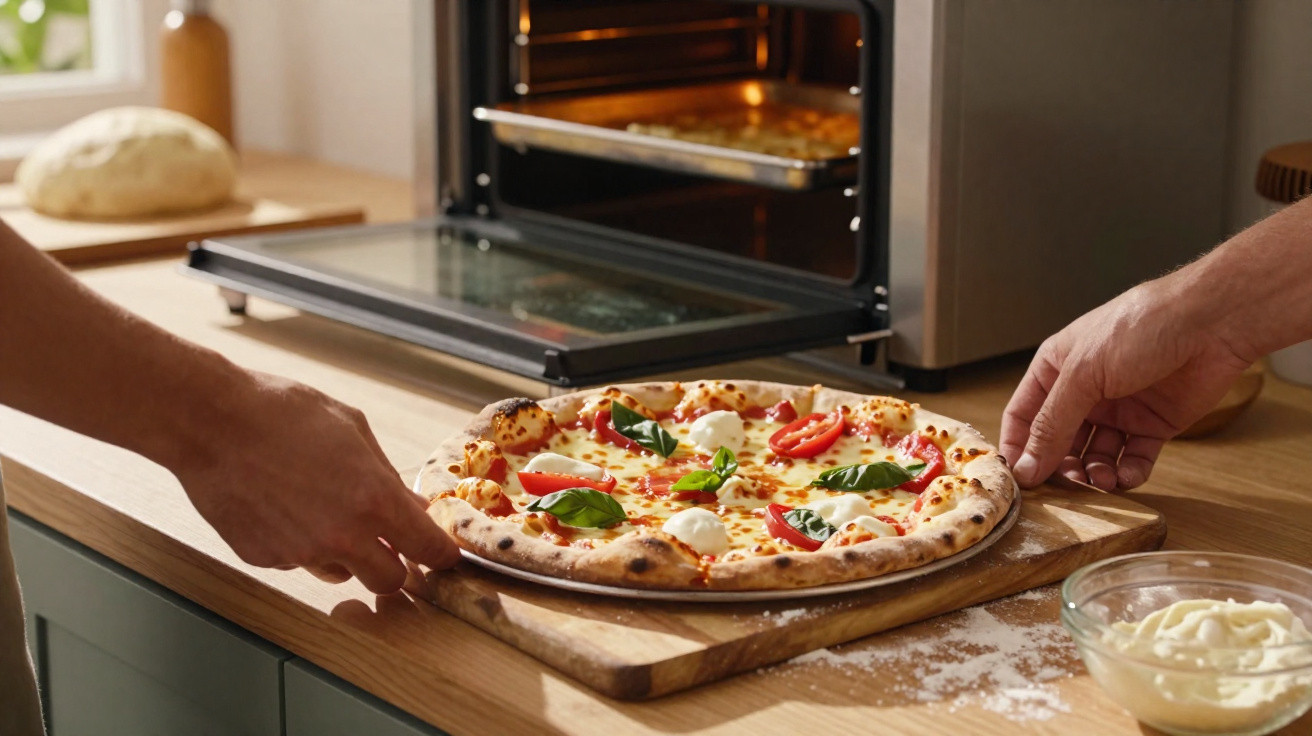
The aroma arrived before anything else: rich, warm and faintly sweet from the dough, with a trace of scorched flour hanging in the air. In my small kitchen, the oven glowed like a fireplace. Two people stood in front of it, pretending to wait for their pizza without a care. Really, though, we were peering through the glass every few seconds. Would the base be crisp this time, or rubbery again? Pulling a pizza from the oven always feels like a small gamble. That blend of anticipation and quiet dread is precisely what makes homemade pizza so appealing. You are hoping for that particular sound when the knife cuts through the base: a soft, dry crrt.
Why a crispy pizza base at home is so hard to achieve
Anyone who has stepped into a genuinely good pizzeria knows the slight humiliation that follows: you remember your own tray-baked pizza and wonder why it never turns out the same. This is not about elaborate toppings or buffalo mozzarella; it is simply about a base that seems thin, sturdy and airy at once. At home, the dough is often too soft, too pale and wet in the middle. You still eat it, nod politely and say, “It tastes great” – while knowing it is not quite the pizza you had imagined. The gap between expectation and reality can be remarkably persistent.
We all know the feeling of taking the tray from the oven, carefully lifting the pizza and finding a disappointing pale patch underneath. There are no dark spots and no firm structure, just a tired, soft surface that feels more like a pancake. A friend recently told me he had seriously considered buying an expensive pizza oven after his guests preferred ordering a delivery. Let us be honest: nobody actually does that every day. So the aim is a method that works in an ordinary kitchen, using a standard oven – with no specialist stone, no £100 accessory and no theatre.
The divide between a rubbery base disaster and crispy pizza is more straightforward than many people assume. It is not about a secret professional dough or magical yeast. Three simple controls make the difference: the moisture level in the dough, the heat of the surface beneath it and how that heat reaches the base. Your oven will never be a 450-degree wood-fired oven. It does not need to be. Once the tray is fiercely hot, the dough is a little wetter than a conventional bread dough, and you top the pizza at the right moment, the result suddenly changes. All at once, the base crackles – and you wonder why you did not make life easier sooner.
The simplest method: hot tray, wet dough, brief rest
The key to crispy pizza at home sounds almost too basic: preheat your baking tray on the lowest shelf – thoroughly and at full heat. Set the oven to 250°C conventional heat, or the highest setting it can manage, and preheat it for at least 25–30 minutes. As the tray turns into a little metal sun, make a very straightforward dough: flour, water, salt, a touch of yeast and a dash of oil. It should be slightly sticky; that is what creates the combination of a thin crunch and a soft crumb. Then comes the crucial stage: take the hot tray from the oven, place the rolled dough straight onto it – without baking parchment, just lightly oiled – add the toppings quickly and return it to the oven immediately.
The most common mistake happens much earlier, long before the pizza goes into the oven. Many people knead too little, add too much flour, then wrestle with a tough, dry dough that barely rolls out. Worried that the base will stick, they add even more flour or place lukewarm baking parchment underneath – and the heat you need so badly is lost. Patience matters too: dough rolled out immediately after kneading is still tense and prone to tearing. Give it 30–60 minutes to rest at room temperature and something close to magic happens. The dough relaxes, stretches thinly with ease and no longer needs to be fought. That calmness shows in the oven later.
An Italian baker once told me:
“Good pizza is not a work of art; it is consistency. The same movements, the same heat, the same respect for dough and time.”
Since then, I have thought more about routine than talent whenever a base goes wrong. Build just three things firmly into your pizza habit and the result will reliably move towards crispness:
- Always preheat the baking tray or cast-iron pan for 25–30 minutes.
- Make dough with a slightly higher water content (around 60–65% hydration) and allow at least 30 minutes of resting time.
- Bake the dough directly on hot metal, without a thick layer of flour or baking parchment in between.
You do not need to be able to do anything more than that. Everything else comes through repetition.
Finding your own homemade pizza routine
The most interesting realisation usually comes after the third or fourth homemade pizza made with this approach. Suddenly, the dough no longer feels like your enemy, but more like a familiar acquaintance whose behaviour is reasonably predictable. You know how soft it can be, when it feels right and when it would benefit from another ten minutes of rest. Rather than forcing it into shape by rolling or pulling, you let it gradually settle into form. Then, while it bakes, a small transformation takes place: the edges puff up, the underside dries quickly and the base develops those faint dark spots. Even while slicing, you can tell you are getting there – the knife cuts rather than simply squashing its way through.
Perhaps you will never be the sort of person who starts dough at seven on a Sunday morning, leaves it to mature for 48 hours and records every crumb. You do not have to be. A practical everyday ritual is enough: mix the dough briefly in the evening, place it in an oiled bowl with a lid and refrigerate it, then let it come to room temperature for an hour the following day before shaping and baking. Pizza then shifts from “special-occasion cooking” to an easy meal after a long day. Somewhere between the third and fifth pizza made this way, you will notice you have become the person friends ask: “Will you bring your pizza again?”
There is something calming about that too. In a world where so much is becoming more complicated, a crispy pizza base remains strikingly clear: water, flour, salt, time and heat. Nothing else. You need no class, specialist equipment or flawless Instagram edit. All it takes is the willingness to give your oven half an hour to heat up and your dough a proper break. You could almost say that learning to bake a simple pizza base until crisp is a quiet resistance to rush. You make time, wait, watch and eat. Next time, it will be a little better.
| Key point | Detail | Benefit for the reader |
|---|---|---|
| Hot tray | Preheat the baking tray for 25–30 minutes at maximum temperature | Delivers an immediate burst of heat and a crispy base without a specialist stone |
| Soft dough | Use slightly more water and allow at least 30–60 minutes of resting time | Makes the dough easier to shape, creates a lighter structure and gives a sturdier edge |
| Direct contact with the base | Place the dough directly on oiled, hot metal rather than thick flour or baking parchment | Improves heat transfer, resulting in a less soggy and more crisp base |

















Comments
No comments yet. Be the first to comment!
Leave a Comment