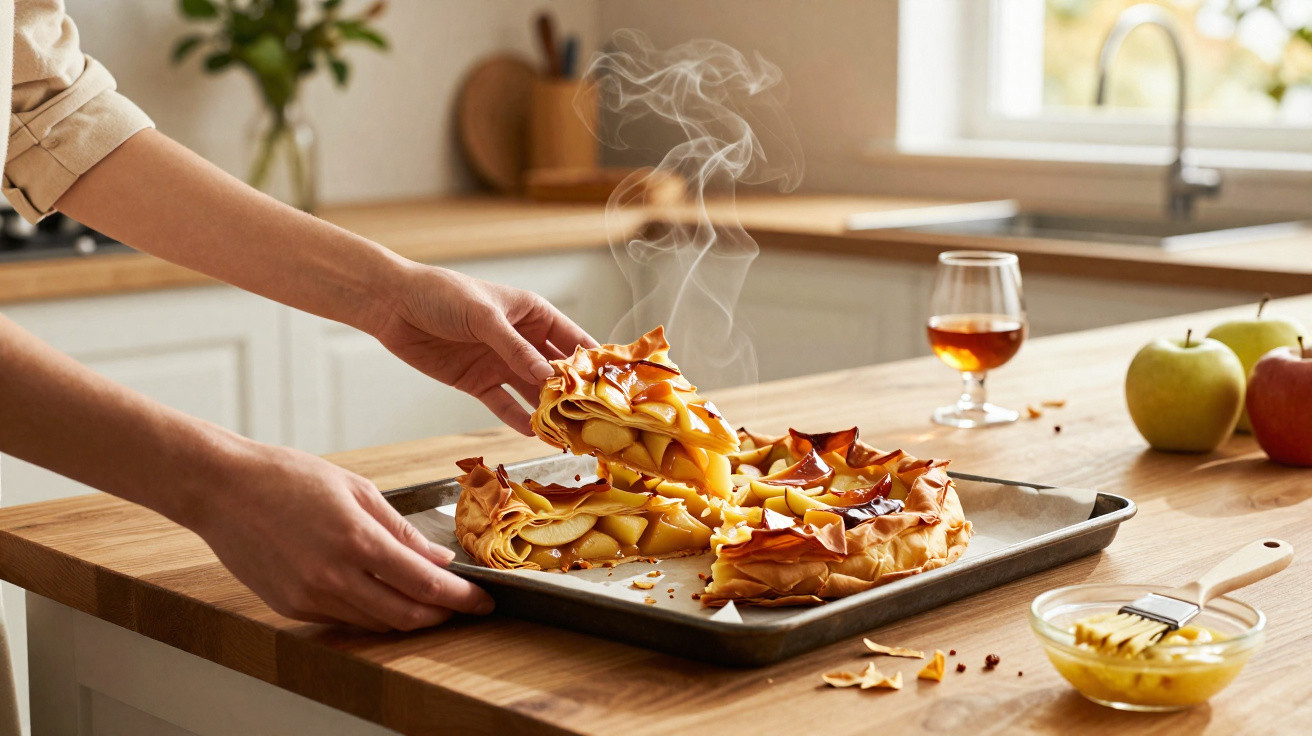
Anyone who loves apple cake should prepare for a small flavour shock. The so-called Croustade, a crisp apple tart from south-west France, looks rather unassuming – until the first bite. It soon becomes clear why some home bakers abandon their traditional apple cake afterwards.
What lies behind the mysterious Croustade
Croustade comes from the rural cooking traditions of Occitanie and Gascony. In the past, a version of this crackling apple tart appeared on almost every celebration buffet there, sometimes under the names “Tourtière” or “Pastis gascon”. The idea is simple but the result is striking: very thin pastry, plenty of butter and sugar, and fragrant fruit – usually apples.
At its heart, it is a layered tart made with sheets of pastry brushed with melted butter and lightly dusted with sugar. Sliced marinated apples are tucked between them, often scented with a splash of Armagnac. During baking, the outside turns golden and crisp, while the fruit beneath remains soft and juicy.
Crisp like strudel, juicy like a covered apple cake – yet an entirely distinctive dessert.
Why many people stop wanting classic apple cake after their first tray
Anyone used to rolling out shortcrust pastry, arranging apples on top and baking it all will be surprised by the contrast offered by Croustade. Whereas an ordinary apple cake tends to be a compact bake, Croustade thrives on opposites: the top and outer layers crackle, while the centre is soft and almost creamy.
Its aroma is another attraction. The numerous pastry layers, butter and optional Armagnac create an intense fragrance reminiscent of a blend of strudel, baklava and apple compote. That scent in particular prompts many bakers to say: “Why have I been content with standard apple cake for years?”
Essential ingredients for a successful Croustade
For a tin that generously serves 4 to 6 people, the shopping list is pleasantly short:
- about 250 g filo pastry (approximately 12 sheets)
- 2 flavourful apples, such as Golden Delicious or Elstar
- 50 g sugar
- 50 g butter
- around 50 ml Armagnac – omit it or use a substitute if preferred
Filo pastry is usually available in the chilled section of larger supermarkets. It may seem delicate at first, but it tears less readily than expected. Any small holes simply disappear once the layers are assembled.
Croustade preparation, step by step
Prepare and flavour the apples
First, wash and core the apples, then cut them into fairly thick slices. Fine slices dry out too quickly. Put the pieces into a bowl and pour over the Armagnac. For an alcohol-free version, use orange juice or a light vanilla sugar syrup instead. Leave them to marinate for about 30 minutes, stirring now and then.
Build the pastry layers
While the apples are marinating, melt the butter gently. Grease a round tart tin. Place one sheet of filo pastry in the tin, brush it with melted butter and sprinkle it lightly with sugar. Repeat this layer by layer until roughly six sheets are stacked on top of one another. Let the edges overhang generously, as this will create volume later.
Fill, close and bake
Drain the marinated apples well and spread them evenly over the pastry. Prepare the remaining six sheets in the same way, brushing each with butter and sprinkling with sugar, then place them over the apples. Fold the overhanging edges loosely inwards and crumple them slightly – this imperfect appearance is precisely part of the Croustade’s charm.
Preheat the oven to 180°C conventional heat. Dot the surface with a few small pieces of butter and add another light sprinkling of sugar. After 25 to 30 minutes, the pastry crust should be golden brown and distinctly crisp.
The moment when a Croustade emerges from the oven with a crackle is the best advertisement for this dessert.
Tips, variations and solutions for minor mishaps
The appeal of Croustade lies in how adaptable it is. Once the basic method is understood, there is plenty of room to experiment.
Appealing variations for every season
- Autumnal: combine apples with pears, plus a little cinnamon and chopped walnuts.
- Summery: use peaches or nectarines with a splash of lemon juice.
- Berry edition: pair apples with a handful of raspberries, but allow for a little extra sugar.
- Alcohol-free: replace the Armagnac with orange juice, apple juice or vanilla syrup.
What if the pastry tears?
Filo pastry dries out quickly, particularly in warm kitchens. It helps to keep a slightly damp tea towel over the stack while working through the layers. If individual sheets tear, there is no problem: use them anyway, shifting the next layer slightly. With so many layers, small imperfections will not show in the finished tart.
How professionals serve Croustade
In south-west France, Croustade is often served warm rather than hot. Many people favour these accompaniments:
- a scoop of vanilla ice cream, slowly melting into the warm apple pieces
- chilled whipped cream without sugar, to balance the sweetness
- a spoonful of crème fraîche, adding a little acidity
To impress guests, dust the top with icing sugar just before serving and offer a small liqueur or dessert wine alongside. The contrast between the crisp pastry shell and soft filling almost automatically becomes a talking point at the table.
Why this tart suits modern kitchens so well
Many classic flour-based desserts now seem heavy, rich and time-consuming. Croustade succeeds with comparatively few ingredients and a straightforward method. The main challenge is simply being willing to work with such thin pastry. After a first attempt, many people realise that filo pastry’s reputation for being difficult is exaggerated.
| Aspect | Classic apple cake | Croustade |
|---|---|---|
| Pastry | usually shortcrust pastry | filo pastry in many layers |
| Texture | even, rather compact | very crisp outside, soft inside |
| Preparation feel | classic, familiar | slightly more playful, almost like crafting |
| Flavour | apple, cinnamon, sugar | butter, caramel, apple, often Armagnac |
Background: what Armagnac does in a Croustade
Armagnac is a brandy from south-west France. It resembles the better-known Cognac, but often has a more rustic, spicier character. In Croustade, it fulfils several roles: it perfumes the fruit, heightens the impression of caramel and softens the sweetness. Most of the alcohol evaporates during baking, while the flavour remains.
If Armagnac is not available, a fruity fruit brandy or simply orange juice can come surprisingly close to the experience. What matters most is giving the apples time to absorb the liquid and its flavours.
Why it is worth making the switch – at least as a trial
People who have baked the same apple cake for years often approach new recipes hesitantly. Croustade is an ideal compromise: familiar ingredients, yet a noticeably different result. Many home bakers report that they now make the classic version only for special occasions – the crisp filo pastry tart becomes their new standard.
Especially in families where children enjoy helping with baking, layering, folding and crumpling the pastry sheets adds to the fun. The result is a dessert that does not look mass-produced, but rather like a small kitchen adventure with a story behind it.

















Comments
No comments yet. Be the first to comment!
Leave a Comment