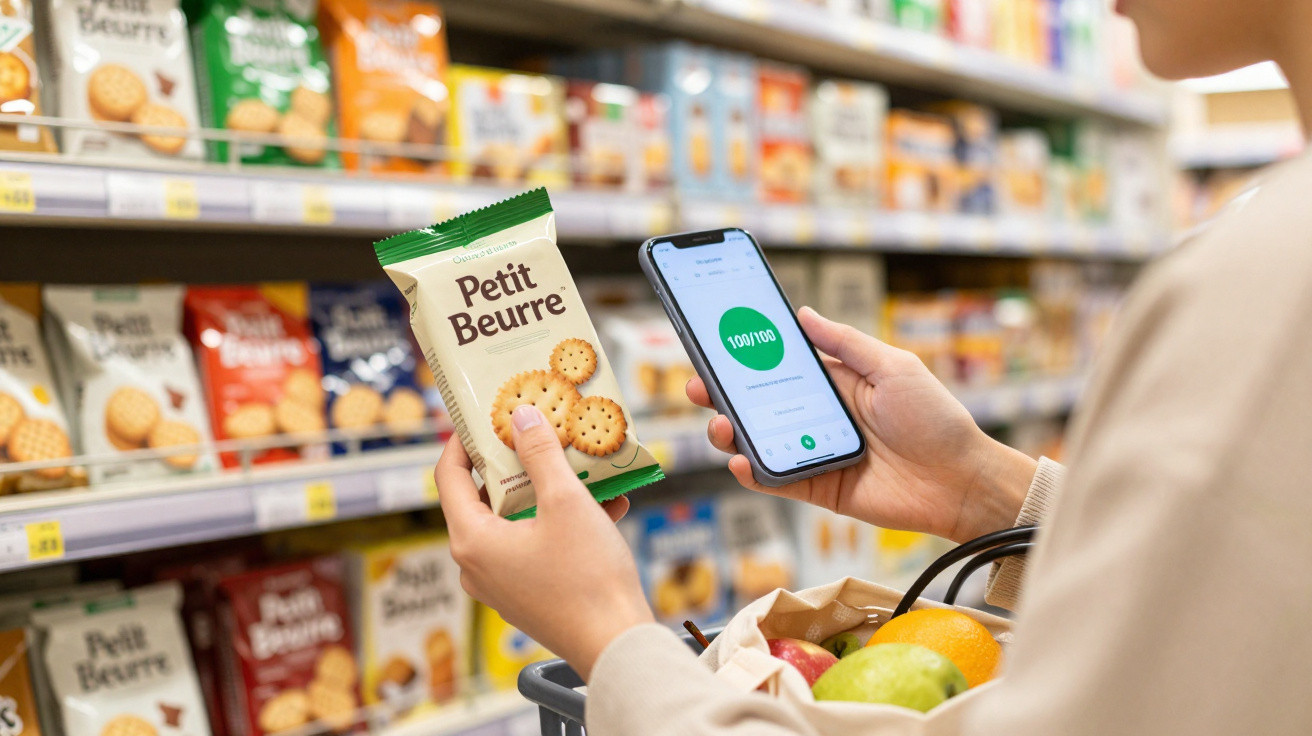
For anyone who enjoys something sweet with coffee, the dilemma will be familiar: most biscuits are sugar-heavy products with lengthy ingredient lists. An unassuming organic Petit Beurre from Intermarché’s own brand breaks that pattern – and achieves Yuka’s maximum score of 100/100. So what makes this product stand out, and what should shoppers generally look for in the biscuit aisle?
An organic Petit Beurre that stands apart
The product in question is a traditional butter biscuit sold under the Chabrior own-brand label, specifically its organic “Petit Beurre” version. At first glance, it looks entirely ordinary: there is no eye-catching pack design, major brand name or lifestyle promise.
Yet this understated approach has attracted attention from nutrition experts. The biscuit scores 100 out of 100 on Yuka. It also meets the criteria of France’s National Nutrition and Health Programme (PNNS) and is placed in NOVA groups 1 or 2 – the categories for unprocessed or minimally processed foods.
“A simple organic butter biscuit, with hardly any advertising behind it, receives Yuka’s top rating and is regarded as a positive exception in the biscuit aisle.”
This puts it among the uncommon group of industrially produced sweet treats that perform comparatively well when nutritional value, ingredients and degree of processing are considered.
Why many supermarket biscuits are problematic
Most conventional sweet biscuits sold in supermarkets come with several drawbacks. Common weak points include:
- a high sugar content, often more than 30 grams per 100 grams
- large amounts of refined fats, sometimes including palm oil
- long ingredient lists containing emulsifiers, flavourings and additives
- a high level of processing that places them in the higher NOVA categories
Sugar can add up particularly quickly. Many people eat a biscuit almost absent-mindedly: after lunch, with an espresso or during the mid-afternoon slump while working from home. According to data from the French agency Anses, many consumers consume more than 100 grams of sugar a day. The World Health Organization recommends staying well below this over the long term – ideally consuming no more than 25 grams of added sugar per day.
Biscuits are among these typical ‘incidental calories’. They are rarely planned for deliberately, yet are eaten as part of a routine. This is where a product with slightly less sugar and a better composition can make a difference – even though it remains a sweet treat, of course.
What makes Chabrior’s organic Petit Beurre special
The appeal of this organic biscuit does not come from a miracle ingredient, but from consistently keeping the recipe simple. According to the report, it is fundamentally made from classic ingredients:
- flour
- butter as the main source of fat
- sugar
- salt
- raising agents
There are no elaborate shortcuts: no palm oil, no emulsifiers, no artificial flavourings and no long list of hard-to-pronounce additives. Most of the fat comes from butter, which gives the biscuit a rounded taste while reducing the need for other, more heavily processed fats.
“In terms of its ingredients, the biscuit is more reminiscent of a simple home recipe than a highly processed industrial product.”
Its sugar content is also more moderate than that of many competing products. It is still sweet, but not excessively so. Its price remains modest too: a pack costs less than two euros, making it a practical everyday option.
Finding Chabrior organic Petit Beurre at Intermarché
Anyone searching specifically for this product should not expect large promotional displays. Chabrior organic Petit Beurre biscuits are usually stocked with the dry biscuits. As an own-brand product, they are often placed on lower shelves, while well-known brands take the eye-level positions.
How can shoppers identify a similarly ‘sensible’ biscuit more generally? A quick look at the packaging can help:
- The ingredients list is short and easy to understand.
- Butter or another traditional fat source is clearly stated.
- There is an organic certification logo on the pack, where the manufacturer promotes this.
- There are no endless strings of E numbers, flavourings and technical additives.
Care is needed with claims such as ‘light’, ‘reduced sugar’ or ‘no added sugar’. These can often conceal sugar substitutes, intensely sweetening ingredients or other additives intended to artificially recreate the usual sweetness or texture.
What do Yuka, PNNS and NOVA mean?
Terms such as the Yuka score, PNNS and NOVA can seem rather abstract to many shoppers. However, they can help put products into context.
| Term | Meaning |
|---|---|
| Yuka | An app that provides information on food nutritional values and ingredients, then gives an overall score in points. |
| PNNS | France’s national nutrition programme, which sets health and nutrition recommendations. |
| NOVA classification | A system that classifies foods by their degree of processing – from unprocessed to heavily ultra-processed. |
A biscuit that receives 100 points on Yuka while also sitting in a low NOVA category combines several benefits: it has a moderate nutritional profile and a comparatively straightforward, less ‘technical’ recipe.
How to include biscuits more sensibly in everyday life
Even a highly rated butter biscuit is still a sweet treat. What matters, therefore, is how it is eaten day to day. A few practical approaches are:
- deliberately allowing one or two biscuits with coffee rather than ‘picking from the packet’
- pairing a biscuit with something filling, such as plain yoghurt or a piece of fruit
- setting portion sizes for children instead of placing the whole packet on the table
- enjoying them not every day, but more as a small ritual once or twice a week
The benefit of a product with a better nutritional rating is not that it can be eaten without limits. Rather, each individual treat has less of an impact, both in terms of sugar and additives.
When checking ingredients is genuinely worthwhile
Many shoppers look first at familiar brands or price. Taking a moment to turn over the packet can be more useful than any advertising claim. With biscuits and similar snacks in particular, this three-step habit is worthwhile:
- Read the ingredients list first: does it fit into two or three lines, or run across half the box?
- Check the main fat source: butter, rapeseed oil or olive oil are different from hydrogenated fats or palm oil.
- Look at the sugar content per 100 grams and compare it with a similar product beside it.
People who use these checks regularly will start to notice patterns over time: some own-brand products perform considerably better than expensive, heavily advertised alternatives. Chabrior’s organic Petit Beurre falls into exactly this category.
Why simple recipes are often the better option
Biscuits with the simplest possible recipe offer another advantage: they are easier to recreate or adapt at home. A classic butter biscuit uses ingredients that almost everyone has in their cupboard. Anyone who wishes can use a product like this as inspiration for baking at home – with less sugar, some wholemeal flour or extra nuts.
For many shoppers, this creates a new awareness: an industrially made biscuit does not have to be a black box. The closer it is to a typical home recipe, the easier it is to understand what is actually being eaten. This inconspicuous organic biscuit from the Intermarché shelf shows that the same approach can work in a supermarket – without gimmicks or trend labels, but with sound nutritional values and a clear, honest ingredients list.

















Comments
No comments yet. Be the first to comment!
Leave a Comment