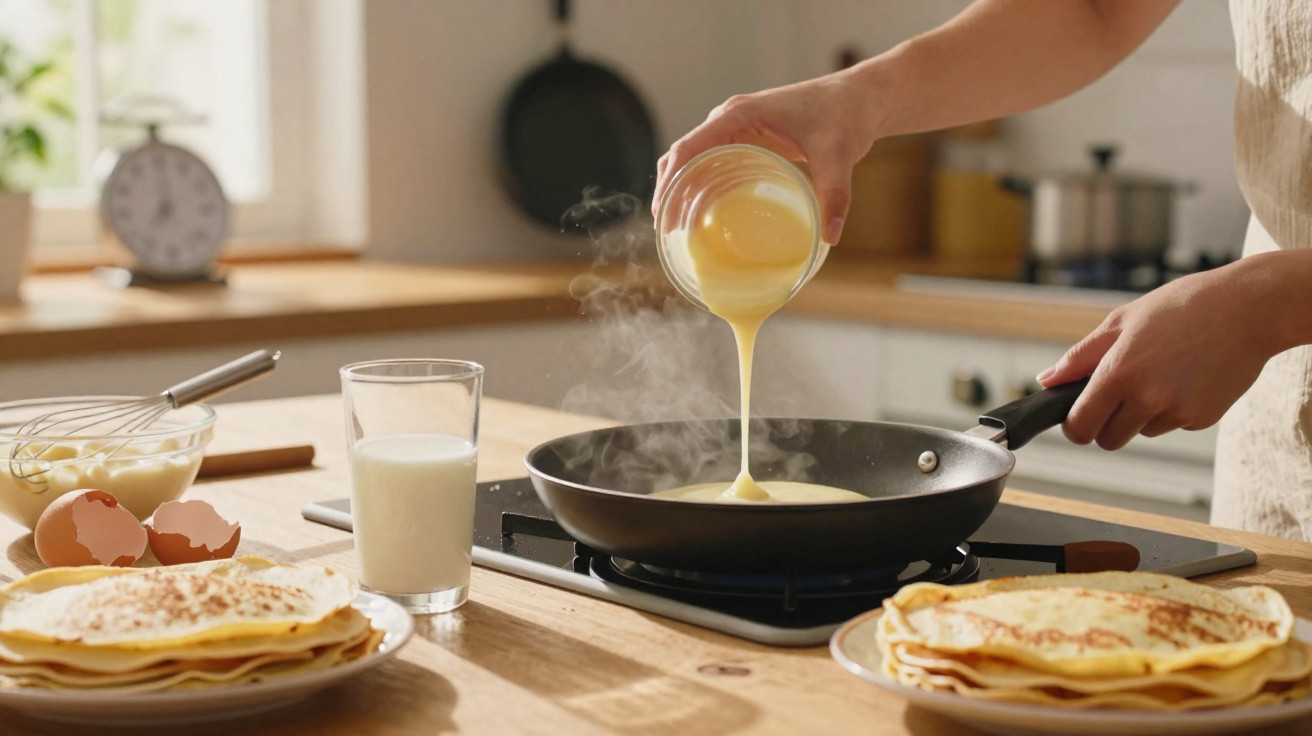
If you fancy making Crêpes on the spur of the moment, the kitchen can often get in the way: the scales are tucked away somewhere, the measuring jug has vanished and you are already hungry. This is where a surprisingly straightforward method comes in. All it requires is an ordinary drinking glass and the so-called 1-2-2-2 rule. It promises soft, flexible Crêpes without kitchen fuss, almost on autopilot.
Crêpes without scales: how an ordinary glass replaces everything
The concept is reminiscent of the famous yoghurt cake: one container acts as the measuring unit, while the ingredient proportions do the rest. For Crêpes batter, a medium-sized glass takes on that job. It completely replaces both kitchen scales and a measuring jug.
“One glass, four numbers – that is all you need to cook even, thin Crêpes, without turning your kitchen into a laboratory.”
The key is not an exact number of millilitres, but the ratio of flour, eggs, milk and oil. Whether you use a water glass, a latte glass or a sturdy tea glass, the result remains reliable provided you use the same size for every ingredient.
The 1-2-2-2 rule: making the batter step by step
The basic formula is easy to remember:
- 1 glass of flour
- 2 eggs
- 2 glasses of milk
- 2 tablespoons of oil
This creates classic Crêpes batter that is neither brittle nor unpleasantly thick. Here is how to prepare it like a professional, without weighing a single gram:
- Put the flour into a bowl and, ideally, sieve it briefly to make it lighter.
- Make a well in the centre and crack in the eggs.
- Start whisking, gradually pouring in the milk as you do so.
- Continue whisking until no lumps remain.
- Stir in the oil until the batter looks smooth and lightly creamy.
- Leave the batter to rest at room temperature for around one hour.
For cooking, an ordinarily heated frying pan with a light coating of fat is enough. Add a small ladleful of batter, tilt the pan until the base has a thin covering, then cook for about one to two minutes on each side until lightly golden.
Why the 1-2-2-2 balance works so well
There is sound kitchen logic behind this simple formula. Every ingredient has a particular role, and their proportions produce the distinctive Crêpes texture.
| Ingredient | Role in the batter |
|---|---|
| Flour | Provides structure and stability |
| Eggs | Binds everything together, giving support and gentle elasticity |
| Milk | Thins the mixture, adds fluidity and makes the batter pourable |
| Oil | Helps prevent sticking and keeps the batter supple |
The resting period also plays a quiet but important part. Over the hour, the flour hydrates properly, the starch absorbs liquid and the batter becomes more uniform. It then spreads more evenly in the pan without tearing.
“The ratio hits the sweet spot: thin, elastic and easy to turn – no crumbly rounds and no tough pancakes.”
Adjusting the batter: what if it seems too thick or too thin?
Even with a fixed formula, small adjustments may be needed, as flours do not all absorb the same amount of liquid and glasses vary slightly in size.
If the batter is too thick
If it barely spreads in the pan and looks more like pancake batter, a quick adjustment will help:
- Add a little milk, starting with just a few splashes.
- Whisk it vigorously until it flows nicely again.
If the batter is too runny
If the batter pools in the pan like water, it needs a little more binding power:
- Sprinkle in one or two tablespoons of flour.
- Mix thoroughly to avoid creating fresh lumps.
The same basic principle applies here: make adjustments using the same unit – the glass you chose – or at least in small, controlled amounts.
Which glass works, and how to scale the quantity
This method works with almost any standard drinking vessel. A few rules of thumb make planning easier:
- Small glass (for example, a water glass, around 150 ml): ideal for 1–2 people.
- Medium glass (a classic drinking glass, around 200 ml): suitable for 3–4 people.
- Large glass (a latte glass, around 250–300 ml): perfect for families or guests.
If you need more batter, simply double or triple the formula; the only essential point is to keep the 1-2-2-2 ratio consistent. Anyone regularly cooking for several people can roughly remember the millilitre capacity of their preferred glass once, but will not need to measure it again in everyday use.
Sweet or savoury: why sugar-free batter is an advantage
The basic version contains no sugar at all. Although that may seem unexciting at first, it creates plenty of options. You can decide at the last minute whether to:
- Top them sweetly: with sugar, jam, chocolate spread, fruit, honey or caramel sauce.
- Fill them savoury: with cheese and ham, spinach and feta, fried vegetables, or smoked salmon and cream cheese.
If you want to flavour the batter itself, mix in a little vanilla, rum, lemon zest or a few drops of orange blossom water. For savoury versions, grated cheese, chopped herbs or a pinch of paprika work well in the batter.
Two small professional habits that make everything easier
The number rule is only part of the story. Two simple habits make cooking in the pan considerably less frustrating.
Treat the first Crêpe as a test run
Almost everyone knows the feeling: the first Crêpe is rarely perfect. Rather than being annoyed by it, use it as a trial. It shows you:
- Is the pan hot enough?
- Is the batter too thick or too thin?
- Is the amount per Crêpe right?
After this test, you can quickly adjust the heat and batter consistency. From the second Crêpe onwards, things usually run like clockwork.
Grease the pan only lightly
Too much fat in the pan makes Crêpes patchy and heavy. Instead:
- Use a small piece of butter or a few drops of oil.
- Spread it evenly around the pan with kitchen paper.
This lets the batter glide cleanly across the surface, brown gently and avoid sticking.
How the method proves itself in everyday life
The 1-2-2-2 rule is especially useful when speed matters: on a Sunday morning, at a children’s birthday party or when guests arrive unexpectedly in the evening. There is no need to look up recipes or have gram measurements to hand. A glance in the cupboard, a reach for a glass, and the rest is committed to memory.
Once you have used the formula a few times, the process becomes almost automatic: glass into the flour, two eggs alongside it, milk beside them and oil at the ready. That also makes Crêpes feel more achievable during the week rather than only for special occasions.
Practical variations and small tricks for more experienced cooks
As time goes on, you may want to experiment. Here are a few ways to adapt the basic formula slightly:
- Part wholemeal: Replace some of the wheat flour with wholemeal flour – the batter becomes nuttier, though slightly more substantial.
- Milk alternatives: Use oat drink or almond drink; you may need to allow for an extra splash of liquid, as they bind differently.
- A subtle flavour: Add a teaspoon of brown sugar and a little cinnamon directly to the batter for breakfast Crêpes.
- Mini Crêpes: Pour in less batter for each portion and cook small rounds, ideal for children or as finger food.
The pan also has an interesting effect: a non-stick pan forgives many mistakes, while a traditional cast-iron pan demands more feel but retains heat exceptionally well. Anyone who makes Crêpes regularly soon notices how the 1-2-2-2 quantity and the ideal temperature can be tailored to their own pan.
For beginners in particular, the glass method removes much of the uncertainty from the process. Instead of fixating on millilitres and grams, you can focus on what genuinely matters for Crêpes: the consistency of the batter, the pan’s heat and the timing of the turn. The 1-2-2-2 rule provides a dependable framework that remains spontaneous, practical for everyday life and easy to remember.

















Comments
No comments yet. Be the first to comment!
Leave a Comment