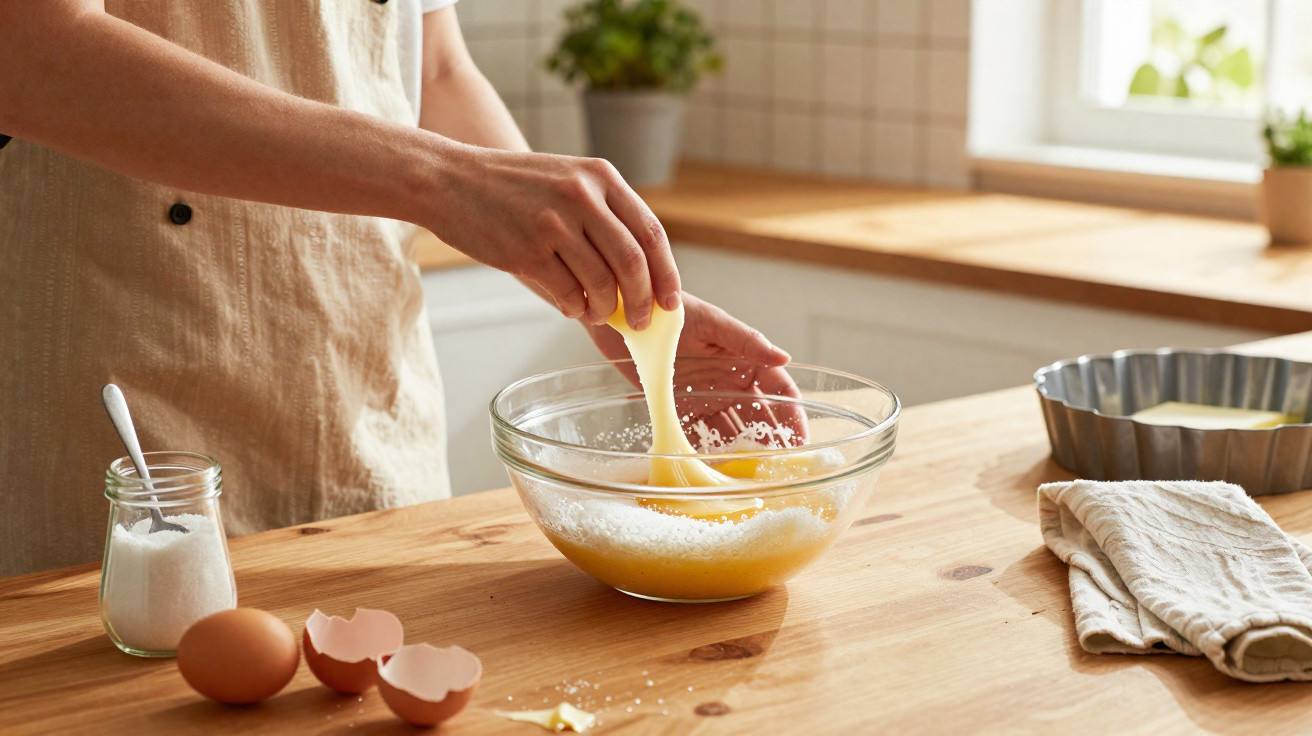
The cake comes out of the oven and the kitchen smells of vanilla and melted butter. You lift the tin, tap the edge gently with a finger and can already tell: it is going to be another dense brick. There is no sign of anything “fluffy”. You cut into the first slice, hoping for a miracle, but the knife does not glide through softly – it has to work. Inside, you wince: once again, a cake that looks fluffy on Instagram but feels more like a crisp rusk at the table.
We all know that moment when the batter still seems light and airy in the bowl, then somehow loses all its promise in the oven. Every time, you wonder what everyone else is doing differently. The neighbour whose sponge cake ALWAYS rises? The grandmother whose sponge feels like a cushion? Perhaps there is no complicated professional secret after all. Perhaps it is simply one straightforward method that changes everything.
Why so many cakes secretly fail
A Sunday scroll through social media can make it seem as though everyone else bakes perfect cakes, while your batter occasionally sits there like lead. In pictures, the crumb looks like little clouds of cotton wool. In your kitchen, however, you end up with a loaf-shaped block that fills you up after two bites. It is not a disaster, but neither is it a “wow”. And one question keeps nagging away: am I too impatient, or am I simply missing the crucial trick?
A mother from Cologne told me that she struggled for years with a marble cake recipe. Same tin, same butter and same baking time – yet her cake was damp and heavy in the middle. Her mother-in-law, using identical ingredients and the same brand of flour, produced an airy classic every time. Only when she watched in the kitchen for help did she notice the real difference: the older woman mixed for far longer – but not once the flour was in. She did it beforehand, while beating the eggs and sugar.
This is where things become interesting, because everyday baking meets chemistry. In many kitchens, all the ingredients are mixed together rather quickly so the cake can be “in the oven fast”. The predictable result is very little air in the batter, plenty of weight and hardly any room for it to rise. Give one particular stage more time and attention, however, and the batter develops a genuine framework of air. This is not a professional pastry chef’s trick, but more like the quiet, unremarkable truth behind a light cake. And it has less to do with baking powder than many people think.
The simple method that makes your cake batter genuinely light
The method itself sounds modest: beat the eggs and sugar until the mixture is truly pale, thick and creamy, and has noticeably increased in volume. Do not mix for 30 seconds or merely “give it a quick stir”; use a hand mixer or stand mixer for 5 to 8 minutes. During that time, something magical happens: air is incorporated as tiny bubbles which later give the cake height and lightness in the oven. Only then should you add butter or oil, followed by flour and baking powder, folding them in gently rather than stirring them in aggressively.
The usual mistake happens precisely when patience runs out. Many people put everything into one bowl, mix briefly until the lumps disappear and put the tin straight into the oven. It sounds efficient, but it destroys the air in the batter. Mix too hard for two minutes after adding the flour and the carefully trapped air vanishes. Let us be honest: nobody does this perfectly every day, especially not between laundry, emails and appointments. Yet a small change to the order and timing makes a significant difference.
An experienced home baker told me:
“Since I started properly beating eggs and sugar, I need fewer tricks. No more doubling the baking powder, no more hoping and worrying in front of the oven door – the batter simply supports itself.”
To make the method easier to apply in everyday life, here is a short checklist for light cakes:
- Beat the eggs and sugar for 5–8 minutes, until the mixture is almost white.
- Stir in the fat, whether melted butter or oil, only briefly and gently.
- Combine the flour with the baking powder, then work it in with a spatula or on the lowest mixer setting.
- Do not leave the batter standing; transfer it promptly into the prepared tin.
- Keep the oven door shut for the first 15–20 minutes so the air structure can stabilise.
What happens when we treat baking a cake like a small ritual
Once you have seen a batter rise so impressively because of a beaten egg-and-sugar base, you start to view the process differently. Mixing is suddenly no longer a “tedious task before baking”, but an active stage in which you decisively shape the texture. You hear the mixer, watch the mixture turn paler and see it take on an almost silky feel. It is not witchcraft; it is more like a quiet promise: give me a few minutes now, and I will give you a light slice of cake later.
Perhaps you will catch yourself at exactly this point next time you bake. You are holding the mixer and wondering: one more minute? Is it worth it? Then you remember the last “brick cake” and the faces of your guests – polite, but not impressed. Moments like these show us how much small actions influence the mood. A light cake feels inviting; it says: have another slice. A heavy, dense cake is more likely to say: one bite is enough, thanks.
There is more in this simple method than just a baking trick. In a small way, it pushes back against that constant “hurry, hurry” reflex. It reminds us that the most inconspicuous step – patiently beating the eggs and sugar – makes the difference between “it is edible” and “wow, what did you do?”. Perhaps this kind of slow, focused movement is exactly what we need more often in our kitchens. And perhaps your next Sunday cake will not only be lighter, but also a quiet argument for giving yourself a few extra minutes in everyday life.
| Key point | Detail | Benefit for the reader |
|---|---|---|
| Beat the egg-and-sugar mixture for a long time | Mix for 5–8 minutes, until the mixture is pale and voluminous | The batter holds more air, making the cake noticeably lighter |
| Work in the flour gently | Fold in only briefly, on a low setting or with a spatula | The air structure remains intact and the cake does not collapse |
| Respect the baking stage | Bake the batter promptly and keep the oven door closed at the start | A stable rise, an even crumb and less risk of a “brick” |

















Comments
No comments yet. Be the first to comment!
Leave a Comment