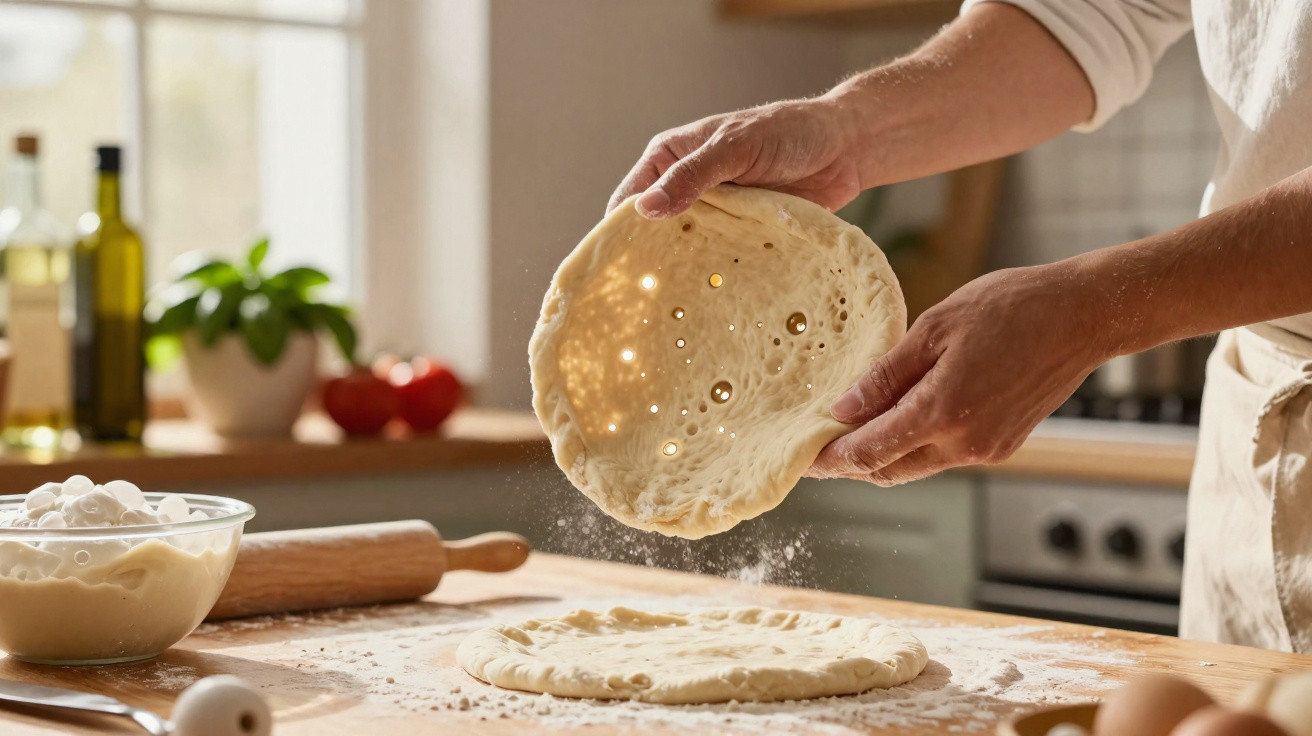
Last Tuesday evening, I watched my neighbour Marco through his kitchen window while he made pizza dough for his family’s weekly dinner ritual. Two identical dough balls sat on the worktop: one was waiting for a rolling pin, while the other would be shaped by hands weathered from thirty years of working dough. The resulting pizzas could not have been more different. The hand-stretched pizza had remarkable chewiness and personality; beside it, the rolled pizza looked flat and lacking in life. Most of us have stood in our own kitchens asking whether technique can really make such a difference. It can.
The Science Behind Dough Structure
Stretching pizza dough by hand means working with a form of living architecture. Within the dough, gluten strands act like miniature elastic bands. Careful stretching with your hands lets those strands arrange themselves naturally without tearing their delicate structure. In turn, this preserves air pockets that create the crust’s distinctive texture and chew.
Research from the Culinary Institute of America found that hand-stretched dough retains up to 40% more air bubbles than dough shaped with a rolling pin. Picture trying to protect soap bubbles by moving them gently rather than pressing them beneath something heavy. A rolling pin effectively crushes the valuable air pockets that fermentation has spent hours creating.
Rolling applies even pressure over the whole dough surface, pushing out the carbon dioxide produced by the yeast. Hand stretching instead uses changing levels of pressure that work with the dough’s natural elasticity. That is why Neapolitan pizza makers will not use rolling pins: they know that texture comes from technique, not ingredients alone.
Mastering the Hand-Stretch Method
Begin with dough at room temperature that has rested for at least 30 minutes. Chilled dough resists you like a stubborn child, whereas well-rested dough almost seems to stretch on its own. Starting in the middle, use your fingertips to press gently outwards as you rotate the dough, allowing gravity to do much of the work.
In truth, many people hurry this stage, creating holes or a base with uneven thickness. Patience is essential, as is accepting that the first few attempts may resemble abstract art more than flawless circles. Dough will tolerate small imperfections, but it will not respond well to rough treatment that damages its structure.
“The dough tells you when it’s ready. You just have to listen,” says Maria Rossi, third-generation pizzaiola from Naples. “Rolling pins are for pastry, not pizza.”
Essential hand-stretching tips:
- Keep the work surface lightly dusted with flour, rather than covering it in flour.
- Use the backs of your hands so that fingernails do not puncture the dough.
- If the dough springs back, leave it to rest for another 10 minutes.
- Try the windowpane test: properly developed dough should allow light to pass through it.
Why This Matters for Your Kitchen
Learning how dough behaves improves your approach not only to pizza, but also to bread, focaccia and other yeast-based baking. The same rules apply throughout: respect the gluten network, retain the bubbles formed during fermentation and follow the dough’s natural behaviour instead of fighting it. Every home cook should have the experience of biting into a crust with genuine character and depth.
| Key point | Detail | Value for the reader |
|---|---|---|
| Gluten preservation | Hand stretching retains the protein structure | Improved texture and chewiness in the finished crust |
| Air retention | 40% more bubbles remain after hand stretching | A lighter, more authentic pizza texture |
| Traditional technique | A Neapolitan method handed down through generations | A connection with authentic Italian pizza culture |

















Comments
No comments yet. Be the first to comment!
Leave a Comment