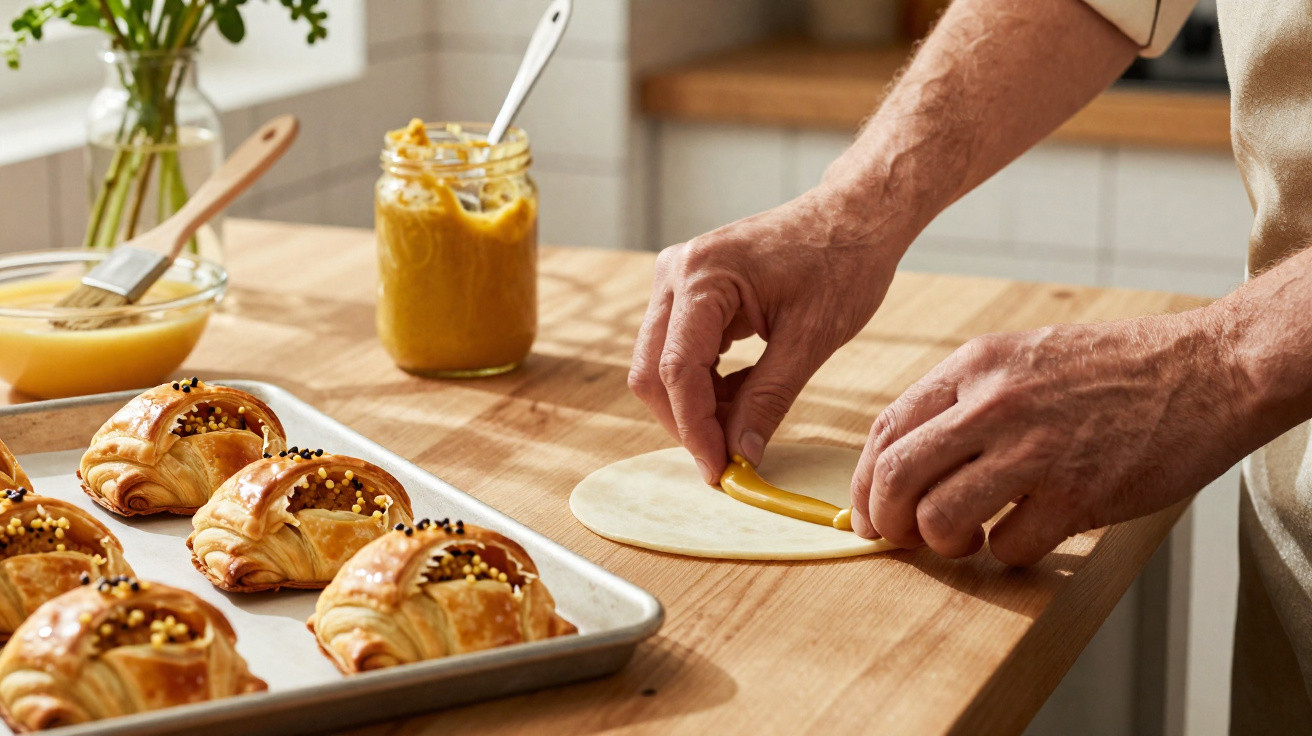
Finger food never seems to be enough: as soon as the bites reach the table, everyone helps themselves. A home cook from France has revealed how she elevates her savoury puff pastry rolls with one small detail, ensuring there are no leftovers. The approach is straightforward, inexpensive and suitable for every season – ideal for unexpected visitors, parties and evenings in front of the television.
The idea behind the new cult puff pastry rolls
Savoury puff pastry rolls are a classic: ready-rolled pastry from the chilled aisle, a sausage filling, then into the oven. What sets this version apart is not an elaborate filling, but an ultra-thin layer of Dijon mustard spread directly over the pastry. This coating adds extra flavour without making the rolls hot or leaving the pastry soggy.
The trick: a delicate veil of Dijon mustard over the pastry – just enough to noticeably intensify the flavour and aroma.
The mix of crisp puff pastry, well-seasoned sausage meat and a gently pungent mustard note clearly strikes a chord with guests: according to its creator, the rolls are eaten in under ten minutes.
What makes the puff pastry rolls so special
The key lies in an aspect of cooking that is often overlooked: balance. It is not the quantity that matters, but the dosage. One tablespoon too much mustard can soften the pastry and make the flavour overly aggressive. Use a little too little, and the effect disappears.
- Crispness: Puff pastry stays firm because only a fine layer of mustard is used.
- Flavour: Dijon mustard significantly enhances the taste of the sausage filling.
- Simple ingredients: Everything is available from the supermarket, with no specialist products required.
- A year-round recipe: Suitable for summer parties, New Year’s Eve, brunches or game nights.
This is especially appealing for hosts with little time: there is no lengthy chopping, elaborate decoration or complicated cooking technique involved.
Essential ingredients for quick party rolls
The core ingredients
- 1 sheet of ready-rolled puff pastry from the chilled aisle
- Raw sausage meat or coarse minced sausage meat
- Dijon mustard, preferably smooth and without mustard seeds
For seasoning
- Salt
- Pepper
- Dried thyme
For a golden finish
- 1 egg yolk, mixed with a little water
Those who wish can also enrich the sausage meat with garlic, paprika or finely chopped herbs. The central idea remains unchanged: few ingredients and a clear flavour.
Step by step: how to make puff pastry rolls
The method is deliberately uncomplicated, so it works equally well after work or shortly before guests arrive.
- Unroll the puff pastry and leave it at room temperature for around 5–10 minutes so that it does not tear.
- Using a spoon or pastry brush, spread a very thin coating of Dijon mustard across the entire surface.
- Season the sausage meat with salt, pepper and thyme, then briefly combine it with your hand or a fork.
- Shape the sausage meat into long strips and position them along the long edge of the pastry.
- Roll the pastry tightly around the filling, then seal the join by pressing it gently.
- Cut the roll into pieces measuring roughly 3–4 cm.
- Arrange them cut-side up on a baking tray lined with baking parchment.
- Brush with the beaten egg yolk.
- Bake in a preheated oven at 200°C conventional heat for approximately 18–20 minutes, until the rolls are golden brown.
For particularly even rolls, chill the filled roll in the refrigerator for 10–15 minutes before cutting. This keeps the pastry firm and produces neater pieces.
Variations for every taste
The basic method works with numerous alternatives. The technique stays the same: a mustard layer, a robust filling, tight rolling and a short baking time.
Other types of mustard
- Wholegrain mustard: Adds a rustic character and goes particularly well with country bread and beer.
- Hot mustard: Ideal for guests who enjoy spicy food – in that case, season the sausage meat a little more sparingly.
- Herb mustard: Creates a fresher result, especially in spring and summer.
Alternative fillings
- Poultry sausage meat: Lighter in flavour and especially good with paprika and spring onions.
- Beef: More robust, making it ideal for winter evenings and as a snack with red wine.
- Vegetarian version: Finely mashed chickpeas or lentils combined with grated cheese, onion and herbs.
Some home cooks add a little onion confit or lightly sautéed onions to the sausage meat. This lends sweetness and additional flavour to the rolls, but it should be used sparingly so the pastry does not become too moist.
Common mistakes – and how to avoid them
| Problem | Cause | Solution |
|---|---|---|
| Pastry turns soggy | Mustard layer is too thick or the filling is very wet | Apply mustard in only the thinnest layer and drain the filling well |
| Rolls open in the oven | The seam has not been properly sealed or the rolls are too loose | Lightly moisten and press down the seam, then roll more tightly |
| Rolls remain pale | No egg yolk used or baking time is too short | Brush generously with egg yolk and follow the stated baking time |
Working quickly with pastry straight from the refrigerator helps keep its layers stable. If the kitchen is too warm, the butter in the pastry starts to melt, and the rolls will not rise as attractively in the oven.
Serving suggestions and practical advice
The rolls are best served hot, although they can be prepared in advance. Unbaked pieces that have already been cut can be frozen, then baked directly from frozen later; simply increase the baking time by a few minutes.
Suitable dips include creamy herb quark, garlic yoghurt, mild ketchup or a light honey-mustard cream. The important thing is for the dip to complement the mustard inside rather than overpower it.
Why Dijon mustard works so well
Dijon mustard is regarded as refined and fairly direct in flavour, without being strongly sweet or overly acidic. This makes it an ideal match for sausage meat and puff pastry: it brings the flavours forward without overwhelming them. With such a thin layer, the heat remains in the background, while its nutty, subtly bitter profile gives the impression of “more flavour”.
Anyone sensitive to heat can dilute the mustard slightly with plain cream cheese. This allows the flavour to be controlled even more precisely – and the rolls will still disappear from the tray into guests’ hands in record time.

















Comments
No comments yet. Be the first to comment!
Leave a Comment