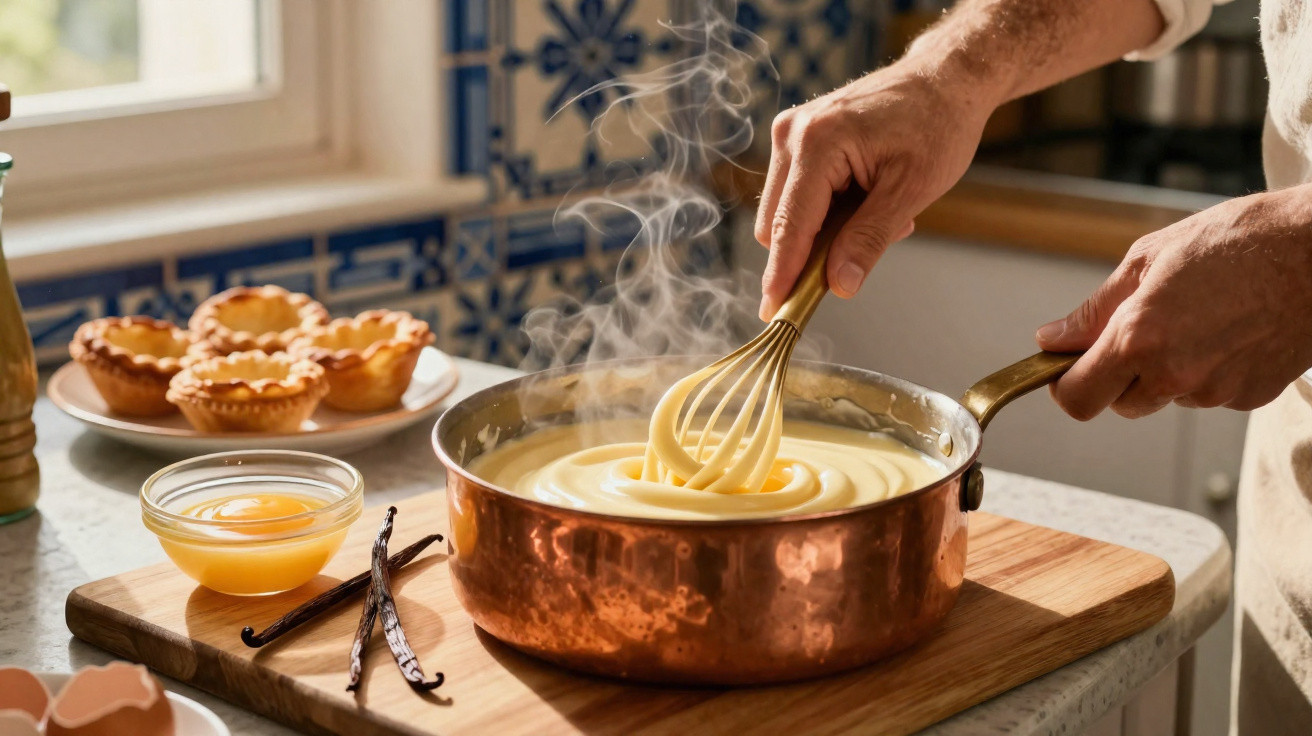
The aroma arrived before anything else: warm, sweet and faintly eggy, settling around the hushed kitchen like a blanket left waiting all afternoon. Beyond the window, the evening traffic played its familiar symphony, while at the hob there was only a small saucepan, a wooden spoon and the unhurried, mesmerising movement of custard thickening.
The radio murmured behind it all, providing the sort of soft background noise that offers company without demanding notice. Somewhere between the first whisking of the yolks and the moment the mixture formed a glossy ribbon, time seemed to loosen.
One taste from the warm spoon transported me straight back to being seven, legs swinging beneath a bakery table as I waited for the woman in the white apron to pass me a small paper cup of vanilla custard.
That first spoonful always seemed to carry a promise.
The quiet magic of real vanilla custard
A simple bowl of vanilla custard has something wonderfully old-fashioned about it. There are no showy toppings or intricate decorations, only a pale, silky cream glowing gently in the kitchen light.
When your spoon dips in, the custard slowly folds over itself, glossy and soft, with the slight wobble that says “I’m rich, but not heavy”. A little curl of steam rises, bringing the scent of real vanilla rather than the harsh hit of bottled “flavor”.
It tastes like the heart of every good bakery in the 80s and 90s: neither overly sweet nor overly fancy, simply right.
Ask people about a favourite pudding from childhood and you will often hear a familiar kind of memory: the bakery where the person behind the counter knew your name, a Sunday treat after church, or a cardboard cake box that left a pale grease mark on the car seat.
Some people recall custard packed into crisp mille-feuille, while others remember it tucked beneath sliced strawberries in little tart cases. My neighbour insists the finest version was warm custard poured over a slice of plain sponge, eaten at the counter with their coat still on.
Those puddings were not “content-ready” or Instagram-perfect. They might have been a touch uneven or lopsided, but the custard within was always smooth and always comforting.
There is a reason custard like this feels so nostalgic. It speaks to a deeply basic pleasure: warm dairy, mild sweetness and vanilla’s perfume, which the mind reads as both “safe” and “special”.
From a technical point of view, traditional bakery custard is a straightforward liaison of egg yolks, sugar, milk, a little cream, cornflour and vanilla. Yet when those ingredients meet through gentle heat, continual whisking and patient thickening, they create a texture our mouths retain.
Over the years, your senses gather all those small details: the scrape of the pan, the scent of scalded milk and the delicate skin that appears when you leave it too long. Quietly, it all gets filed under “home”.
How to make bakery-texture vanilla custard at home
Begin with the ingredients a small-town bakery might reach for on an ordinary Tuesday morning: whole milk, a dash of double cream, several egg yolks, ordinary sugar, cornflour and, if you can find one, a real vanilla pod. Split the pod, scrape out the fine black seeds and add both the seeds and pod to the milk before heating it.
Heat the milk and cream only until tiny bubbles gather around the edge. Do not let it boil or send up clouds of frantic steam. At the same time, whisk the yolks, sugar and cornflour in another bowl until pale and lightly thickened.
Next comes the essential stage: gradually stream the hot milk into the yolks while whisking continuously. Then return the entire mixture to the pan and place it back over a low heat.
This is the point at which many home cooks start to worry. For what feels like forever, the custard remains thin, and turning up the heat can seem irresistible. You keep stirring, wondering whether anything is happening and questioning both your choices and your hob. We have all known that moment when pudding appears doomed for no apparent reason.
In reality, custard thickens during its final minute. It can look milky one moment, then suddenly allow the spoon to leave a clear trail the next. Keep the heat low, keep your wrist moving and look for the first slow bubble breaking at the surface. That is the signal to stop.
Remove the pan from the heat, whisk for a few more seconds and pass the custard through a fine sieve into a clean bowl. The sieve is the unassuming hero that rescues the mixture from tiny lumps and flecks of scrambled egg.
The most nostalgic custard isn’t the one that looks perfect-it’s the one that tastes like someone took their time.
- Don’t skip the vanilla pod
If a pod costs too much, choose a good-quality extract instead, but stir it in off the heat so its flavour remains mellow and rounded. - Avoid boiling at all costs
Boiling causes the custard to split and overcooks the eggs, producing the grainy, curdled texture you secretly dread. - Cover the surface directly with cling film
Place it directly on the custard before chilling so that no skin can form. This is how bakeries keep it silky in the fridge. - Whisk before serving
Chilled custard firms up, but a brief whisk immediately restores that creamy bakery-style consistency. - Use it a hundred ways
Pipe it into choux buns, spread it inside croissants, spoon it over fruit or eat it from the bowl in the fridge at 11:38 p.m.
Why a simple bowl of vanilla custard means so much
Vanilla custard never shouts; it speaks softly, yet that quiet voice somehow reaches the centre of your day. One spoonful slows everything down for a moment. Your shoulders relax and the kitchen light seems warmer.
There is no elaborate presentation to perfect and no theatrical reveal when you cut into it. It is simply a calm, thick cream that tastes familiar whether you are eight, twenty-eight or fifty-eight. Its constancy is where its power lies.
Honestly, no one makes flawless custard every day. That is likely why, on the occasional day when you take time to separate eggs and scrape out vanilla seeds, it feels as though you have made a small holiday within a regular Tuesday.
You may follow a professional recipe precisely to the gram, or make it from memory once you have prepared it a few times. Perhaps you replace some milk with extra cream when life feels difficult and you want something particularly luxurious. Perhaps you reduce the sugar because you prefer a fuller dairy flavour.
The charm of a classic bakery-style custard is its tolerance for small inaccuracies. Stir for a little longer, let it cool a little more slowly or fold it into a plain tart case, and suddenly the whole kitchen resembles the back room of a pastry shop.
Friends come in, notice a trace of vanilla and ask, “What are you making?” That question alone provides half the enjoyment.
Some recipes announce “special occasion”. This one quietly offers itself for every moment in between: the evenings when you do not want an enormous project, only the comfort of a spoon, a bowl and a familiar flavour that asks nothing of you.
Eat it warm from the pan, leaning over the worktop with the window open towards the street. Chill it, pipe it into shop-bought puff pastry and, for one glorious moment, pretend that you own a bakery. Serve it in tiny glasses after a chaotic weekday supper and watch the table become quiet.
Perhaps that is why nostalgic vanilla custard remains with us. It changes an everyday kitchen into the childhood place you remember: no sign and no menu, only that scent, the first spoonful and the sense that, for a few minutes, everything is quietly and simply enough.
| Key point | Detail | Value for the reader |
|---|---|---|
| Slow, gentle cooking | Low heat, constant whisking, no boiling | Delivers that smooth, bakery-style texture every time |
| Real vanilla flavor | Use beans or good extract, added at the right moment | Creates a round, nostalgic taste that feels “like the bakery” |
| Versatile base recipe | Same custard works for tarts, choux, cakes, or eaten plain | Saves time and lets you create multiple desserts from one batch |

















Comments
No comments yet. Be the first to comment!
Leave a Comment