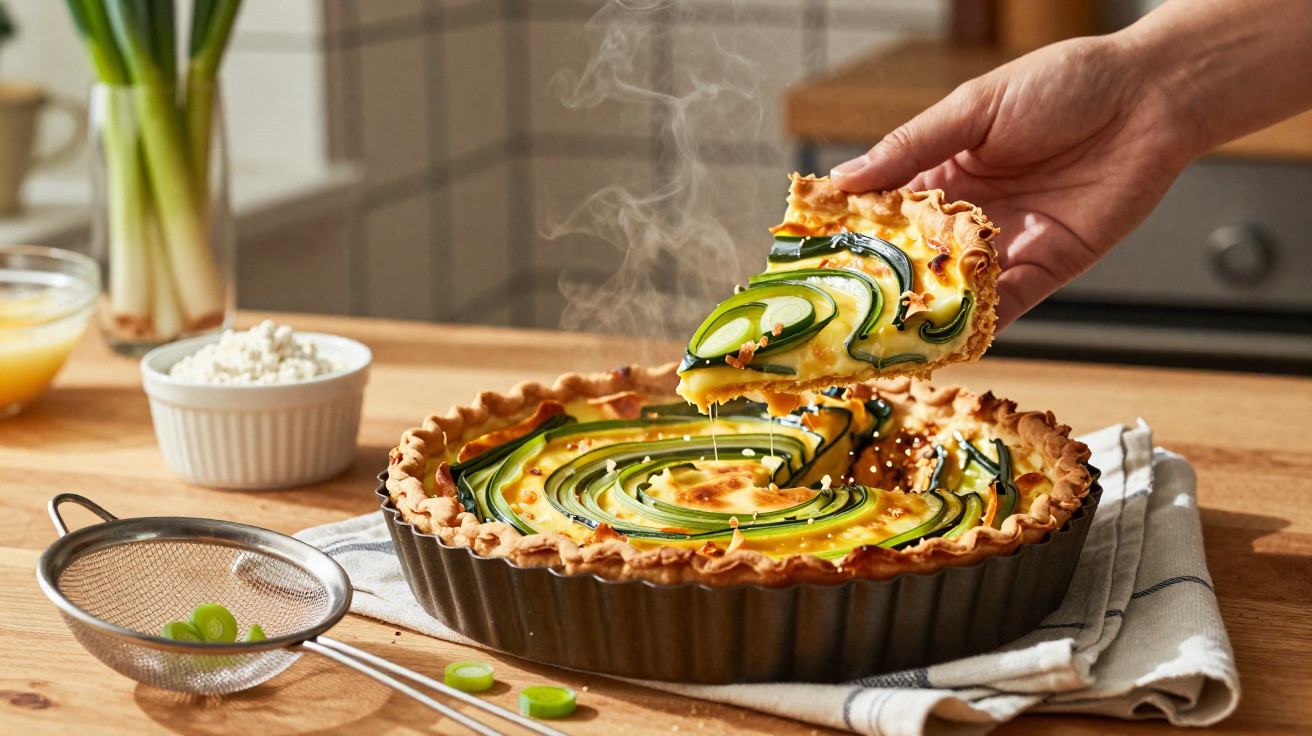
Many home cooks will recognise the situation. The leek quiche looks perfect in the oven and smells wonderful, yet when it is served, the base collapses and sticks to the knife. The cause is almost never the oven or the tin, but rather an easily overlooked stage in preparing the leeks and the custard.
Why leek quiche bases so often turn soggy
Leeks are ideal vegetables for winter and spring: fragrant, mild and gently sweet. Yet that very quality comes with a troublesome downside. The stalks are made up of around 90 per cent water. When heated, their plant cells rupture, releasing liquid exactly where it is least welcome: into the uncooked pastry.
The usual method tends to go something like this: slice the leeks into rings, sweat them in butter until soft, taste them and decide they are ready, then tip them straight onto an unbaked pastry case. Add the custard and put it in the oven. It sounds sensible, but it can create a damp disaster.
“When very wet leeks meet cold, raw pastry directly, the pastry base has virtually no chance of ever becoming crisp.”
Water released by the leeks combines with the starch in the pastry. Pastry needs heat and relative dryness to cook and develop a firm structure. If it is sitting in what is effectively a puddle, however, it remains as a sticky, doughy layer, regardless of how long the tin stays in the oven or how often the temperature is raised.
The most common cause: leeks that are too wet on unprotected pastry
The central mistake can be summed up in one sentence: the leeks are too wet and the pastry base has too little protection. Residual moisture, hot vegetables and cold pastry also create extra condensation steam.
This is what happens:
- The leeks continue to release water in the oven.
- The liquid seeps into the pastry and prevents it from cooking properly.
- The base stays raw and soft inside; although its surface may look baked, it is carrying a wet filling.
Many people try to solve this by baking at a higher temperature or for longer. Often, the edge then burns while the centre remains unstable. The real issue arises earlier, in how the vegetables and pastry base are handled.
Three layers of protection: the method for avoiding soggy quiche bases
For a crisp base, it is best to use three simple “barriers”: one for the leeks, one in the custard and one on the pastry itself. None of them requires specialist equipment.
Step 1: Drain the leeks thoroughly
First, the leeks need enough time to shed their water. A quick sweat in the pan is not sufficient.
- Cook the leeks gently in a little fat over medium to low heat.
- Do not use a lid, so that steam can escape.
- Stir and cook them down until visibly less liquid remains.
- Then transfer the leeks to a fine sieve and leave them to drain for at least 15 minutes.
- Let them cool slightly before filling the pastry case; lukewarm is ideal.
This considerably reduces the water content of the leek mixture. For an especially precise approach, briefly spread the cooked leeks on kitchen paper and dab them gently dry.
Step 2: Use the custard as a “moisture catcher”
The custard, generally made with eggs and cream or milk, can help provide stability. One small addition turns it into an ally against sogginess: starch.
“Just one tablespoon of flour or cornflour in the custard acts like a sponge for excess moisture.”
In practice, do the following:
- For a standard 26–28 cm tin, add 1 tablespoon of flour or cornflour to the custard.
- Whisk thoroughly until no lumps remain.
- As it bakes, this mixture thickens and holds the liquid in a creamy yet stable structure.
Instead of travelling unchecked downwards, the water is held within the custard. The result is not dry, but pleasantly moist without making the base soggy.
Step 3: Seal the base with a protective layer
The third barrier sits directly on the pastry. The aim is to create a thin layer between the pastry and filling, stopping liquid from soaking in straight away.
Popular options include:
- Cheese layer: Sprinkle the raw pastry lightly with grated Parmesan, then partially bake it until the cheese is lightly browned and forms a “seal”.
- Egg-white seal: Brush the base with beaten egg white and partially bake it for a few minutes, until the surface has set.
- “Blotting paper” trick: Scatter 1–2 tablespoons of fine semolina, breadcrumbs or ground almonds over the base. They absorb surplus liquid like blotting paper and are barely noticeable in the finished slice.
For extra security, combine two of these approaches, such as a brief partial bake with egg white plus a thin layer of semolina.
Baking leek quiche: how to achieve a genuinely crisp result
For a dependable quiche that does not turn soggy, it helps to follow a clear sequence. One possible order is:
- Roll out the pastry, place it in the tin and prick the base.
- Seal it as preferred: add cheese or egg white and/or scatter over the “blotting paper” ingredient.
- Cook the leeks down slowly, drain them thoroughly and allow them to become lukewarm.
- Mix the custard with starch or flour, whisking it well.
- Spread the lukewarm leeks evenly over the prepared base.
- Pour the custard over them.
- Bake in a preheated oven at around 180°C until the surface is golden brown and the centre appears set.
A typical sign that it is cooked enough is that the centre of the quiche only has a slight wobble; the surface no longer has a milky shine, but looks dry and lightly browned.
“The biggest final mistake is tipping piping-hot leeks straight from the frying pan onto ice-cold pastry – that drives water into the base before the actual cooking has even begun.”
Why starch, semolina and almonds work so well
Many of the small tricks used by cooks have a straightforward physical explanation. Starchy ingredients such as flour, cornflour, breadcrumbs and semolina swell when they come into contact with liquid. This allows them to bind excess water instead of letting it pass freely into the pastry.
Alongside a little starch, almonds also contain fat. When baked, ground almonds form a fine layer that buffers moisture while also adding flavour. Anyone who enjoys nutty notes can therefore alter the taste of the quiche at the same time.
Practical variations for different everyday kitchens
These tips can be adapted flexibly according to the time available, preference and ingredients in the cupboard. For example:
- When time is short: Simply drain the leeks thoroughly and add 1 tablespoon of starch to the custard.
- For guests: Partially bake the pastry base, seal it with cheese and add a thin layer of semolina as well.
- For a lighter version: Replace some of the cream in the custard with milk or yoghurt, using a little more starch so that the mixture still sets firmly.
Anyone who makes quiche regularly will gradually develop a feel for the right leek consistency before filling: more dry-glossy than soupy, soft but with no visible liquid left in the base of the pan.
Common questions about leek quiche – with brief answers
Many people wonder whether a different pastry would solve the problem. Shortcrust pastry with a higher fat content is slightly more forgiving than a very lean base, but the underlying issue remains: too much water from above will soften every version.
Oven temperature is another consideration. Choosing very low temperatures risks the custard setting before the base receives enough heat. Around 180°C with conventional top and bottom heat offers a good balance between even cooking and reliable browning.
It is also worth considering how much the leeks should be pre-cooked. Raw pieces have the advantage of releasing less water, but they often remain fibrous and taste sharper. Gentle cooking followed by draining usually produces the most aromatic and, at the same time, most easily digestible result.
Anyone who applies the barriers described here consistently will usually notice the difference with their first leek quiche: the base holds its shape, remains stable when cut and no longer feels like raw dough when eaten, but becomes what it should be – a crisp foundation for a generous, aromatic leek filling.

















Comments
No comments yet. Be the first to comment!
Leave a Comment