It begins with that barely noticeable smell when you open the bread bag in the morning. It is not the warm, yeasty aroma you expected, but a slight sourness that tells you, “You waited one day too long.” You inspect the slices for tiny traces of mould, then press them with your fingertips. A few feel dry around the edges. One seems questionable. Suddenly, breakfast resembles a science experiment.
You remember the partly eaten loaves you have thrown away this month: the absurd cost of good sliced bread and the guilt of binning food that was perfectly fine only yesterday.
Some people say freezing bread keeps it perfect for weeks. For most of us, though, the image is of slices frozen solid, then thawed into something like cardboard.
In reality, the difference is ten seconds.
The unnoticed issue inside your bread bag
A quiet timer starts as soon as fresh sliced bread leaves the bakery or supermarket shelf. A crust that crackled an hour earlier starts to soften, while the crumb slowly begins to dry out. You cannot see much difference on the first day and may hardly notice it on the second. By day four, the texture has changed; by day five, you are deciding whether to toast it or throw it away.
Bread is not really designed around modern routines. We buy large loaves for “later”, then pick our way through them over a week. It is in that time between buying it and eating it that the quality disappears.
Imagine an ordinary week. On Monday, you bring home a lovely sliced country loaf because you are “going to eat more at home this week.” On Tuesday, two slices become avocado toast. Wednesday brings a sandwich bought while you are out, leaving the loaf untouched. On Thursday, you are too tired to cook, so you order a takeaway. By Friday, the bread has been opened and closed repeatedly, absorbing air and humidity like a sponge.
Come the weekend, the end slice is hard, those in the middle have become strangely chewy, and you are standing over the bin with that familiar sense of shame. Repeat that over weeks and months, and it can feel as though you have been buying bread simply to throw it away.
There are two main reasons bread goes stale: it loses moisture, and its starches rearrange and become firmer. Both processes happen even while the loaf remains wrapped. Refrigeration actually speeds this up, which is why the apparently sensible advice to “just keep it in the fridge” quietly spoils so many loaves. Freezing, however, puts the process on hold - provided you do it properly.
That is when the 10-second trick changes the story. Rather than merely making bread “edible” for longer, it helps keep it good for longer, close to its first-day texture and with very little effort.
The 10-second freezer trick for sliced bread
This is the approach quietly favoured by bread enthusiasts and savvy home cooks. As soon as you return home with sliced bread, do not leave it on the worktop “for a few days”. Prepare it straight away.
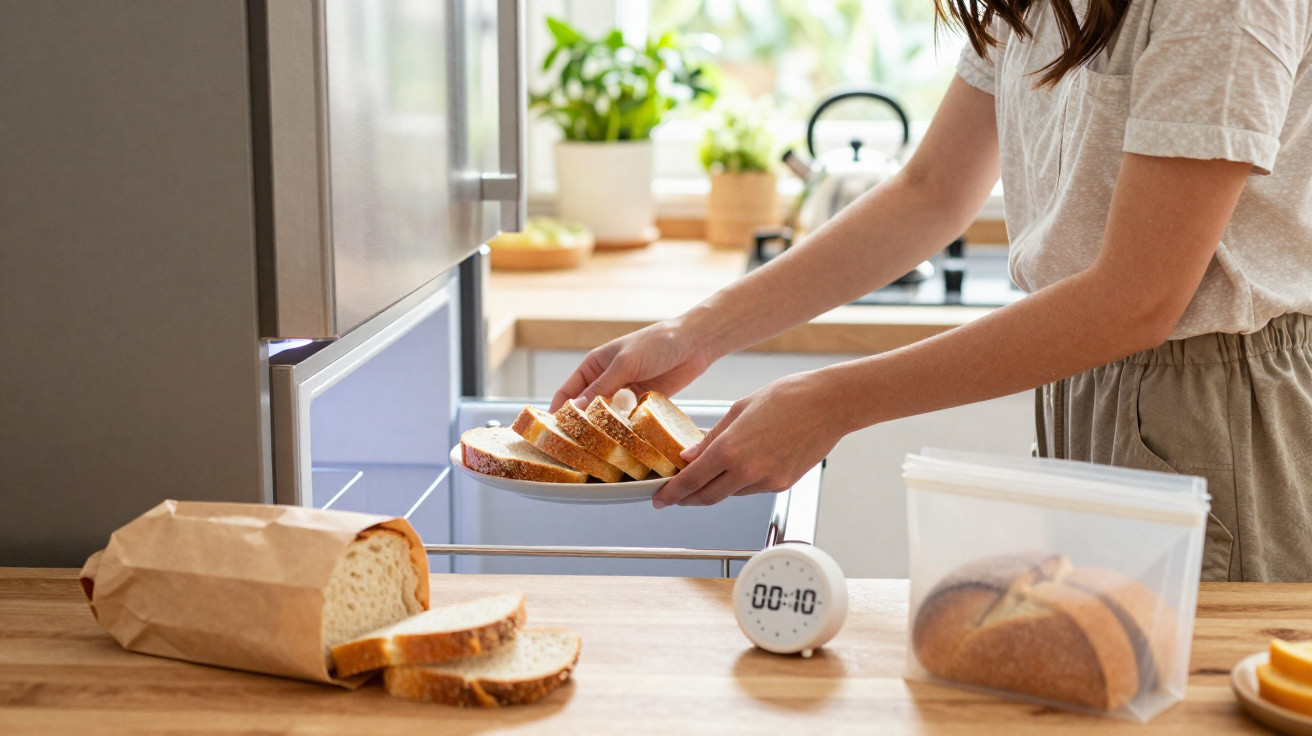
Take a clean freezer bag or airtight container, open the sliced loaf and use your fingers to gently loosen the slices a little. It takes ten seconds, no more. This small step leaves just enough air between the slices to stop them freezing into one solid block.
Next, put the loaf - still in its original bag if it is intact - into the freezer bag or container. Push out excess air, seal it and place it straight in the freezer. Freeze the entire loaf at once; do not tell yourself, “I’ll freeze what’s left later.”
Whenever you need bread, remove only the number of slices required. Because they have not fused together, you can quickly separate one, two or four slices. Toast them directly from frozen, or put them on a plate for 10–15 minutes to defrost. They return soft and springy, remarkably similar to fresh bread. Meanwhile, the remainder of the loaf stays safely paused for up to two additional weeks.
Those first ten seconds of separating the slices are where the magic lies. Miss that tiny step and frozen sliced bread turns into one large ice block. You pull at it, it snaps, crumbs scatter and half the loaf becomes a collection of odd fragments. People then stop freezing bread because they believe it “doesn’t work.”
Realistically, nobody wants a task to do every day. That is precisely why this freezer trick works in everyday life. You prepare once, in that brief moment after bringing the loaf home, and future breakfasts, grilled-cheese emergencies and last-minute sandwiches all reap the benefit. There is no daily upkeep or complex routine: only one small habit you can repeat.
Keeping frozen bread soft rather than sad and icy
The key is how you handle the frozen slices afterwards. For bread that is soft and almost fresh, take out what you need and leave it on the worktop briefly. Thin supermarket slices need five to ten minutes, while thick bakery slices need nearer fifteen. As they warm, the moisture within them gently redistributes, helping the crumb remain tender instead of chalky.
For toast, there is no need to wait at all. Put the bread into the toaster directly from the freezer. At first, you may need an extra cycle or a slightly higher setting, then adjust as needed.
The mistake many people make is defrosting a full bag on the worktop “to use over the next few days”. Those slices immediately begin the same journey towards staleness again. By the second day, you are back where you started. Treat the freezer as a parking place, not as a pantry.
Another frequent problem is placing bread in the freezer in nothing but its thin original bag, complete with air pockets. This invites freezer burn: dry, frosted edges and strange flavours. Put it in a thicker freezer bag or a sturdy container, remove the air and the bread will retain its own taste rather than picking up the flavour of last month’s frozen lasagne.
We’ve all been there, that moment when you fish out a lonely, frosty slice from the back of the freezer and wonder what past version of you thought this was a good idea.
The 10-second trick is basically a promise from your present self to your future self: when you go looking for bread, it won’t be a disappointment.
- Separate the slices once as soon as you bring the loaf home.
- Choose a thick, airtight freezer bag or box for added protection.
- Freeze the whole loaf immediately, rather than saving it for “later.”
- Remove only the slices you need, exactly when you need them.
- Defrost slices briefly for sandwiches, or toast them from frozen.
- Do not thaw and refreeze the same slices if you want to preserve their texture and flavour.
- Label the bag with the date if you tend to lose track of time.
Why the 10-second freezer trick matters beyond bread
There is a quiet satisfaction in opening the freezer and knowing the loaf inside is genuinely usable. It is not a graveyard of “good intentions”, but a supply of soft slices that can become breakfast within five minutes. Avoiding waste and making one simple product last an extra two weeks feels more meaningful than simply saving a few pounds.
Bread is one of those daily staples that subtly reflects how your household is running. When it becomes stale and ends up in the bin, it nags at you. When it is gradually used for sandwiches, toast and late-night snacks across a couple of sensibly planned weeks, it feels like a small domestic success.
The 10-second freezer trick is almost absurdly simple, which is exactly why it works. There is no need for specialist containers, a huge freezer or a spreadsheet of use-by dates. All it takes is a small adjustment on the day you buy bread, followed by taking out only what you require when you require it.
After trying it for a month and seeing how few slices reach the bin, it ceases to be a “tip” and simply becomes “how you deal with bread now.” That is the real change: not some miraculous hack, but a modest, repeatable choice that quietly respects your time, your money and the food on your table.
| Key point | Detail | Value for the reader |
|---|---|---|
| Separate slices before freezing | Gently fan out or loosen the slices for 10 seconds so they do not freeze together | Makes it easy to take only what you need without breaking the loaf |
| Use proper freezer protection | Put the bread, in its bag, inside a sealed freezer bag or box | Prevents freezer burn and keeps the taste and texture close to fresh |
| Thaw smartly | Toast from frozen or defrost slices for 10–15 minutes on the worktop | Provides soft, springy bread for up to two extra weeks rather than dry, stale slices |

















Comments
No comments yet. Be the first to comment!
Leave a Comment